
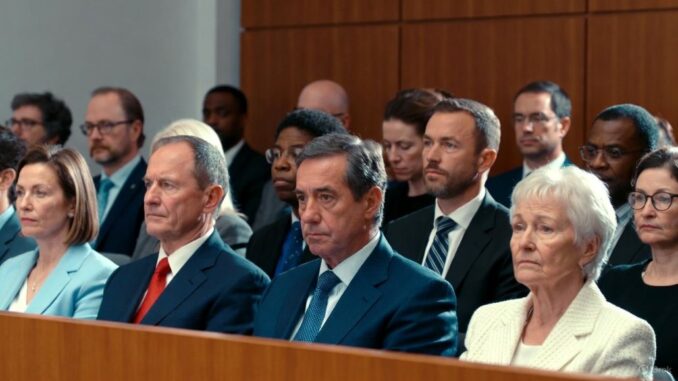
As a result of DH’s current jury service, I started reflecting on my own experience when I was randomly selected to undertake it in 2010.
At the time I was 23 and working on rotation in rural Cameroon. Whilst we had internet at the compound and office located in Yaoundé, the 14-hour trip from our site of operations along forest tracks and laterite roads was enough to put one off undertaking the journey unless essential. Comms were therefore generally limited to a 10-minute phone call each fortnight on the company sat phone. Even then the jungle canopy was not conducive to a stable connection and so one had to drive to a hill not far away which provided better line of sight with the sky and thus a more stable connection. It was in this environment, then, that I was informed by my dear Goose (Mother Goose) that a formal brown envelope stamped On Her Majesty’s Service had arrived. Whilst on the phone she opened it and informed me: you’ve been called up for jury service.
Getting back to camp I told my Exploration Manager, a burly South African, who found it a novel prompt to bombard with me a mix of Afrikaans and English abuse: kak man, what de hell am I to doo eh, poes!” We are still good friends to this day. My Chief Operations Officer, an English ex-freight pilot, was less accommodating. “Fucks sake, Codpiece. God damnit. You’ll have to get out of it. Find a way out of it.” D. Blunkett had previously tightened the rules on those who could be excluded and despite both of us trying (more so my COO, less so me) it was confirmed that my occupation working abroad was not sufficiently important to warrant being excluded.
And so it was that I walked into Coventry Criminal Court in the late summer of 2010 to be met with metal detectors and security guards and a general hush as found at a library.
The confirmation letters had been very clear about some things (What benefits can I claim; Am I entitled to child care; What support can I claim for lunch) it was less clear on other things such as where to go upon arrival and what to do. After security I approached a receptionist who snapped at me to go to a certain room along a particular corridor after a flight of stairs etc etc etc. Despite her worst instructions I eventually found the place. Codpiece being Codpiece I was early but the large room was already half-full with some groups chatting and others not.
A lady gave a briefing a short while later for new potential jurors that if you weren’t selected that day by 10:00 you were free to go home. This was the case for me for the first week. And I thought it was bloody brilliant. My rotation at the times was 12-weeks-on-4-weeks-off (a bastard of a rotation, and not one I would accept again) and the service came at the end of my four weeks of leave. I was therefore getting additional time in Blighty to see family, mates, go to the pub, go out; everything I couldn’t do when abroad. Best of all, whilst some employees don’t pay their employees during jury service, the admin of cancelling mine for the duration of it and picking it up again was enough for the company to just keep paying me anyway.
At the start of the second week I was randomly selected as part of the 16 people who enter the courtroom as part of a potential jury. This is to provide reserve jurors in the event that one may know the defendant or their impartiality could be in some way compromised. My name was not selected and so I was free to go for the day.
Trial 1
On the Tuesday I was called again into the court room and this time was chosen as one of the 12 members of the jury. Having one’s name called out in front of an assembled court (minus the defendant(s)) was intimidating and exciting in equal measures. The weight of the moment was palpable: a little knowledge of the history behind the establishing of such a setup and an acute awareness of the privilege to live in a country whereby such a system exists left me, in some ways, in awe of the moment. There was, without doubt, a mix also ofdoing one’s duty.
The trial lasted three days until the Thursday and was utter farce from the beginning. The defendant, ‘a man’ (to use a modern journalistic term), was on trial for attempted theft: his blood and DNA had been found on a smashed window at a property. His defence was that he was walking past the house and saw stereo and hi-fi equipment which he thought was his own through a window. He did not think it important that the window as at the rear of the property bounding a row of garages. He continued that in seeing the equipment he proceeded to go to the front door and ring the bell but nobody answered, at which point he returned to the rear of the property and tapped on the glass with a length of 2×4 wood that happened to be lying around. It was this action which had supposedly broken the glass and cut his hand. He then ran away. When the homeowner returned, he saw the broken glass and called the police who took a blood sample and matched the DNA.
The trial lasted three days. We, as the jury, took less than 45 minutes to unanimously decide. There was some back and forth. It’s perhaps the good-nature and open-mindedness of people that others took more convincing than me. It’s also true that single voices can sway significantly if sufficiently articulate; or conversely that stubbornness and emotion can block common sense and reason. There is no perfect system, but what I observed is likely the least-worst of the options.
Trial 1 – announcing the verdict
Returning to the courtroom I stood, as foreman, and delivered the verdict to the courtroom and defendant. I shall never forget the grin from the defendant which met me saying guilty. He knew the farce of the trial. It angers me to this day when I think of the waste of resources, time, energy and money spent. But such was his right, and such is the system.
Upon delivering the verdict the court permitted the jury to know of the defendant’s prior convictions which was a long litany of thefts and handling of stolen goods. I did not return for sentencing and nor have I looked it up.
Trial 2
As the trial ended on the Thursday I was therefore available again for selection on the Friday which would’ve been the end of the two weeks one is required to be available for. Much to my COO’s disgruntlement (a flight had been booked for me on the Saturday) I was again selected and entered the courtroom and was subsequently called out as one of the 12 to make up a jury. This one lasted, if I recall, a further five days, ie: to the following Thursday of week 3.
If I thought the previous trail was a farce, this one was on another level. In short, a teenage romance had developed in to warring families and factions on either side upon separation. There were allegations of intimidating behaviour and minor damage to property. It climaxed when one faction approached one of the houses of one of the other faction with some effin and jeffin and an allegation of a blade until a neighbour called police who arrested the mother and father of one of the teenagers.
Over the five days the prosecution and defence cross examined various witnesses from each faction. My main memories of this period are of the fallibility of humans (the weather ranged from bright sunlight to pitch black with the moon out); it’s the perception of some that fault never lies with them; and that I will struggle to stifle a chuckle, in spite of the gravitas of the situation, when a prosecuting barrister asks “and what brand of sausages was it, that you were cooking?”
The case, as far as I was concerned, was six of one and half a dozen of the other. Right or wrong it was just one faction called the police on the other before they had done so to them. This gained traction when I presented it to the jury during deliberation and I think most felt relieved it had been voiced. To that end it was unanimously decided to deliver a not guilty verdict. My own view now is that there are subtleties of right and wrong in this trial but that what they all needed was to grow the fuck up. Hey ho.
Trial 2 – announcing the verdict
I was, again, voted foreman. There were three verdicts to deliver and as the judge read each one I delivered the jury’s decision. The lady-defendant mouthed ‘thank you’ to me as I announced each one. I didn’t know what to make of that then and nor do I to this day when I sometimes think about it. I have no doubt none of them changed their behaviour and it is likely used as a stick to beat the other faction round the head with.
Returning to Cameroon
When I eventually returned to our camp in Cameroon, the Cameroonian geologists were keen to know where I’d been. When I explained, they couldn’t understand. It bolstered my main takeaway from my days in Africa: if a lion could speak English you wouldn’t understand what he said. We soon returned to our normal conversations of borehole depths and drill pads and obscure mineralogy assemblies.
I am grateful at having undertaking jury service at such an impressionable age. It highlighted much to me which informs a lot of the impressions I have of our country. Working where I did at the time also brought it all into such stark contrast. When my girls are sufficiently old I shall take them to public galleries to view trials in an attempt to expose them to a fundamental mechanism of justice delivered in this country. To what end, I do not know; but exposure to the system is not a bad thing, per se.
© Cromwell’s Codpiece 2025


