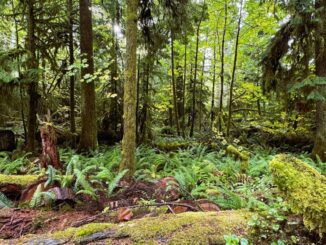
In Part 5, we crossed back over the US border into Montana for an overnight stop in Billings. As any regular traveller knows, one should always pack a universal bathplug for those occasions where the hotel one is missing or leaking. This was the one of those occasions and mine proved very useful.
A shorter drive today, only 185 miles to Yellowstone National Park, home to some impressive geothermal features, wildlife, canyons and lakes. With Montana’s excellent roads and sensible approach to speed limits, it didn’t take too long. There’s a lot to see, so I’ll be staying here for four nights. As mentioned previously, this was one of the first US National Parks I ever visited back in the late 1980s and have returned a couple of times since, so was somewhat familiar with which areas were the most interesting and should be explored first.
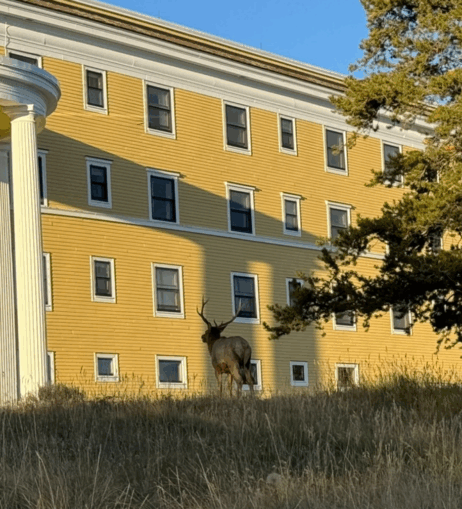
Entering from the East Entrance you travel for about 25 miles along a high altitude (>8000 ft) pass and past a couple of clear mountain lakes before reaching the much larger Yellowstone Lake, alongside which my hotel was situated. The hotel entrance was temporarily obstructed by a herd of wild elk grazing outside – they can be quite dangerous if cornered so were quickly chased-off by a passing Park Ranger before they had the opportunity to gore any of the group of Japanese tourists who were getting a little bit too close to them.
© Snotsicle 2025
Although quite grand and very clean, the park hotels are also somewhat rustic, lacking things such as A/C (not really needed in mid-September), TVs and in-room WiFi. Fortunately, there was an ethernet cable poking out of the desk and, being a retired techie geek, I always include a tiny portable router in my travel gadget bag, so wireless internet access was quickly made available.
The next day, I headed around the southern loop of the figure-of-eight park road towards Old Faithful, the famous geyser (you can argue among yourselves as to whether it is pronounced “gee-zer” or “guy-zer”) which erupts approximately every 1-2 hours. The National Park Service are quite good at predicting when the next eruption is likely, based upon the height and duration of the previous one, and post their estimate on notice boards so that visitors can spend their time & money in the restaurants and gift shop rather than sitting around staring at the cone for an hour. It appeared that I’d just missed one, so I popped into the Visitor Centre to buy a can of bear spray then set off on one of the backcountry hikes into the surrounding hills for a couple of hours to find two of the more remote, but less spectacular geysers which are situated away from the well-trodden tourist boardwalks.
Returning just in the nick of time, Old Faithful let rip with several hundred people gawping and pointing their phones at it.
Old Faithful Eruption
Returning to the hotel I stopped off at a couple of other geothermal areas with bubbling mud, steaming fissures, boiling cauldrons and colourful paint pots – if there is enough interest I may save those photos for a future “Postcard from…”.
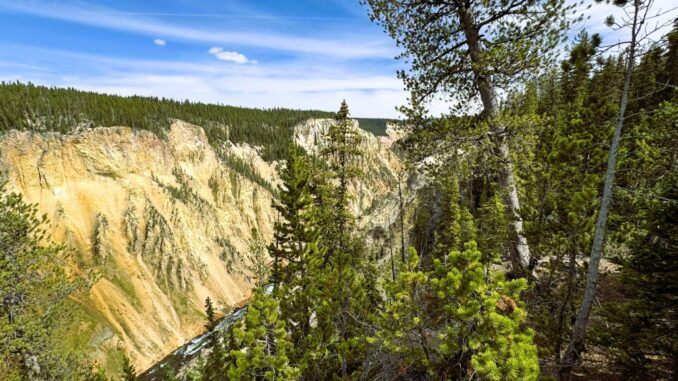
Day 2 was dedicated to exploring the Grand Canyon of the Yellowstone, not to be confused with the actual Grand Canyon in Arizona, which is very much larger and red rather than yellow.
© Snotsicle 2025
There are a pair of waterfalls (upper & lower) at one end and hiking trails along either side of the canyon, both of which I followed for a couple of miles to escape the tour bus passengers who congregate around the main viewpoints. It wasn’t too busy at that time of year but must get very crowded during the peak summer months.
Returning to the hotel later that afternoon, I spotted a handful of cars parked haphazardly at the side of the road, their occupants pointing binoculars and long camera lenses at something on a nearby embankment. That’s actually quite a common occurrence in the western National Parks and invariably an indication that some notable wildlife has been spotted.
Needless to say, I joined them and got a nice recording of an adult Grizzly Bear hunting for berries.
Adult Grizzly Bear
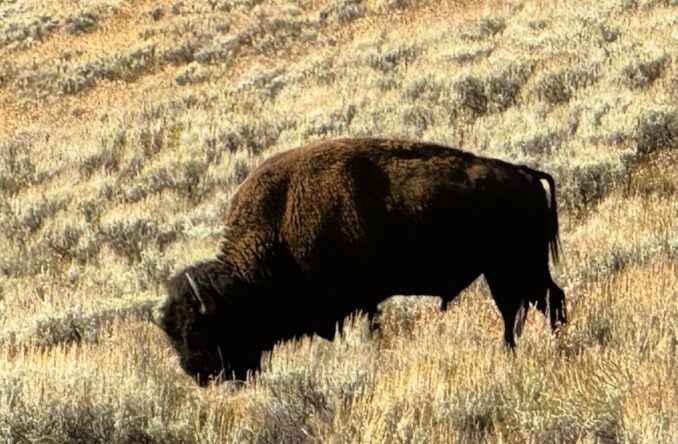
Bears and Elk aren’t the only hazardous mammals in the park, there are also around 5,000 wild Bison living there, some in large herds, others solitary or in smaller groups. They are usually found in the grassland areas but frequently wander across the roads or sit in the shade next to trails.
© Snotsicle 2025
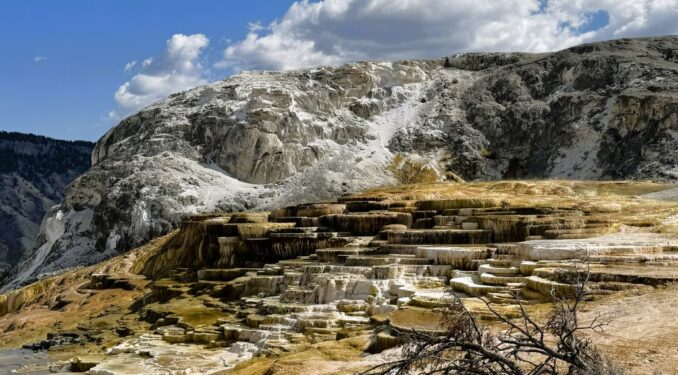
On the final day, I concentrated on the northern loop of the main park road, which included the Norris Geyser Basin and Mammoth Hot Springs both of which had more steaming, bubbling & squirting attractions. These areas were busier than the southern part of the park, possibly because they had been made more easily accessible and were close to some of the larger hotels.
Mammoth is essentially a large hill, rising around 300ft above the surrounding terrain, made up of terraces of Travertine that have formed over many thousands of years from hot calcium carbonate-rich water bubbling out of the ground. It is a similar process to that which creates limescale deposits in kettles or around dripping taps. Earthquakes and other natural events occasionally change where the water escapes from the fissures, thereby creating the different levels spread across quite a large area. Wooden staircases and boardwalks have been built over some of the terraces so that visitors can get up close and walk around without causing any damage.
© Snotsicle 2025
Completing my tour of Yellowstone it was time to head north again to the next National Park, one which spans the border between Montana, USA and Alberta, Canada, comprising more spectacular scenery. More on that next week.
© Snotsicle 2025