This weekend sees the 200th anniversary of railways – or at least of the first steam locomotive-hauled passenger service, which took place on the Stockton to Darlington railway 200 years ago today (27th September). On that day, Locomotion No. 1 became the world’s first steam engine to carry passengers on a public line. Built by George Stephenson at his son Robert’s company, the Robert Stephenson and Company, it was George who drove the first train. The engine was then called Active and later renamed Locomotion. It pulled a train with 450 passengers at a speed of 15 miles an hour.
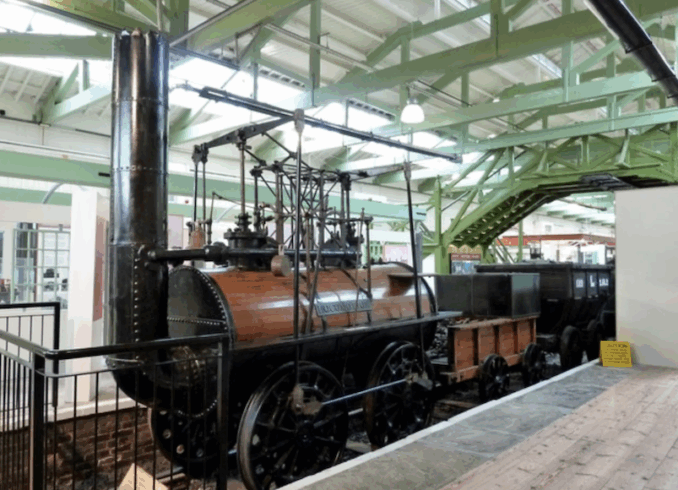
The original Locomotion,
Mary and Angus Hogg – Licence CC BY-SA 2.0
This Saturday, the main event is “Anniversary Journey,” a reenactment which spectators can view from the Hopetown Darlington viewing area as the train crosses Skerne Bridge in Darlington. Two hundred yards from Skearne bridge, there are also free activities and live entertainment at Hopetown Darlington, including Morris dancing and music from the Stockton & Darlington Ukulele Express Band. Live screening of the event is being streamed to Darlington’s Market Square.
Hopetown Darlington is part of Darlington’s Rail Heritage Quarter (formerly known as Head of Steam and, prior to that, the Darlington Railway Centre And Museum) and is named after the nearby Hopetown carriage works and Hopetown Foundry – now long closed. A seven and a half acre site, it sits next to the Stockton and Darlington line and incorporates the present North Road railway station on the Tees Valley Line that runs between Bishop Auckland and Saltburn via Darlington.
Approximately 20 miles of the original Stockton and Darlington (S&DR) route is still in use. While other sections of the original line have been abandoned, key features like the Skerne Bridge still exist, and these days include a network of heritage walks.
On the other side of the tracks to the North Road station and museum is the Darlington Locomotive Works – home of The A1 Steam Locomotive Trust. Also on site is the 1861 Shed (also known as North Road Locomotive Works), a historic 19th-century railway building, originally a locomotive shed, now used by preservation groups.
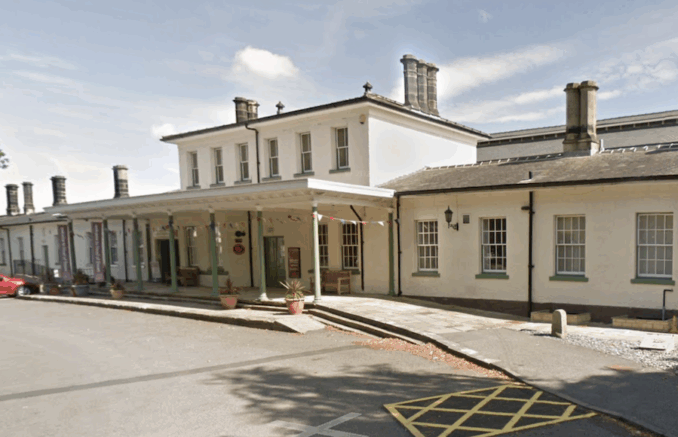
© Google Street View 2025, Google.com
A hundred years ago a cavalcade took place on July 2nd 1925, to celebrate the centenary of the railways. In anticipation, our friends at The Railway Magazine noted;
‘The London and North Eastern Railway Company has arranged a three-day programme in celebration of the Railway Centenary. On July 1 the Duke of York, who, with the Duchess of York will take part in the various ceremonies, will open at Darlington an exhibition of railway engines, rolling stock and material representing the development of railway transport during the past century.
‘On the following day, July 2, there will be a procession over the old Darlington and Stockton route of old and modern locomotives and rolling stock, which will include Locomotion No. 1 engine, built by George Stephenson, drawing a replica of the passenger train that it hauled a distance of 26 miles to Stockton on September 27, 1825, at the opening of the line.
‘Another interesting item in the procession will be a train composed of flat wagons on which various railway tableaux will be presented. In contrast with the early locomotives and rolling stock will be examples sent by the group railway companies of modern locomotives and rolling stock. It is estimated that the procession will be approximately six miles in length.
‘The Duke and Duchess of York will witness the passing of the procession from a grandstand near Eaglescliffe and they will subsequently be conveyed by special train to Stockton, where they will be entertained at luncheon in the Borough Hall by the Mayor of Stockton.
‘On July 3, after the close of the International Congress in London, the delegates have been invited by the LNER to visit Darlington and inspect the Railway Centenary Exhibition.’
And so it came to be.
In July 1925, the editor of Railway Wonders joined the royal couplr (who were to become King George VI and Queen Elizabeth the Queen Mother) and other dignitaries in the North East town. Rather breathlessly, the following report appeared subsequently in the Railway Wonders,
‘When I arrived in Darlington I found the town “en fete” – the streets were gaily decorated with flags and bunting, the shops were closed, and everyone seemed to be having a holiday in honour of the event. There were special bands and entertainments in the public parks, and everything possible was being done to make the anniversary an event to be remembered – more especially, perhaps, by the boys and girls.’
Everywhere the editor noted evidence of the spirit of the week. In the park was a huge flower-bed designed in the form of a locomotive, with a suitable floral inscription “Centenary: 1825 – 1925”. Shop windows were suitably set out with locomotives represented in cardboard, soap, chocolate, and even in fruit. Old prints showed the early railways. Dozens of books, old and new, told of locomotives and railways. Hatters and tailors entered into the spirit by displaying in their windows hats and suits of the period, as worn by the passengers of the trains a century previous.
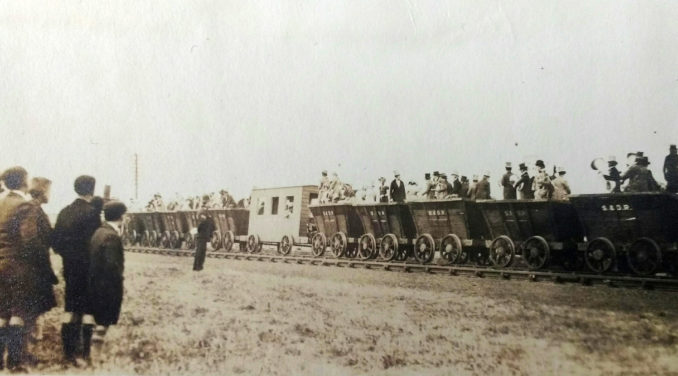
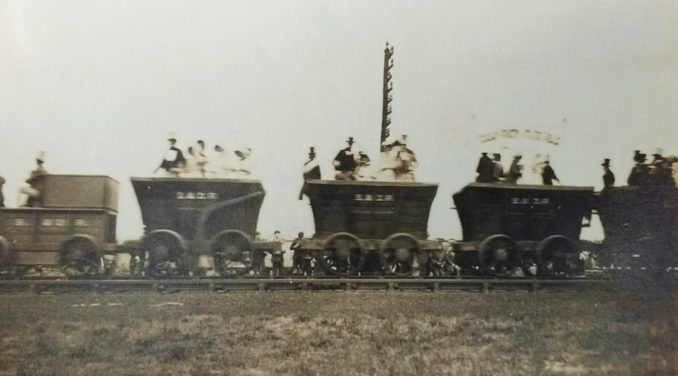
Sure enough, Locomotion No. 1 made an appearance and was captured by posterity in old photos passed to this author and used in a series of Mystery Album articles four years ago. Well worth another airing, Locomotion No. 1 can be seen to the left with the Union Jack prominent to the right. No squeamishness about raising the colours in those days!

© Always Worth Saying 2025, Going Postal
© Always Worth Saying 2025, Going Postal
© Always Worth Saying 2025, Going Postal
No. 1 hauled replica coal wagons of the type that would have been used in 1825 to carry passengers. In the middle of the formation was what is presumably the world’s first passenger carriage. In further proof that not much changes this more comfortable ride was called ‘the directors’ carriage’.
All was not plain sailing. Contemporary correspondents report the train was due to stop at the royal grandstand at Eaglescliffe. It arrived belching black smoke and covering lady passengers in soot and dirt. Coming to such a sudden stop that the wagons crashed together, occupants were thrown violently about and had to clutch wildly at each other to stay upright. Even the directors ended up in a confused heap in their long coach.
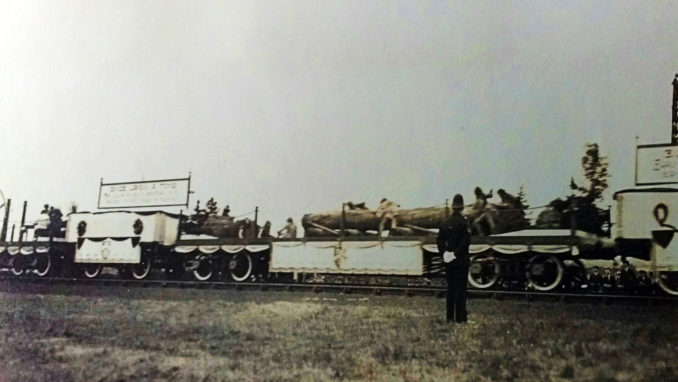
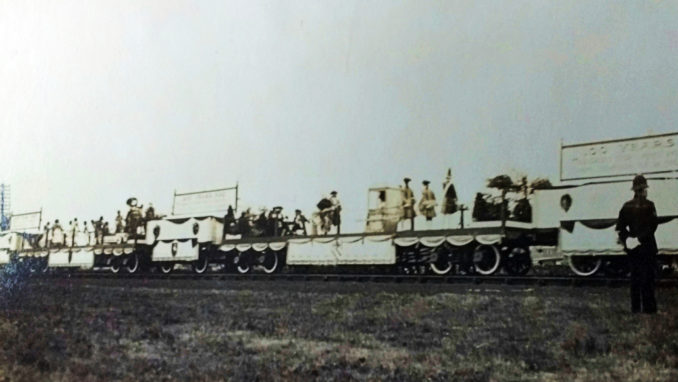
As for the flat wagons containing a railway tableaux,
© Always Worth Saying 2025, Going Postal
© Always Worth Saying 2025, Going Postal
A crowd estimated at a quarter of a million enjoyed a consist of six wagons each carrying a different life-sized diorama. The first was allegorical and depicted astrologers grouped at one side of a symbolic wheel, with a scene showing modern engineering practice on the other. The two scenes were joined through the spokes of the wheel by a huge chain, representing the links of time.
The second tableau is featured in our top photograph and shows prehistoric men just about to invent the wheel as they use tree trunks as rollers. The reader will have to use their imagination regarding the ‘Pharaohs on a wheeled platform being drawn by slaves’. Unfortunately, our second photograph appears to show the giant step backwards taken when wheel and axle were discarded and replaced by the sedan chair.
More recent tableaux might include the railways during wartime, nationalisation, stop-start modernisation that saw steam replaced with diesel and electric traction, and privatisation. I wonder what the next hundred years will bring?!
© Always Worth Saying 2025