
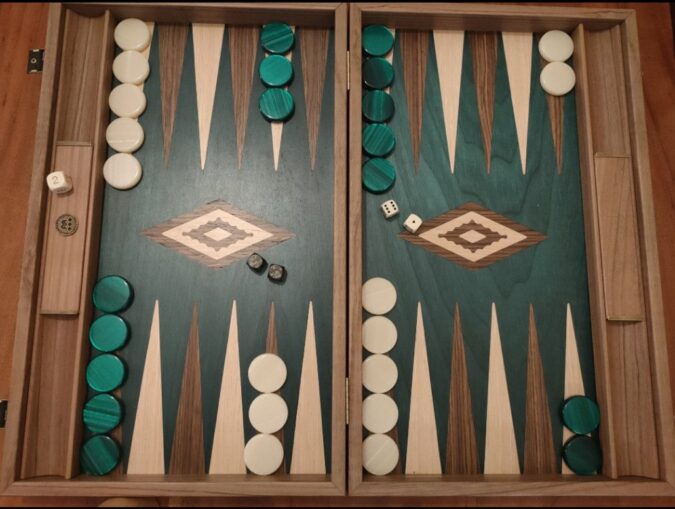
Backgammon, one of the oldest known board games, traces its origins to ancient Mesopotamia, but England significantly shaped its history. By the 17th century, backgammon was popular in English taverns and homes, with the term “backgammon” first appearing in English literature around 1645, possibly derived from the Middle English “baec gamen” (back game). Edmond Hoyle’s “A Short Treatise on the Game of Back-Gammon” standardized gameplay in 1743.
The game further developed in the 1920s with the introduction of the doubling cube, where a player offers to double the points at stake. This added a lot more complexity to matches, although you don’t have to use it in casual play. The 1960s saw a revival of interest, with London and New York becoming hubs for competitive play and gambling, driven by figures like Prince Alexis Obolensky, who popularized the game internationally.
The Rules
Backgammon is played on a board with 24 triangular points split into four quadrants, where two players, each with 15 checkers, move in opposite directions, aiming to bring all their checkers to their home board and bear them off first. The board always has the same starting set-up. Players roll two dice to determine moves, advancing checkers according to the dice values—either moving one checker the sum of both dice or two checkers separately. If a player rolls doubles they get four moves of that number (e.g., four 6s), significantly increasing their strategic options. Checkers can land on open points or with a single opponent’s checker, which is “hit” and sent to the bar. Hit checkers must re-enter from the bar before other moves. The first to bear off all checkers wins. A single win (1 point) occurs if the opponent has started bearing off; a gammon (2 points) is awarded if the opponent hasn’t borne off any checkers; a backgammon (3 points) is scored if the opponent has checkers in the winner’s home board or on the bar.

Why Backgammon is Such a Great Game
Backgammon’s allure lies in its elegant and balanced gameplay. At its core, it’s a mathematical game of probability, yet the board’s visual arrangement of checkers intuitively conveys positions of strength and weakness —an ugly setup usually signals a weak position, allowing players to grasp the game’s state without deep mathematical knowledge, though understanding probabilities enhances play.
Like life, backgammon forces players to balance risk and caution, as players decide when to push aggressively or play defensively. Chance plays a significant role, enabling weaker players to beat more experienced ones, and games can often switch around quickly and come down to the final roll. Or you can occasionally be humiliated by your opponent – stuck on the bar as he bears off his soldiers as you then run for your home board with your tail between your legs. It has understandably been nicknamed “the cruelest game.”
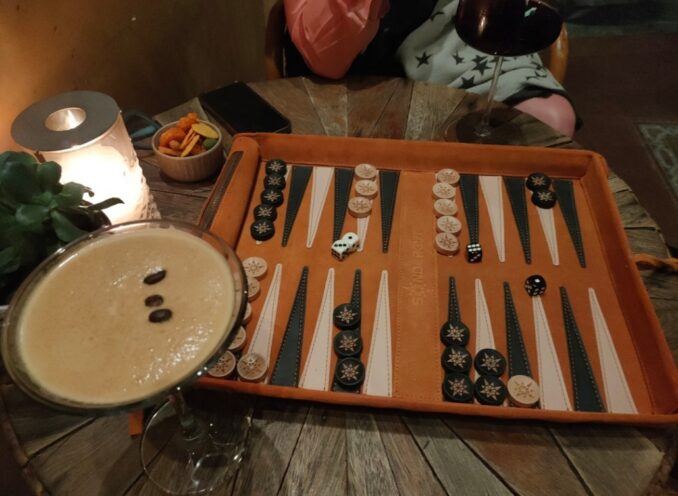
Quick to learn and play, backgammon allows novices to start playing in minutes, yet studying basic theory can dramatically improve skill and appreciation without requiring the autistic dedication chess demands to master. It is also a great game to introduce young children to as they can quickly grasp the essentials.
The physical board – with its distinctive sound of rattling dice and clinking checkers, as well as different colour combinations – adds to the experience. These are often lovely works of craftsmanship, and many players end up collecting them.
When it comes to buying boards, Manopoulos is a handmade Greek producer with many options. Think carefully about the size of board depending on where you will play. Competition boards are surprisingly big. I would also recommend the phone app Backgammon NJ which is very good for solo games against the computer and learning the best moves. Another good way to start, or get back into the game, is to revive the old traditions and play in your local pub, many of which will have the game on a shelf.
© text & images JimmySP 2024


