
DIP’s nuclear element
The vast expense of the nuclear element of the Defence Investment Plan (DIP) – by far its largest commitment – has drawn our focus in two previous articles upon the following:
- Dreadnought nuclear deterrent ballistic submarines (SSBN)
- Trident missiles and their warheads
Today we will look at
- Nuclear-powered fleet submarines
Fleet or attack submarines, SSNs
First of all, what do we mean by a fleet submarine? Sometimes called attack submarines or SSNs (SS for submarine and N for nuclear), these are nuclear-powered but not nuclear-armed. Equipped with torpedoes and land attack cruise missiles, if the deterrent submarines are bombers, then these are fighters. If the deterrent submarines are trucks, these are sports cars.
The Navy’s present class of SSNs are Astutes, all seven of which were built, or are building, at Barrow-in-Furness in Cumbria. Successors to the Trafalgar Class (which were also known as T Boats), these were supposed to be a batch two Trafalgar, but at vast expense and with cripling timeline and technical problems, the wheel was reinvented with the Astutes tipping the scales at c7,000 tons to Trafalgar’s c4,800.
The same glacial progress seen with the new Dreadnought-class SSBNs (new ballistic missile submarines that carry the UK’s nuclear deterrent) is being repeated with the Astute-class. From the first-of-class being laid down to the last boat’s commissioning will take 28 years — by which time the first Astute will already be approaching decommissioning.
By comparison, the seven Trafalgar class were built quickly. From the first boat’s keel laying in April 1979 to the last’s commissioning in October 1991 took just 12 years, with each submarine typically then serving for around 30 years. Predecessor Swiftsure (six in class) was first laid down in June 1969, with the final one commissioned in March 81 – again, 12 years.
Astute’s successor, therefore, has to be close to being ready before the last of the Astutes has been completed, unless there is going to be a submarine gap similar to the present frigate gap. In reality, there already is a submarine gap as no Astutes are available at the moment due to delays in maintenance, repairs and refit.
The next generation
That next generation of SSNs will be AUKUS, a cooperative effort between Australia, the UK and the USA. Thus far, the UK is committed to up to 12 vessels and the Australians to 5. Beyond the submarine gap, there is also a weapons gap, with the UK relying for ground attack upon American torpedo tube-launched cruise missiles, which the USA doesn’t make any more. UK stocks are said to be in the tens rather than the hundreds, meaning each Astute may only fire fewer than a dozen cruise missiles in anger during an entire 30-year service history.
Submarine inflation continues with AUKUS expected to be ‘over 10,000 tons’ – as the wheel is being reinvented yet again. A newer, bigger and more numerous class of submarine, added to the Dreadnought SSBN replacement for Valiant, and a lack of capacity to maintain Astute, requires a massive infrastructure upgrade codenamed Project Royal Oak.
Part of the £298 billion Defence Investment Plan, this ten-year £26 billion programme will deliver new docks, waterfront infrastructure, engineering facilities, accommodation and operational buildings at HMNB Clyde, HMNB Devonport, and (for the surface fleet), at HMNB Portsmouth.
Faslane
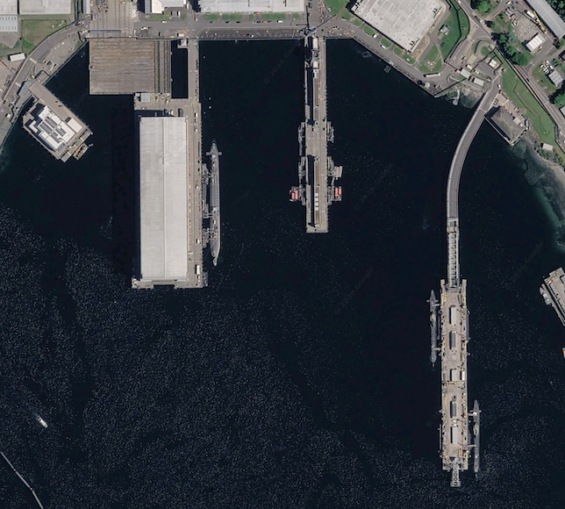
HMNB Clyde accounts for the biggest slice of investment with £15.1bn committed, promising to make Faslane Scotland’s biggest construction site. Some Puffins were surprised that last time we were able to source aerial photographs of the Atomic Weapons Establishment’s Aldermaston and Burghfield sites. *Taps nose* Shall we fire up the Going-Postal stealth drone again and have a look around HMNB Clyde at Faslane? I think we should.
© Google Maps 2026, Google licence
Key projects here include three new floating docks for submarine maintenance, and a new shoreside to support them. A new off-site engineering facility will increase submarine maintenance capacity, as will other modernisation of dock infrastructure.
This investment is aimed at supporting the UK’s nuclear deterrent, Astute-class submarines and the future Dreadnought SSBNs and AUKUS SSNs.
In the photograph, we note a Valiant-class submarine alongside to the left, close to the big white box which is the ship lift.
To the right, two Astutes are alongside. Ominously, HMS Artful is described as being in a ‘low-readiness state’ while, worse still, HMS Abush is said to be ‘in very low readiness ’. ie being broken up for spares.
Devonport
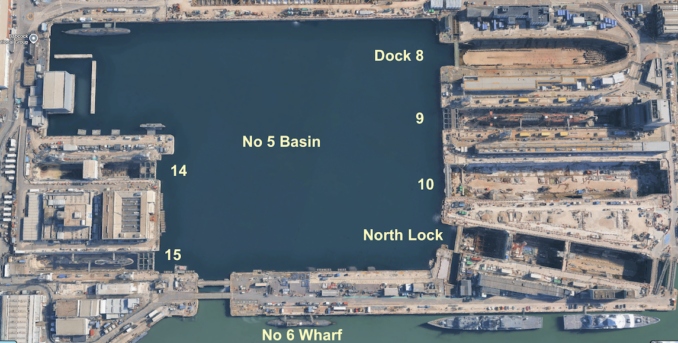
At the other end of the country, at HMNB Devonport near Plymouth, £7.1 billion will be spent on a major dockyard renewal focused on submarine support. Devonport will remain the UK’s centre for heavy submarine maintenance through upgrades to 15 Dock, modernisation of 10 Dock and work on 14 Dock to restart submarine defuelling operations.
© Google Maps 2026, Google licence
If we zoom in, in 15 Dock we see HMS Astute under mid-life revalidation heavy repair. At the moment, HMS Anson is also at Devonport for routine maintenance after a trip to Australia. In 9 Dock we see HMS Victorious being overhauled to extend her service life (at a cost of £600 million) to prevent a deterrent gap owing to delays to Dreadnought.
The Navy’s nuclear legacy
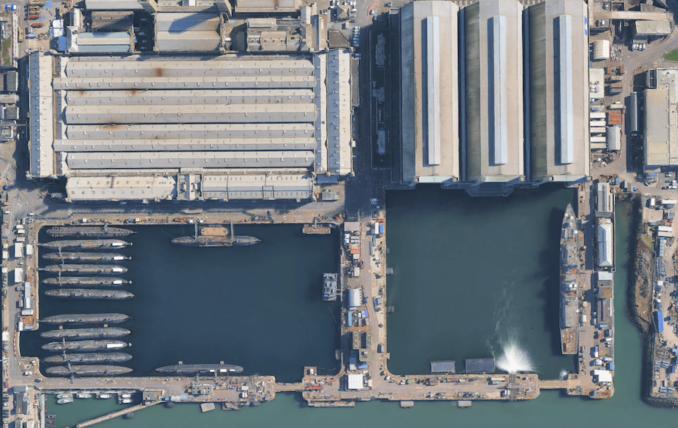
Besides existing and new submarines, all of the Navy’s 22 decommissioned nuclear submarines are stored afloat. As the UK did not fully dismantle any of its nuclear-powered vessels for decades, these retired hulls are moored in long-term storage awaiting disposal.
If we look again at Number 5 Basin at Devonport (above) we can see one in the top left corner, and one in the middle at the bottom, on Number 6 Wharf.
The basin next to Number 5 (below) contains numerous others.
© Google Maps 2026, Google licence
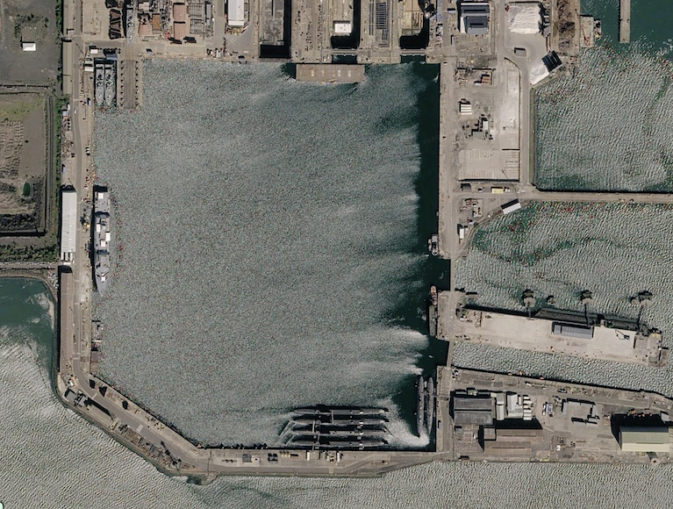
If we return to Scotland, to Rosyth on the Forth, we see four Resolution boats (the precursor to Valiant) at the bottom middle of the photograph below, and two fleet submarines to their left at the ‘vertical’.
© Google Maps 2026, Google licence
One of these is HMS Dreadnought, Britain’s first nuclear submarine, which has been tied up at Rosyth for 46 years. The cost of fully decommissioning these vessels, full of asbestos as well as low, intermediate and high level radioactive waste, will be beyond eyewatering.
Meanwhile in Russia
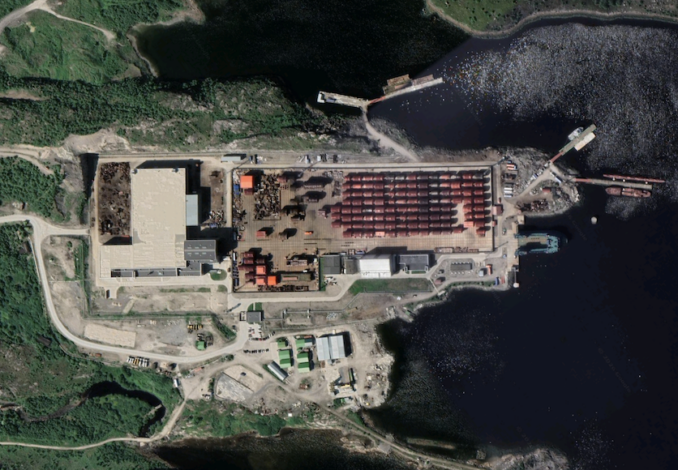
Meanwhile, if we sneak our drone into Comfort Class on Поезд № 21, Конечная Мурманск, about 50 miles along the Arctic coast from Murmansk, we find this:
© Google Maps 2026, Google licence
A facility in the middle of nowhere storing Russian submarine reactor sections at little cost, while the rest of the various vessels will already have been turned into razor blades or, more likely, something useful for the Russian military.
© Always Worth Saying 2026