
At 21 he was building the locomotives for Brunel’s Great Western Railway. Then he took Brunel’s Great Eastern and used it to lay the first lasting telegraph cable across the Atlantic. This is the man from Bedlington who connected two continents.
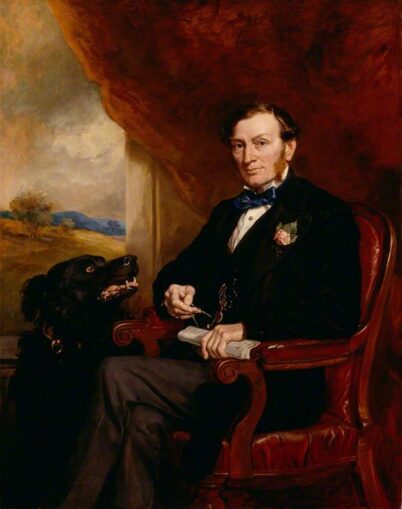
Francis Grant, Public domain, via Wikimedia Commons
Daniel Gooch was born at Bedlington in Northumberland in 1816, which means the the region can claim yet another of the people who built the railways… you may accuse me of bias, and you’d be right.
A Northumbrian apprenticeship
Gooch came from an iron-working family and learned his trade in the foundries and engine shops of the early industrial north, including a spell at Robert Stephenson and Company in Newcastle, the world’s first locomotive works. By his late teens he knew engines inside out and in need of a job.
His father managed iron works, and the family moved as the trade took them, so young Daniel picked up his experience in several of the great engine shops of the age, from the Tredegar works in South Wales to the Stephensons’ factory in Newcastle. He applied to the brand-new Great Western on the strength of that grounding, and Brunel, gambling on youth, handed a 21-year-old the keys to the locomotive department over plenty of older men.
Brunel’s engine man at 21
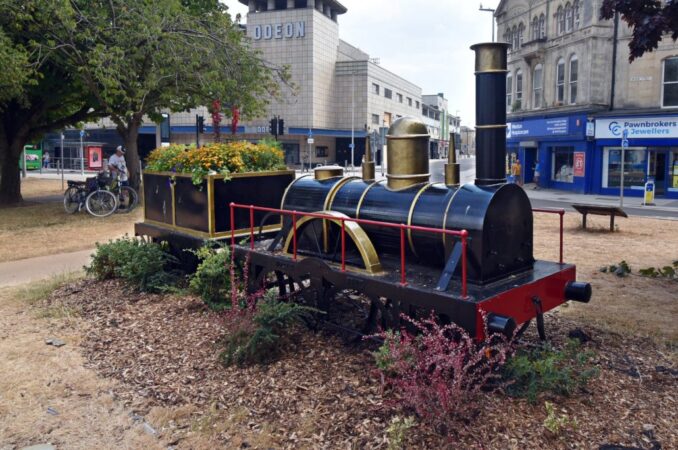
Loco Steve, CC BY-SA 2.0, via Wikimedia Commons
In 1837, aged just 21, Gooch was appointed the first locomotive superintendent of the Great Western Railway. Brunel, the company’s chief engineer, had committed the line to his famous broad gauge, a track 7 feet wide instead of the 4 feet 8 and a half inches everyone else used, on the theory that a wider gauge meant faster, steadier trains.
Editorial note, for the pedants: gauge width on its own doesn’t contribute to speed; Japan’s bullet trains run on standard gauge. Brunel’s broad gauge did pull heavier loads faster (vs. standard) in the Gauge Commission’s trials of 1845, but the engineering argument was never really settled. The broad gauge was abolished on grounds of cost long before anyone proved the case either way.
Gooch said so himself, years later, with beautiful bluntness. Brunel, he wrote, fancied that no one could do anything but himself, and for all his genius at bridges, surveys and stations, his locomotives were almost useless. So the 21-year-old quietly took over the job of designing engines that actually worked, and delivered. From his Swindon works, which he established, came a string of fast, reliable broad-gauge locomotives, including the Iron Duke class, machines with vast single driving wheels that could hold 70 miles an hour when most of the country pottered along at half that. Over his career he was responsible for some 340 locomotives.
The proof came early. The Great Western’s first genuinely reliable engine, North Star, had been built not by Brunel but by Robert Stephenson and Company, and it was Gooch who nursed it into proper working order while Brunel’s own machines stalled and failed. From then on the arrangement was settled without anyone having to say it: Gooch drew the engines, and Brunel left them well alone.
For two decades Brunel’s railway ran on Gooch’s engines, and the Great Western earned its nickname, God’s Wonderful Railway, on the strength of them.
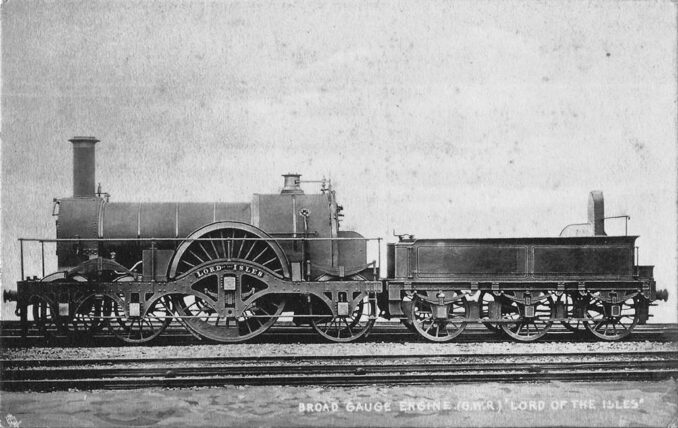
Great Western Railway, Public domain, via Wikimedia Commons
The biggest ship in the world
Brunel’s final creation was the Great Eastern, a steamship so vast that nothing approaching her size would be built for another 40 years. As a passenger liner she was a commercial disaster, too big for the trade of her day, a beautiful white elephant that helped break her creator’s health.
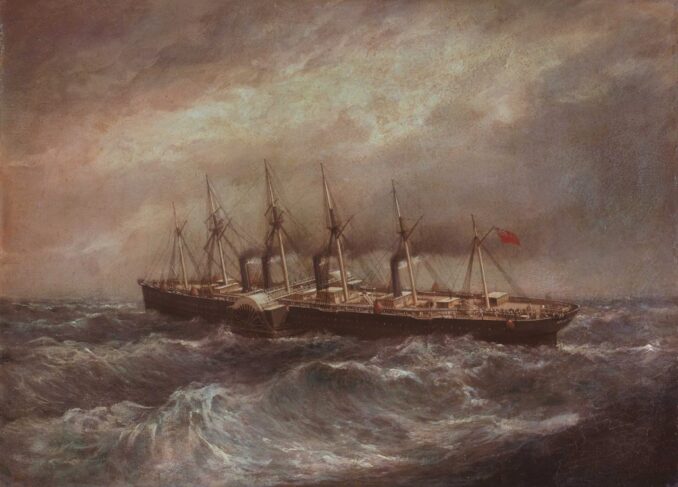
Henry Clifford (painter), Public domain, via Wikimedia Commons
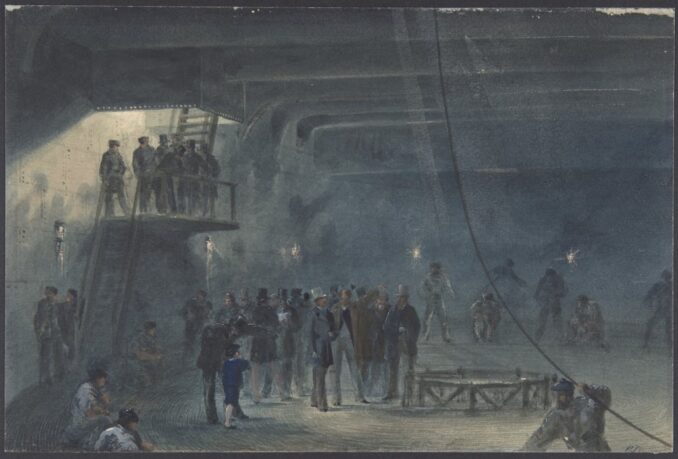
But there was one job in the world that needed a ship that enormous. Laying a telegraph cable clean across the Atlantic Ocean meant carrying thousands of miles of heavy cable in one hull, paying it out steadily over weeks at sea. Only the Great Eastern was big enough. And the man put in charge of the company that would use her was… Daniel Gooch.
Shrinking the Atlantic
Robert Charles Dudley, CC0, via Wikimedia Commons
It did not work first time. In 1865 Gooch sailed on the Great Eastern to lay the cable, only to watch it snap and vanish into two miles of water, an agonising failure with the job most of the way done. He resigned his post at the Great Western in 1864 to give the cable his full attention, and he refused to give up on it.
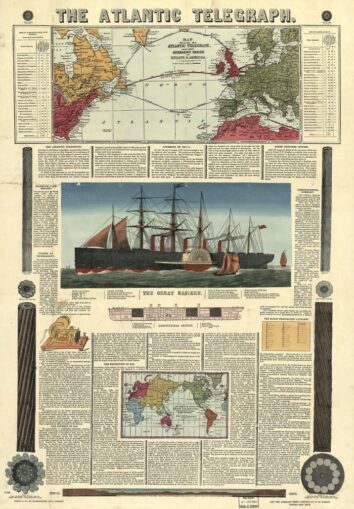
In 1866 they went back, laid a fresh cable the whole way to Newfoundland, and then, astonishingly, sailed back out, grappled up the lost 1865 cable from the bottom of the ocean, and completed that one too. Suddenly there were two working telegraph lines under the Atlantic. A message that had taken a fast ship the better part of two weeks to carry now crossed in minutes. The world had, for the first time, been wired together, and a Northumbrian had done the wiring. Gooch was made a baronet for it.
Bacon, G. W. (George Washington), Public domain, via Wikimedia Commons
It is hard to overstate what that meant. An earlier cable laid in 1858 had carried a few messages and then died within weeks; Gooch’s 1866 line was the first that lasted. Almost overnight, news, market prices and government dispatches that had taken a fortnight to cross by ship were leaping the Atlantic in minutes.
Chairman
He was not finished. Gooch had already become chairman of the Great Western Railway in 1865, and he held the post until his death in 1889, dragging the company back from the brink of collapse and seeing it through the slow, painful abandonment of Brunel’s beloved broad gauge. He sat in Parliament as a Member for Cricklade for a spell as well, almost as an afterthought.
He died at Windsor in 1889, a baronet, a former chairman, the man who had built God’s Wonderful Railway’s engines and wired two continents together. Brunel got the bridges, the ship and the legend. Gooch got the engines to run and the cable to lie flat on the seabed, which are the harder jobs and the quieter ones. He shrank the Atlantic to the length of a wire.
The cable held but his name, sadly, did not.
© Paranoid Android 2026

_-_Sir_Daniel_Gooch,_1st_Bt_-_NPG_5080_-_National_Portrait_Gallery.jpg)

_Lord_of_the_Isles.jpg)

