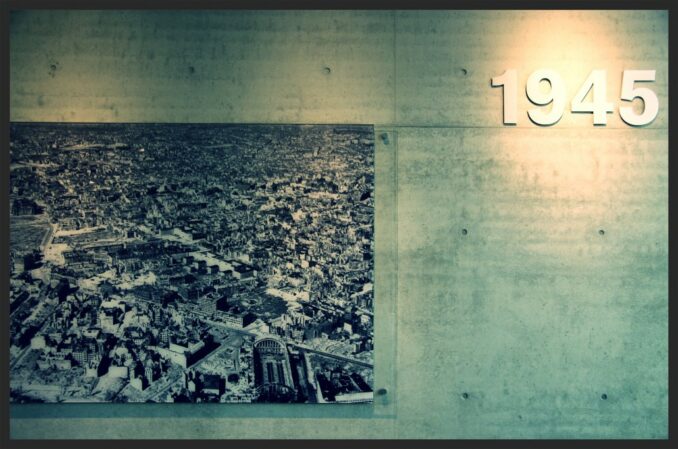
Most people believe World War II ended in 1945. In reality, its most important consequences were only beginning. The fighting stopped. The maps were redrawn. The narrative was presented as settled—and fixed in place. But the most enduring consequences of the war lay beyond the battlefield—in the construction of a system that still shapes the world today. World War II is typically presented as a moral and military turning point—a struggle between clearly defined forces, culminating—according to the standard narrative—in “liberation” and reconstruction. That version of events is familiar. It is taught, repeated, and rarely questioned at a structural level. But wars do not arise in isolation—and they do not end cleanly. They emerge from political decisions, economic structures, and strategic interests that extend far beyond the battlefield. And while the human cost—measured in the loss of millions of lives on all sides—was profound, many of the war’s longer-term consequences took shape not in the moment of victory—but in the systems built afterward. Understanding World War II, therefore, requires looking not only at what was fought—but at what was created in its aftermath.
It is often said that history is written by the victors. Whether or not one fully accepts that idea, it is clear that dominant narratives tend to stabilise over time—while alternative interpretations remain marginal. Yet those alternative interpretations exist—and in some cases, they come from figures directly involved in the events themselves. General George Patton, one of the most prominent U.S. commanders of the war – certainly the one most feared by the Germans – recorded in his diary in May 1945: “I am afraid that we have destroyed the wrong enemy.” Patton believed that the defeat of Germany had encouraged & enabled the expansion of Soviet communism across Eastern Europe—an outcome that would shape the geopolitical landscape for decades. Whether one agrees with that assessment or not, it reveals something important: Even at the highest levels, the meaning and outcome of the war were not universally agreed upon.
But wars are not only fought with weapons—they are sustained through systems of finance. Large-scale conflict requires massive mobilisation of resources. That mobilisation depends on funding. And funding depends on financial structures. A number of researchers have explored the relationship between Western financial institutions and geopolitical developments during the twentieth century. Tony Sutton, for instance, a scholar at the Hoover Institute, investigated the connection between the capitalists and communism. He wrote a major study Western Technology and Soviet Economic Development, describing how the western based banks played a major role in developing the Soviet Union from its very beginnings up until 1970. In a volume titled Wall Street and the Bolshevik Revolution he detailed the relationship of New York’s Wall St banks and the Bolsheviks, who led the 1917 revolution and established the first communist state in Russia.
These interpretations remain contested. (By the Banksters). But they point toward a broader reality : Economic power and political outcomes are often deeply interconnected. And yet, this dimension is rarely central in mainstream accounts of World War II. In early 1933, Germany moved to assert control over its own money creation, stepping outside a system of internationally mediated, interest-bearing finance centred in major international banking institutions, particularly in London and New York. That shift is central to a line of interpretation that sees monetary control—not just ideology or territory—as a factor in the tensions that led to war. By 1944, however, the direction of travel was clear—and it was moving the other way. Before the war had even ended, representatives from 44 nations met to design the post-war system. The result was the Bretton Woods framework.
Out of it came two institutions:
- The International Monetary Fund
- The World Bank
Alongside these, the U.S. dollar was established as the world’s primary reserve currency.
At first glance, this appeared to be a practical solution to post-war reconstruction. But it also introduced something far more consequential. After the war, reconstruction was not carried out through independent national development alone. It was financed—at bigly scale—through debt. By 1945, the major powers were already operating under unprecedented financial burdens. The United Kingdom’s national debt had risen to over 200% of GDP. The United States had also accumulated substantial wartime debt, exceeding 100% of GDP. Much of this was financed through government bond issuance and credit expansion, linking post-war recovery directly to ongoing systems of borrowing and interest. What followed therefore was not a temporary phase of reconstruction—but the embedding of debt as a structural feature of modern economic life. This dynamic was to be entrenched – debt……… not as a temporary tool but as a permanent structural mechanism. Countries borrowed to rebuild infrastructure, stabilise currencies, and manage economic transitions. Over time, this evolved into a system in which:
- National economies became structurally dependent on borrowing
- Repayment obligations shaped policy decisions
- Access to credit became conditional
In practical terms, economic sovereignty was no longer absolute. Nations were operating within a shared financial architecture—one in which key decisions were influenced, and at times constrained, by external institutions. This system did not emerge through widespread public debate. It was not the result of referenda or democratic mandates. It took shape through wartime agreements—and was consolidated in the decades that followed. So, as we can see World War II did not simply conclude in 1945. It merely marked a shift in emphasis. Military outcomes did not stand apart from financial capacity—they were shaped and constrained by it. What States could fight, sustain, and ultimately achieve was increasingly determined by access to credit, the cost of borrowing, and the structure of their monetary systems. Territorial control was shaped in the same way: not only established through force, but sustained—and often limited—by debt, financial constraints, and access to external funding. Systems of credit, debt, and institutional coordination became more formalised, more global, and more central to how power was exercised. These dynamics did not begin in 1945 — but the post-war order consolidated and expanded them to an unprecedented scale. What changed was not the existence of these mechanisms—but their scale, integration, and permanence. This does not fit neatly into conventional narratives. But it aligns with observable realities:
- Persistent national debt across nearly all major economies
- Ongoing reliance on borrowing
- Increasing influence of supranational financial institutions
So………..If these structures are pivotally central, why are they not more widely discussed in connection with World War II?………Part of the answer may lie in how historical narratives are formed. Over time, media systems have consolidated. Academic frameworks have stabilised. Certain interpretations become standard—while others remain peripheral. Those with greater financial and institutional power have often been better positioned to shape media narratives and influence as to how historical events are presented. Concerns about how institutions shape public understanding have also been expressed by contemporary commentators. As Thomas Sowell has observed:
“The barbarians are not at the gates, they are inside the gates – and have academic tenure, judicial appointments, government grants, and control of the movies, television, and other media. The question of the hour – and of the next century – is whether all this can be turned around.” — Dr. Thomas Sowell, 1994
Similar concerns about the shaping of narrative have been raised in different forms by postwar commentators. Writer Louis Marschalko, advanced interpretations in which major political and economic systems were seen as interconnected rather than opposed. Central to this perspective was the idea that influence over finance, media, and public perception plays a significant role in shaping historical outcomes. Marschalko, for example, repeatedly emphasised the role of propaganda, mass psychology, and information control in shaping public understanding of events. He also argued that official versions of postwar history tend to overlook the suffering of defeated nations and the imposition of new structures in the aftermath of the war, & extended his critique beyond Europe to the United States, arguing that America has fallen under similar “world-conquering” forces which he argued played a decisive role in shaping political decisions and public perception. He made the case that the United States entered both European wars in 1917 & 1941 in the interests of powerful financial and business forces. He also argued that American democracy functions as a façade, with media, government, and education acting as key instruments through which influence—and, in his view, mass control—is exercised.
His interpretations are controversial and widely disputed, but they reflect an enduring line of thought that emphasises the role of narrative and information in the exercise of power. There is no room for doubt that the twentieth century witnessed immense human suffering under multiple political and economic systems. Estimates of deaths under communist regimes alone reach into the tens of millions. But large-scale violence was not confined to any single system. Wars, proxy conflicts, and foreign interventions—often justified in terms of security or the spread of democracy—also resulted in immense destruction and loss of life. These events are often treated as separate historical chapters.
But viewed together, they raise broader questions:
- Were ideological conflicts always what they appeared to be?
- To what extent were underlying economic, financial, and strategic structures shaping outcomes?
- And what kind of system ultimately emerged from this period?
Today, most governments operate within financial systems that depend on continuous borrowing. Debt is not an anomaly—it’s evolved into a structural feature. Interest payments shape national budgets. Credit conditions influence policy. Economic decisions are made within frameworks that extend beyond purely domestic control. Whether one views this system as stabilising or constraining, one thing is clear: It did not arise by accident. It was built. World War II did not simply end a conflict. It marked a transition into a different kind of system. One in which power is exercised not only through territory — but increasingly through structure. The post-war order embedded a model in which:
- Nations operate within a shared monetary framework
- Debt is permanent
- and key economic decisions are shaped by systems beyond direct democratic control
This is not a fringe interpretation. It is a structural observation. Understanding World War II, therefore, is not only about the past.
It is about the architecture of the present.
© DJM 2026