
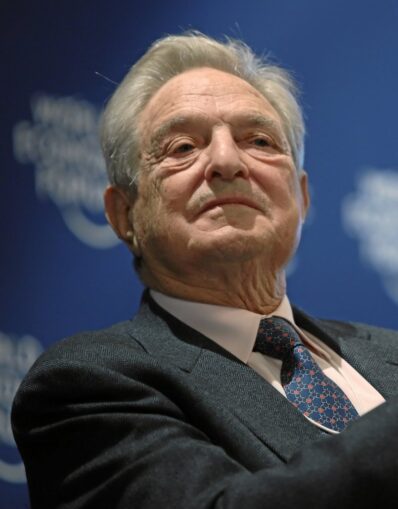
To trace every milestone in the storied career of George Soros would be a Sisyphean task, yet certain pivotal moments demand illumination — moments that forged the path to his vast fortune, a wealth that, intertwined with his singular temperament, has granted him extraordinary latitude in the realm of sociopolitical influence. The reverberations of this influence ripple through our present in ways scarcely anticipated. Soros does not always stand in the spotlight, nor can his involvement always be definitively proven, let alone tied in with deleterious global consequences. Yet the evidence, at times starkly compelling, speaks for itself. A growing chorus of informed voices now warn of the profound and often troubling impact of Soros’s activities, as disparate threads of information weave into a coherent, disquieting tapestry. Soon, the focus will shift to these very matters—to historical currents, clandestine networks, orchestrated crises, and the subtle choreography of global events that have shaped the 20th and 21st centuries.
At the heart of this narrative lies Soros’s philosophy, deeply influenced by the theories of Karl Popper, whose ideas he fleetingly invoked. A lifelong admirer of Popper, Soros has never relinquished his aspiration to be regarded as a philosopher capable of effecting change. His doctorate, earned in 1954 at the London School of Economics, stands as a testament to this enduring ambition. As for his financial odyssey, the details that emerge are nothing short of revelatory, shedding light on the evolving cast of characters who crossed his path, the methodologies that underpinned his empire, and the deliberations that shaped his ascent. Yet the central question is not how Soros amassed his wealth, but what he has chosen to do with it — the initiatives he has championed, the vast sums he has deployed as a philanthropist to reshape the world in his image. His endeavours, as we shall see, touch the very essence of our collective existence.
For those captivated by the mechanics of Soros’s rise from humble origins to billionaire status, eager to decipher and perhaps emulate his strategies, this account may prove unsatisfying. Such readers would be better served by consulting the writings of the financial oracle himself. The paragraphs that follow will instead foreground sociopolitical and geostrategic dimensions, probing the future of Europe—and by extension, Germany—without delving exhaustively into the minutiae of Soros’s wealth-building or offering a blueprint for replicating his success. Nevertheless, no portrait of Soros would be complete without a nod to the extraordinary arc of his achievements.
During his tenure at Wertheim & Co., Soros remained a considerable distance from his first million, with billions a distant dream. He envisioned a five-year stint, sufficient to amass $500,000, after which he planned to return to England and pursue philosophical studies. In reality, he lingered until 1963, immersing himself not only in finance but also in philosophical inquiry. During this period, he penned an essay titled The Burden of Consciousness, printing it at the firm’s expense and sending a copy to Popper, who responded with encouragement. This prompted Soros to visit his former mentor, a decade after completing his studies. It was in this crucible of thought that the Hungarian émigré, now adrift in America, forged his theory of reflexivity. Born of personal experience, this theory grappled, in broad strokes, with the interplay between thought and reality. Soros posited that our understanding of the world is inherently imperfect, as we are ourselves embedded within the very systems we seek to comprehend. Through this lens, he sought to illuminate how individual perceptions and biases could sway market dynamics, potentially upending established economic principles.
His attempt to place thought and reality in a dialectical relationship gave rise to the principle of reflexivity, though the endeavour was fraught with challenges—not least the difficulty of articulating something novel on a timeworn subject and the struggle to define reflexivity itself. Often, what he wrote one day seemed incoherent by the next, a maddening cycle of clarity and confusion. Though Soros took his philosophical pursuits seriously, he harboured doubts about their reception. In a chapter titled “Autobiography of a Failed Philosopher,” he recounts his son Robert’s childhood observation: “My father sits down and spins theories to explain why he does this or that. But I remember thinking as a kid, dear God, at least half of it is nonsense.” Yet to grasp markets as Soros did required a profound understanding of the world itself—especially for one intent on shaping it. He later noted that his theory of reflexivity could explain the efficacy of the propaganda techniques depicted in Orwell’s 1984, particularly in the context of post-9/11 American politics under George W. Bush, whom he fiercely opposed.
In the 1960s, such concerns were far from his mind. The “failed philosopher” toiled between 1963 and 1966, revising his doctoral dissertation while working, with waning enthusiasm, at Arnhold and S. Bleichroeder, where he had risen to vice president. Increasingly, he felt himself spinning in intellectual circles, trapped in a fruitless loop. Resolving to break free, Soros drew a line under his philosophical musings and turned his focus back to the world of commerce, where his true genius awaited.
To be continued
© DJM 2026