
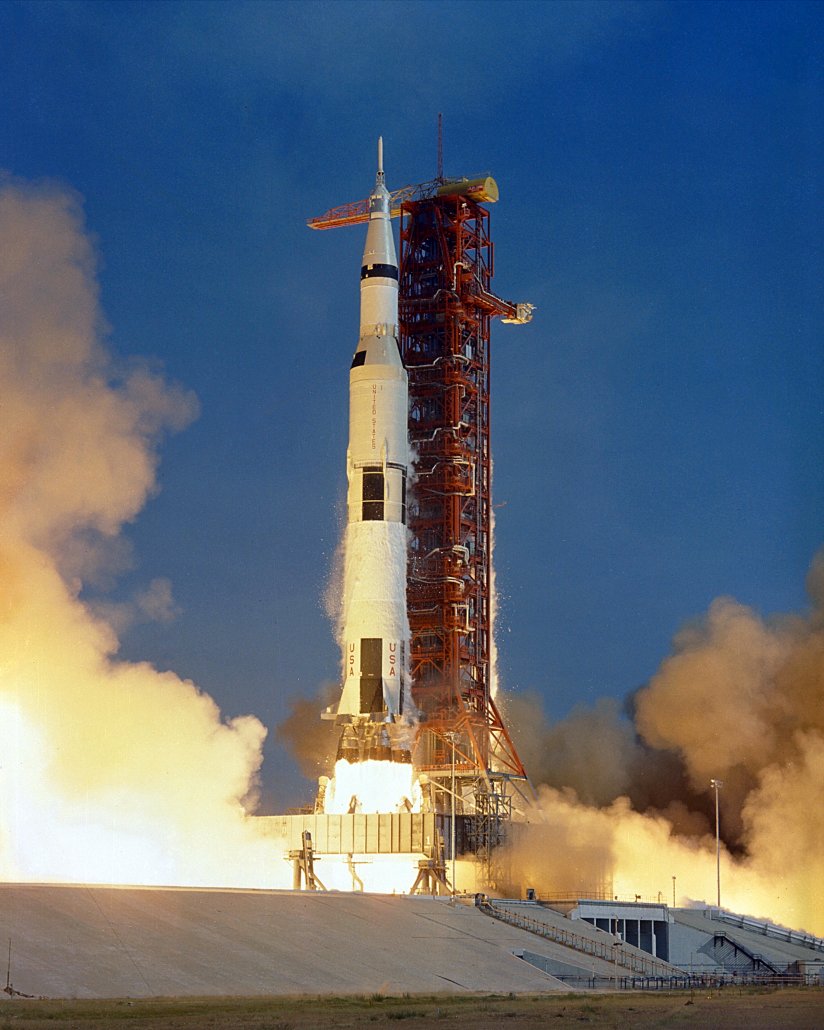
NASA, Public domain, via Wikimedia Commons
An article on the role some Erics played in the American rocket program has been beckoning me for a year or three. Everyone has heard of Operation Paperclip whereby in 1945 German scientists, some with very dubious pasts, were offered pardons and work in the USA. Quite a few of these had worked on the V2 program and were far in advance of American rocket technology. The Russians also gathered as many of these rocket scientists as they could though as we may see, they didn’t get the best of the bunch. The most famous of these paper clippers has to be Wernher von Braun. He had been in charge of the V2 program and ended up as the boss of NASA.
The story starts in the Third Reich with the development of the V2 though it was originally called the A4 or Aggregat-4 when work started, the V in V2 stood for vengeance (Vergeltung). There were years of trial and error before it worked and it cost an absolute fortune. This was another Hitler balls up. It could deliver a 1 ton warhead several hundred kilometres. Even if they had fired thousands of them it would have made little difference to the outcome of the war. The billions spent on its development would have been better used elsewhere. Hitler’s problem was he was clutching at straws, always looking for a wonder weapon that would win him the war.
By war’s end the V2 was the first and only ballistic missile and both the USA and Russia were very interested not to mention the British. The A4 project had been placed under the control of the SS, Himmler was such an empire builder. As the war came to an end von Braun and his colleagues saw the writing on the wall. They collected as much paperwork as they could, to stop the SS destroying it, and set off for Bavaria where they were picked up by the Americans and made an offer that was hard to refuse. It is told that the Americans got about 1,600 of these scientists and the Russians got over 2,000 of them. I believe the equivalent Russian offer was made at the point of a gun.
While those in the USA got on famously, well mostly, the Russian ones were second rate. Sergei Korolev, the rocket boss in Russia, sent his Germans back in 1955 as they were not really making a difference. This is an important point to remember. The Americans needed help from their Germans, the Russians not so much. In what came to be known as the Space Race the Americans were running second best until they landed a man on the moon. Until 1969 the Russians were always one step ahead.
Another important point to know is that both sides wanted to build ballistic missiles, intercontinental at that so they can bomb each other. These would be known as ICBMs. A V2 or similar did not have the range to reach the other side. How powerful did these ICBMs need to be. This depended on how heavy the nuclear bombs would be. The Americans estimated 2 tons, the Russians guessed 6 tons. This meant the Russian ICBM would be at least three times more powerful than the American version.
Initially these German scientists in the USA were sent to Huntsville in Alabama. Their job was to get the captured V2 rockets working and to teach the Americans the secrets of how they worked. They were launched from White Sands in New Mexico and 67 took off between 1946 and 1951. The last two of these were launched from a new site, Cape Canaveral in Florida. The Germans developed the V2 into the semi multi stage Redstone rocket. The two stages were not like we see these days, only a small part separated at the end of stage 1. The Redstone could carry a 4 megaton bomb 325km in 10 minutes. By this time the Air Force was more interested in fast jets rather than missiles.
The Russians were busy developing their R-7 Semyorka rocket which was a real ICBM, the Redstone was only a BM. In contrast to the Redstone’s initial 325km range, the R-7 had a range of 8,000 km. It was the R-7 that would launch both Sputnik and Yuri Gagarin.
Now we reach 1957 and both sides were looking to launch satellites into orbit. Von Braun wants to use a modified Redstone called the Jupiter-C to launch a satellite into orbit. This is rejected by Eisenhower, he really did not like the people who bombed Stan Boardman’s Granny’s chip shop. Dwight wants an American rocket to do the launch. He casts around and the Navy offer to build the Vanguard rocket. However the Vanguard took some time to get working with the usual litany of failed launches.
In May 1957 the Russians test their giant R-7 and in October they launch Sputnik into orbit much to the consternation of the world and especially the USA. Sputnik was little more than a tin can with a radio transmitter whose signal could be picked by anybody near enough to its path.
In November 1957 they put a dog into orbit, the unfortunate 3 year old Laika, a stray that had been found in Moscow, The poor dog died of hypothermia on the fourth orbit. True to form the commies in Moscow lied and said she was euthanised humanely. No such thing happened and they had no way to bring the craft safely back to earth. It was always going to be a one way trip.
By now the Americans are pulling their hair out. In December they tried a launch with a Vanguard rocket but it disappeared in a big explosion. The press christen this Kaputnik. Von Braun spots an opening and tells Eisenhower he can launch a satellite within 60 days and notwithstanding his nationality, von Braun gets the go ahead. The launch uses a modified Redstone called the Jupiter-C and Explorer 1 goes into orbit. It carries various scientific instruments and discovers the van Allen belt around the earth.
By now JFK was President and he was not so anti-German as Eisenhower had been, a stroke of luck for those in Huntsville.
This was effectively the start of the Space Race. Both sides continue launching satellites and the Americans even launched a chimpanzee named Ham who survived his ordeal. We are up to January 1961 by now and Project Mercury is underway. The Russians meanwhile played their ace in April 1961. The diminutive Yuri Gagarin did one orbit in his very small tin can. This was a very basic spacecraft called Vostok-1. Yuri was only about 5 feet tall and just about squeezed into the capsule. The details don’t really matter, the Russians had put a man into orbit and recovered him. This was a sensation at the time and yet more egg on American faces. Never mind that his capsule was so basic he had to jump out of it on the way down and finish his descent with a parachute.
A word about G forces. You are subjected to a few Gs on the way up but it is coming down where it really hits you. From orbit you may get 11 or 12 Gs on descent whereas a sub-orbital flight will give you about 15Gs. Poor old Ham’s trajectory was 1 degree out and even though he came back from orbit, he also suffered 15Gs. Ham lived to be 25 and died in a zoo in North Carolina.
May 5th 1962 Mercury-Redstone 3 launches Alan Shepherd into a sub-orbital flight. I remember this time well and I always wondered, even at the tender age of 11, why the Americans were doing sub-orbital, so just up and down, rather than orbits. The answer is that their Redstone rockets were not powerful enough to push the Mercury capsule high enough for orbit. The rockets used in the early days of space shots were basically ICBMs and if you remember the Russians had built a much more powerful one than the Americans.
During the Mercury project there were 6 manned launches. Two sub-orbital using a Redstone rocket and then four orbital using the Atlas rocket.
From 1960 onwards Wernher von Braun and his team of Germans were working at the Marshall Space Flight Centre under NASA control designing the Saturn range of rockets. These would end up launching the Apollo missions to the moon.
Operation Paperclip paid off handsomely for the Americans. The same can’t be said of the Russians who must have been rather disappointed with their haul of the master race. In their defence it must be said that the Russians under Sergei Korolev were more successful than the Americans for at least a decade during the Space Race. If you check out the various stories of the American launches it has to be said that Murphy’s Law was running in overdrive, so many things went wrong but then again, we learn from our misfortunes. The Russians have kept quiet about their problems, their 5 year plans only allowed for success.
© well_chuffed 2026