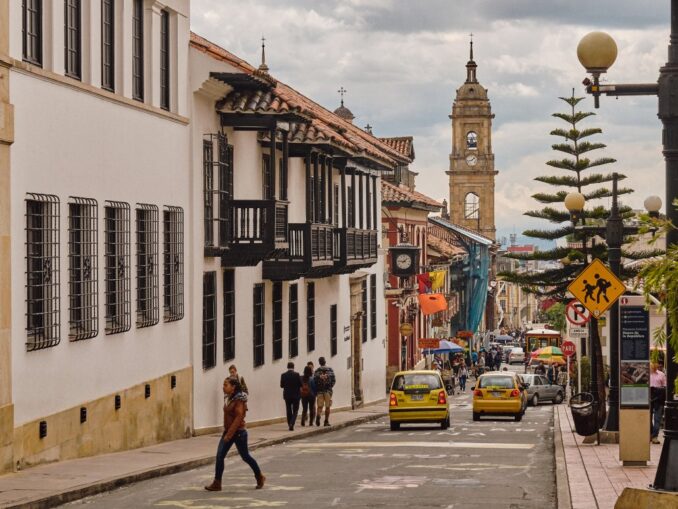
Pedro Szekely from Los Angeles, USA, CC BY-SA 2.0, via Wikimedia Commons
The director of the prison rose to greet us, and invited Tom and I to sit in the chairs in front of his desk and offered coffee. He was a tall, slim and genial grey-haired man in a cardigan, with a large potted marijuana plant behind his back, which was kind of ironic. The year was 1985, the drug wars in Colombia were at their height, and Pablo Escobar reigned supreme.
We’d moved as a family to Colombia nearly three years earlier – my wife was Colombian, we had one son, soon to be followed by another, born in Bogotá. It seemed a good idea at the time, I was bored sick of working night shifts at the BBC’s World Service radio, South America was under reported, and I’d always enjoyed my visits there. I’d also stumbled across a small television news agency called UPITN who were keen to have someone on the ground in Bogotá. They gave me a crash course in how to operate a 16 mm film camera and change the film by touch in a portable black bag, offered to pay a small monthly guarantee – enough to pay the rent anyway – with more generous payments per stories used on top. I also picked up agreements for on-use payments per story from BBC radio, The Daily Telegraph, ABC Australia and CBC in Canada. It would have to do, and seemed way more attractive than the nightly commute to the Aldwych, so we packed, rented out our flat in Clapham, and left.
And for the most part it was a good life. With two or more syndicated stories a week we could afford a large apartment with a maid, just inside the boundary of the affluent North side of Bogotá – the city was divided between the rich North and the notorious and dangerous slums of the South. We had a beaten-up Renault-4, which we used to explore the surrounding countryside, and it wasn’t long before our second son, Simon, was born.
It was a busy time for news there, but not safe, and I was soon filing many more than two stories a week. The El Salvador peace talks were being conducted in Bogotá, guerrillas from groups like the FARC, the ELN and M-19 were very active, and it was the heyday of the narco kings, with cocaine production going through the roof and people like Pablo Escobar and Carlos Lehder holding sway. I had contacts with most of the groups and the politicians. I interviewed President Betancur, dined with the Justice Minister, Lara Bonilla, on the night of his assassination, and went to Lehder’s house for a drug-fuelled celebration after he formed a political party. He was later arrested and extradited to spend years in a US prison, before he finally got cancer and was sent to Germany to die.
So how did Tom and I – he was a laid-back California type who was Time Magazine’s man in Colombia, although not a staffer – come to be sitting in the director’s office in La Modelo prison, known to inmates as The White University (La Universidad Blanco)? Well obviously, a lot of the stories we covered involved the drugs trade, and I had been commissioned by UPITN to do a story which would show that the government’s much-vaunted policy of spraying pesticides on marijuana and cocaine plantations was a failure. The pesticides killed just about everything, including crops of potatoes, maize and coffee, the peasants hated them, but most of the drug plantations were well hidden in the vast jungles of the country, and supply was barely affected.
Tom had become one of my better friends on the local journalistic circle, and he decided to join me as I prepared to go and film a house in the lawless southern slums of Bogotá which was packed to the gunnels with bales of marijuana. My bright yellow car was covered in press stickers, and I had even taken my older son, Daniel, along with me, strapped into his baby seat in the back – after all, it was supposed to be a safe prearranged shoot, and we weren’t expecting any problems.
We found the house and were ushered inside, but I had barely begun filming when car horns started bleating outside and half a dozen officers from F-2, Colombia’s specialist anti-drug unit, burst in. Everyone was arrested.
“What do we do with the gringos?” asked a junior officer.
“I hate fucking gringos; let’s do them,” the captain, a thin-lipped man clutching a pistol, snapped viciously.
“What about the kid?’
“We have institutions for kids like that.”
Fortunately, a sympathetic officer took down the number of my brother-in-law Gato and went to call him, and he was soon at the station to collect Daniel.
First, we endured two days and a night at F-2’s headquarters, separated and sitting in straight-backed chairs and repeatedly being told to sign our ‘confessions’, except there was nothing to confess. Luckily, I had kept the telex assigning me to the story. We weren’t allowed to sleep, no food was provided, and further down the corridor we could hear the shouts and screams of other prisoners being physically abused. Eventually the local journalists’ union came to the rescue, and I had a visit from the British consul. He was friendly and sympathetic but a bit of a weed and not a lot of use beyond guaranteeing that I would be properly looked after and treated fairly. Tom had less success with the American embassy, who didn’t send someone until more than a week later, by which time we were in La Modelo.
The prison was opened in 1960, a sprawling white-walled supposedly high-security complex between the Western and Southern suburbs of the city. Guards with rifles manned the numerous watch towers, but the guards within were only armed with batons. At the time we entered its formidable walls the place was becoming notorious for murder, corruption, extortion, organised crime and factional warfare. It was severely overcrowded, and the prisoners weren’t just divided by cells – they were divided into factions, captured guerrillas in one area, right-wing paramilitaries in another, drug traffickers in another, and so on. Sometimes factional warfare would break out, with shootings and even grenades being deployed. I doubt we would have survived in one of these general areas. Many years later the dismembered remains of at least one hundred prisoners were found in the building’s drainpipes. Luckily, we were put into a small special wing for ‘celebrity prisoners.’ We each had our own cell and could order a bed to be made (Tom did, but I just made do with a mattress on the cold floor, making a bed smacked too much of permanence to me), and we could buy extra blankets.
We were sharing our wing with a gang accused of stealing £13-million from the Colombian Defence Ministry’s bank account in London, so, despite being roused for a cold shower at six every morning, we were relatively comfortable. We had a television with a VHS player and an exercise bicycle, and we could go into the main prison courtyard whenever we wanted. But losing one’s freedom is a harsh experience, and seeing my wife and kids through a mesh wire fence was deeply unsettling. I would spend hours on end just sleeping to try and shut out the nightmare.
The main courtyard was like a microcosm of the outside world with a regular underground economy – there were restaurant franchises, shops, laundry services, pool tables and all sort of goods on sale. Protection could be bought, while extortion also generated revenue; in short, La Modelo was a valuable territory in which control meant money and power. At the top of the pile were the most powerful inmates, the caciques, who wielded genuine authority and lived in cells with en suite facilities – if one was released, these cells would be sold on for thousands of dollars, as would the various franchises for services.
Tom and I were also a big story in the local media, and television crews and reporters regularly came in to interview us, dubbing us the ‘narco periodistas’, or narco journalists. True to form, the BBC frantically backed away from having anything to do with me, but UPITN stepped up and dispatched their New York bureau chief to Bogotá. She was a fearsome French woman, infamous in the company’s folklore for the time when, during a blazing row with another senior manager, he shouted at her that she was ‘nothing more than a Belgian whore’; to which insult she retorted instantly “I am NOT Belgian!”
Certainly, the colonel handling our case was no match for her. There was no evidence against either of us except that we had been filming in the house stuffed with marijuana when it was raided, and I could prove with my precious telex that I’d been assigned to the story. After ten days of my saviour bending the colonel’s ear, he finally capitulated and signed my release papers. I was watching ‘Flashdance’ when a guard came into our cell block and told me I was free to go. To this day, every time I hear the theme tune to that movie it takes me right back to La Modelo.
In all I’d spent six weeks without charge in the ‘White University’ and emerged stick thin. Tom was not so lucky – like the BBC, Time Magazine adopted a hands-off approach, and he ended up serving three months before being freed. There was no habeas corpus in Colombia at the time; the country was under emergency rule and any suspect could be held for six months without charge.
The experience had shaken me, and then I started getting phone calls with death threats in the middle of the night and decided that after three years the Colombian adventure was over. It’s a stunningly beautiful country, but it was going through a bad time. I returned to London and took a desk job with UPITN, I was eternally grateful to them and stayed with them for many years, eventually becoming their Vice President for Europe after ITN sold their stake and they became WTN (Worldwide Television News). And Europe meant not just East and West Europe, but also the whole of the former USSR, paving the way for many more adventures in the years to come.
When Tom did eventually get out, he and his wife Zuma were killed in a road accident within weeks. Some former colleagues in Bogotá claimed the accident was suspicious. They left three young daughters, who were taken into state care. I have no idea what happened to them
© Porkpie November 2026