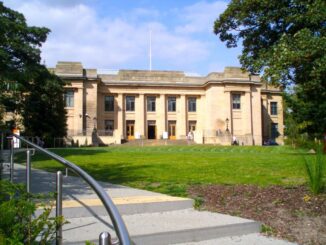
Lancelot Brown was a Northumbrian gardener who spent forty-odd years digging lakes, shifting hills and moving the odd village for a good chunk of the English aristocracy, all so that it would look as if nobody had touched a thing. He also managed to fall out with the King’s architect over a vegetable patch.
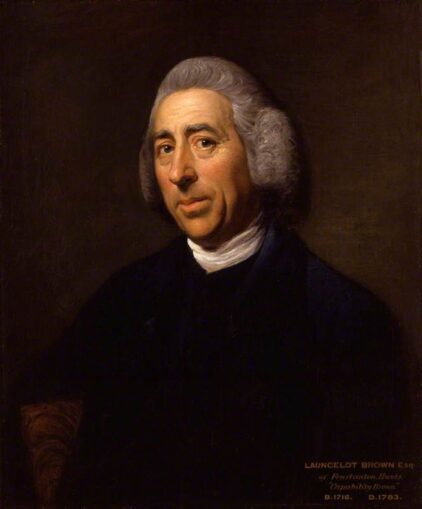
Nathaniel Dance-Holland, Public domain, via Wikimedia Commons
Kirkharle
Brown was baptised on 30 August 1716 at St Wilfrid’s in Kirkharle, a tiny place about 20 miles north-west of Newcastle, where his father farmed and worked as land agent for the local squire, Sir William Loraine. He left the village school at Cambo at 16 and spent the next seven years or so working in the gardens at Kirkharle Hall.
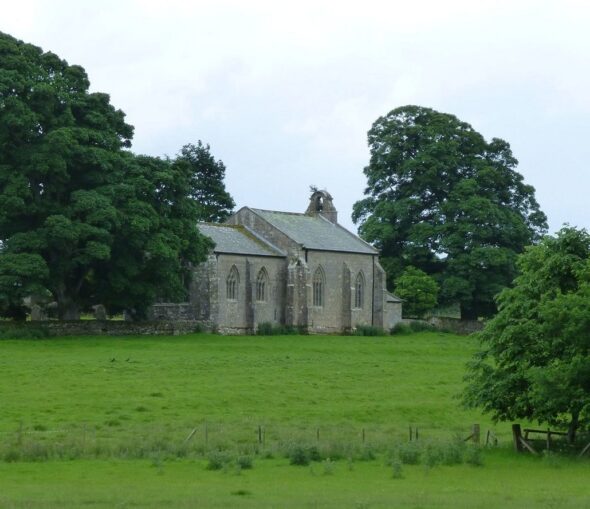
© Copyright Russel Wills and licensed for reuse under this Creative Commons Licence.
Loraine was what the Georgians called an improver, which meant he couldn’t leave anything alone. One of his contributions to the scenery, put up in 1728, was a stone in a field marking the spot where one of his ancestors had been barbarously murdered by the Scots in 1483, on his way home from church. That was 245 years earlier, which is a long time to hold a grudge, even in Northumberland.
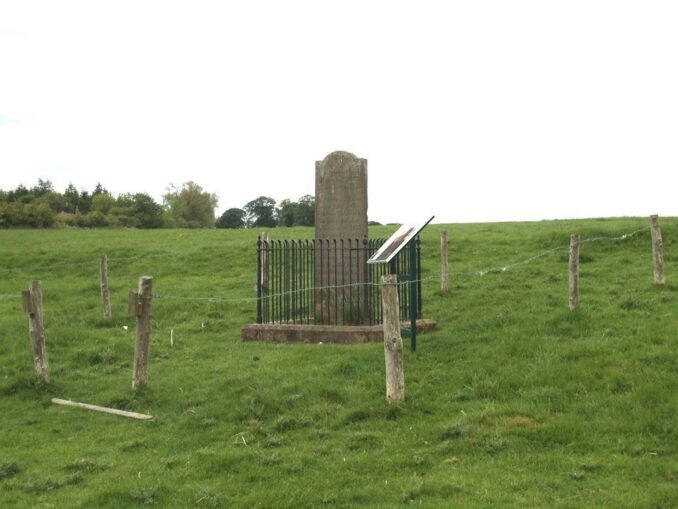
© Copyright Bill Henderson and licensed for reuse under this Creative Commons Licence.
Stowe
In 1739, aged 23, he headed south, and by 1741 he was at Stowe in Buckinghamshire, one of the most famous gardens in England, where he became Lord Cobham’s head gardener and stayed for ten years.
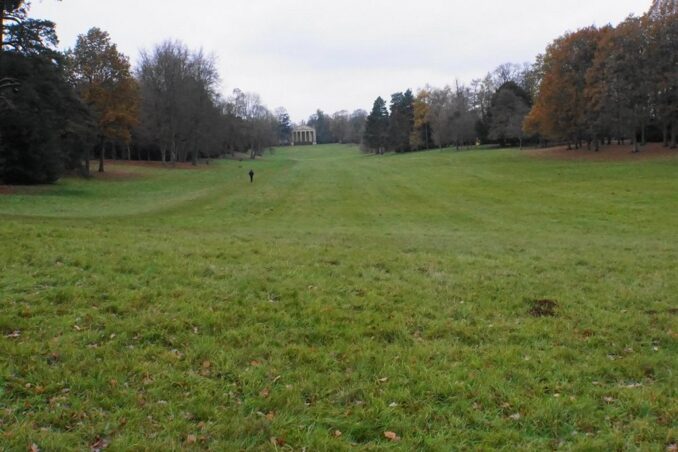
© Copyright Bill Boaden and licensed for reuse under this Creative Commons Licence.
Before long he was doing jobs for Cobham’s friends as well, and in 1751 Horace Walpole, the Prime Minister’s son and the great gardening gossip of the day, wrote that Warwick Castle had been “well laid out by one Brown who has set up on a few ideas of Kent and Mr. Southcote”, which is about as backhanded as compliments come. Keep an eye on Walpole though, as he turns up again at the end.
Where the “Capability” came from
The usual story is that he told clients their estates had great “capabilities”, by which he meant room for improvement (and, I suspect, room for a large bill).
He wasn’t shy with the clients either. In 1776 the Morning Post told the story of a gentleman in Staffordshire “who had more money than land” showing him round the estate. Brown said a hill needed planting with clumps of trees and a valley needed flooding, and both times the gentleman said he couldn’t, because that bit belonged to his neighbour, Mr Jennings. Brown’s parting words were: “Your most humble servant… I think Mr. Jennings should have sent for me, not you.”
Croome (out of a bog)
Croome, in Worcestershire, was his first big job on his own account, from 1751. The old village and church spoiled Lord Coventry’s view, so they were swept away and the village rebuilt out of sight behind some trees (planning objections not really being a thing in 1751), and Brown had the best part of two miles of river dug by hand.
We know what the ground was like beforehand because, after Brown died, Coventry put up a monument by the water “to the memory of Lancelot Brown, who by the powers of his inimitable and creative genius formed this garden scene out of a morass”. A morass is a bog, so that is an earl admitting, in stone, that his garden used to be one.
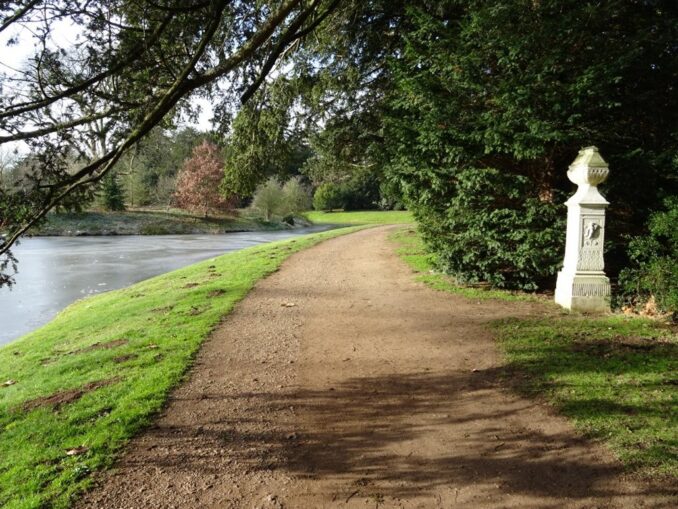
Path passing the ‘Capability’ Brown memorial, Croome by Philip Halling, CC BY-SA 2.0, via Wikimedia Commons
Blenheim (and a bridge with 33 rooms)
Blenheim Palace was the nation’s thank-you present to the Duke of Marlborough for beating the French, and it came with a bridge by Sir John Vanbrugh which was, to put it kindly, a bit much. It crossed the Glyme, which is a very small river, and it had rooms inside it. The Duchess told a friend she had counted 33. I am still wondering what anybody does with 33 rooms inside a bridge.
In 1764 Brown was called in. He dammed the Glyme and flooded the valley, so that the giant bridge finally had a lake under it big enough to justify it, and the bottom rooms ended up under water.
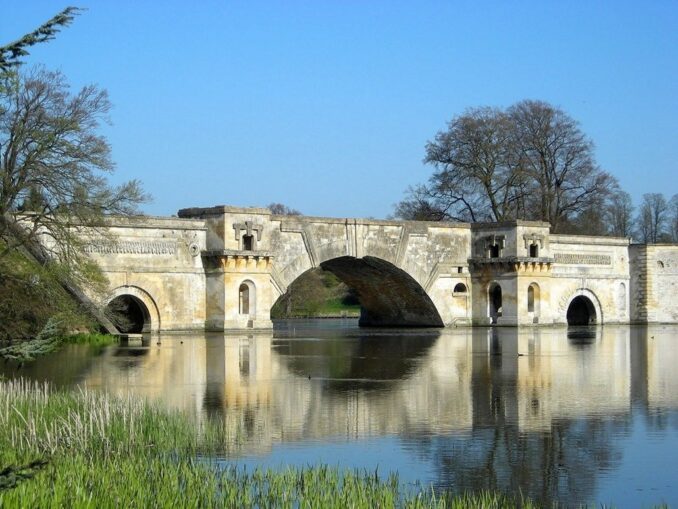
© Copyright Mark Percy and licensed for reuse under this Creative Commons Licence.
The King’s gardener (and the pineapples)
Also in 1764 he was made George III’s chief gardener at Hampton Court, with a house in the palace grounds and an extra £100 a year for growing pineapples. Yes, pineapples.
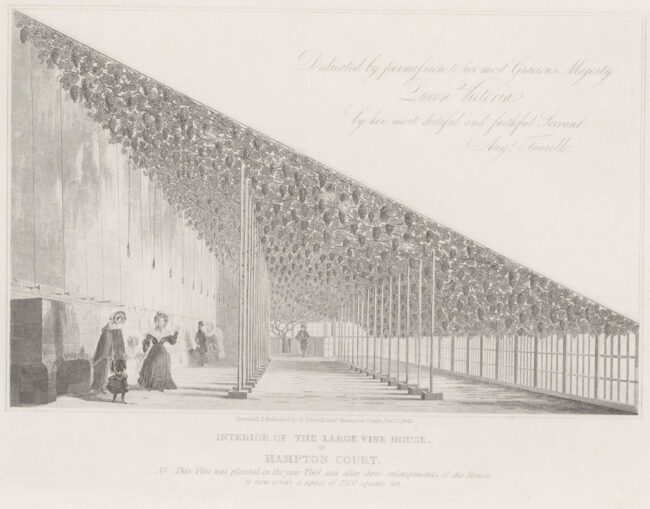
S. Turrell jr., Rijksmuseum, Public domain (CC0).
The feud over a vegetable patch
Not everyone in the King’s service was a fan. In July 1770 the architect William Chambers, who was Comptroller of the King’s Works, inspected Brown’s gardens and declared them “in ruinous condition”. Brown ignored a polite letter about it and then got a stiff one, and his reply survives in the National Archives:
“I have lived long enough not to wonder at anything, therefore it did not surprise me… You will be so good as to inform the Gentlemen of the Board of Works That Pique I pity, That the Insolence of Office I Despise, That Ideal Power I laugh at, & That real Power I will ever disarm by doing my Duty.”
This was how you told a senior civil servant to get lost in 1770. He then demanded that Chambers hand back the half-acre of the royal kitchen garden which Chambers had been using to grow his own vegetables. Chambers hung on to it until 1783, the year Brown died.
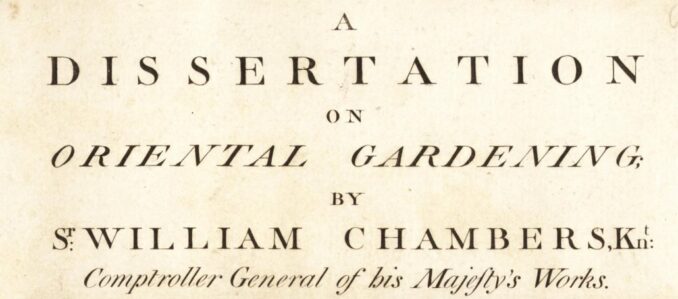
William Chambers (London, 1772), Getty Research Institute copy, Public domain, via Internet Archive.
The best dig of the lot came from the poet Richard Owen Cambridge. Brown was “vapouring one day” about how much he had changed the face of the country, when Cambridge said, “with great gravity”: “Mr. Brown, I very earnestly wish that I may die before you.” “Why so?” said Brown. “Because I should like to see heaven before you had improved it.”
Hertford Street
On 6 February 1783, on his way back from visiting Lord Coventry, Brown collapsed at the door of his daughter’s house in Hertford Street, Mayfair, and died. He was 66.
Horace Walpole, as promised, passed the news on to a friend like this: “Your Dryads must go into black gloves, madam: their father-in-law, Lady Nature’s second husband, is dead!” Dryads are tree nymphs, black gloves were funeral wear, and a father-in-law in those days could also mean a stepfather, so Walpole had Brown married to Mother Nature with the trees as his stepchildren. That is quite a promotion from “one Brown”.
The King took it rather differently. According to the poet William Mason, George III went over to Richmond gardens and told the under-gardener, “in a tone of great satisfaction”: “Brown is dead: now Mellicant, you and I can do here what we please.” Mason didn’t much like the King, so make of that what you will, but it does sound like a man who had been losing arguments with his gardener for 19 years.
So, to summarise
So, a gardener from Kirkharle spent forty-odd years on what he once called “the hideing what is disagreeable and shewing what is beautifull” (his spelling, not mine), at probably well over 200 estates by the latest count. He didn’t forget Northumberland either, as from the 1760s he worked for the Duke of Northumberland at Alnwick Castle, seat of the family of Harry Hotspur (remember him?).
As for Kirkharle, in 1980 the owners found a plan for the grounds, attributed to Brown and probably drawn in the 1760s, tucked away in a chest of drawers. In 2010 they finally dug the lake, the best part of 250 years late, which is going some even for a builder.
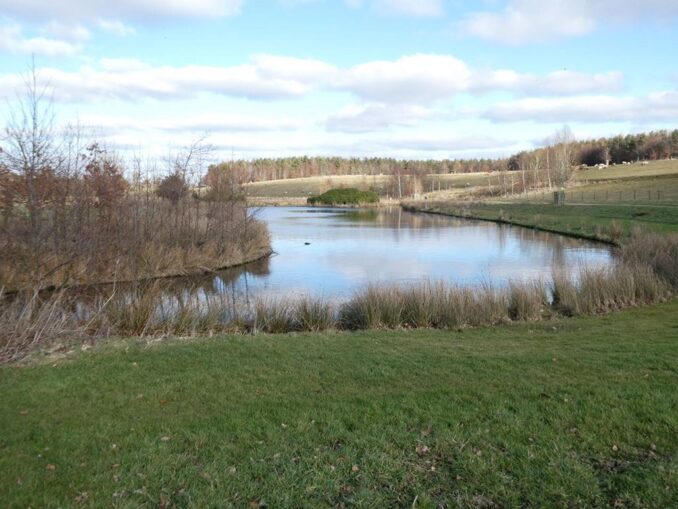
The Lake at Kirkharle by Oliver Dixon, CC BY-SA 2.0, via Wikimedia Commons
And in 2018 Westminster Abbey gave him a memorial fountain in its cloister, designed with some help from Alan Titchmarsh (yes, him off the telly). The verse round the side of it is by Horace Walpole, who seems to have come round to him in the end.
Lady Nature, as far as I know, never remarried.
© Paranoid Android 2026