
George Biddell Airy was Astronomer Royal for 46 years. He drew the line the whole world sets its clocks by, weighed the Earth from the bottom of a coal pit in South Shields and never, as far as anyone can tell, threw away a single piece of paper. He also lost Britain a planet and told the government that Babbage’s calculating machine was worthless.
Every time you check a map or set your watch, you are quietly interacting with the legacy of this man. Longitude zero, the line the entire planet measures itself against, runs through the eyepiece of a telescope George Airy bolted to the floor of Greenwich Observatory. The world’s time zones, your flight times, the clock on your oven: trace any of it back far enough and you land on a brass instrument lined up by a man from Alnwick.
He was probably the most powerful scientist in Victorian Britain. He was also, by various measures, the most annoying.
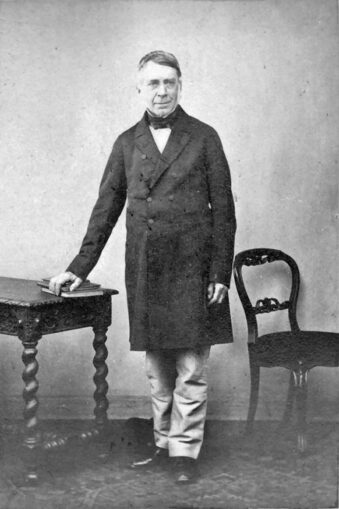
Public domain
The man who never threw anything away
Airy was born in Alnwick in July 1801, into a family that could trace its name back to 14th-century Westmorland. His father, an excise man, was moved to Hereford when George was about fifteen months old, and the family went with him.
He went to grammar school in Colchester, then to Trinity College, Cambridge, where he finished top of his entire year in 1823. Senior Wrangler, they called it. The best mathematician of his cohort, full stop.
His defining trait, though, was order. Pathological, almost beautiful order.
From his student days to his deathbed, Airy kept everything. Every letter, every bill, every abandoned calculation. His son wrote that he seems “not to have destroyed a document of any kind whatever”, right down to the “counterfoils of old cheque-books” and “notes for tradesmen”, all “carefully preserved in the most complete order”. He even wrote his autobiography up to date at the age of twenty-one, presumably so that it could be filed.
His son also records that he once spent a whole afternoon writing the word “Empty” on large cards, to be nailed onto a great number of empty packing boxes, because they kept getting mixed up with the full ones. He kept his household accounts by double-entry bookkeeping, the system shops use, and “valued extremely the order of book-keeping”. The man loved admin the way other people love wine.
The filing, however, later came back to bite him.
The lens he built for his own eyeballs
At Cambridge, Airy had a problem. His eyesight was terrible. He had astigmatism, where the eye focuses unevenly and the world goes soft at the edges.
So in 1824, aged 23, he sat down and worked out the maths for a cylindrical lens that would cancel the blur. Then he had one ground by an optician in Ipswich and put it in front of his own eye. It worked. A Frenchman had patented a cylindrical lens a few years earlier, but Airy is usually credited as the first to work out the maths and fix astigmatism properly, and the very same correction sits in millions of spectacle prescriptions today. If your glasses have a “cyl” figure on them, you can thank a Northumberland astronomer.
Forty-six years and a spotless desk at Greenwich
In 1835 Airy became the seventh Astronomer Royal, running the Royal Observatory at Greenwich. He held the post for 46 years, which is roughly forever in any job.
Before long he was the man Whitehall called whenever a problem had numbers in it. He set the accuracy standard for the great clock at Westminster, the one with the bell now nicknamed Big Ben, demanding it be accurate to within one second when striking the hour and report to Greenwich by telegraph twice a day. That obsession is why the clock is as good as it is.
Victorian governments also kept trying to knight him, and he kept saying no. He turned it down in 1835 and again in 1847. In 1863 he actually said yes, then wrote back to ask whether there would be any fees, since “to persons like myself of small fortune an honour may sometimes be somewhat dear”. Told it would cost about £30, he decided that “an unsought honour may be an incumbrance” and turned it down for a third time. The man who kept double-entry accounts for pleasure was always going to check the bill first.
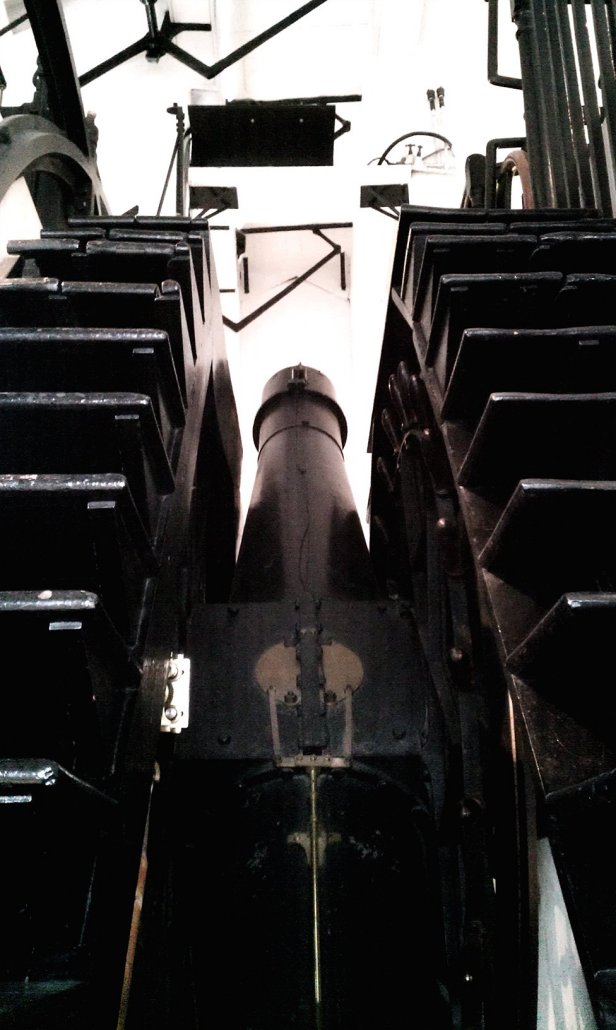
Andres Rueda, CC BY 2.0, via Wikimedia Commons
Airy’s Transit Circle at Greenwich, the telescope that fixed the prime meridian. Andres Rueda, CC BY 2.0, via Wikimedia Commons.
Down a pit to weigh the world
Here is a properly North East part of the story. In 1854, Airy wanted to measure the density of the whole Earth. His method was wonderfully blunt: dangle a pendulum at the top of a deep hole and an identical one at the bottom, and time how each swings. Gravity is a touch stronger lower down, so the pendulums tick at slightly different rates, and from that gap you can work out the mass of the planet under your feet.
The deep hole he chose was Harton Colliery in South Shields, about 380 metres straight down. He found that gravity at the bottom beat gravity at the top by one part in 19,286, and from that he calculated the Earth’s density at roughly 6.6 times that of water. Modern figures sit a bit lower, but for a man swinging pendulums in a pit it was a remarkable effort. He had tried the same trick twice in Cornwall years earlier and been beaten once by flooding and once by fire, when the basket holding all his instruments was “brought up to the surface (in my presence) on fire”, which I have to say was rather unfortunate.
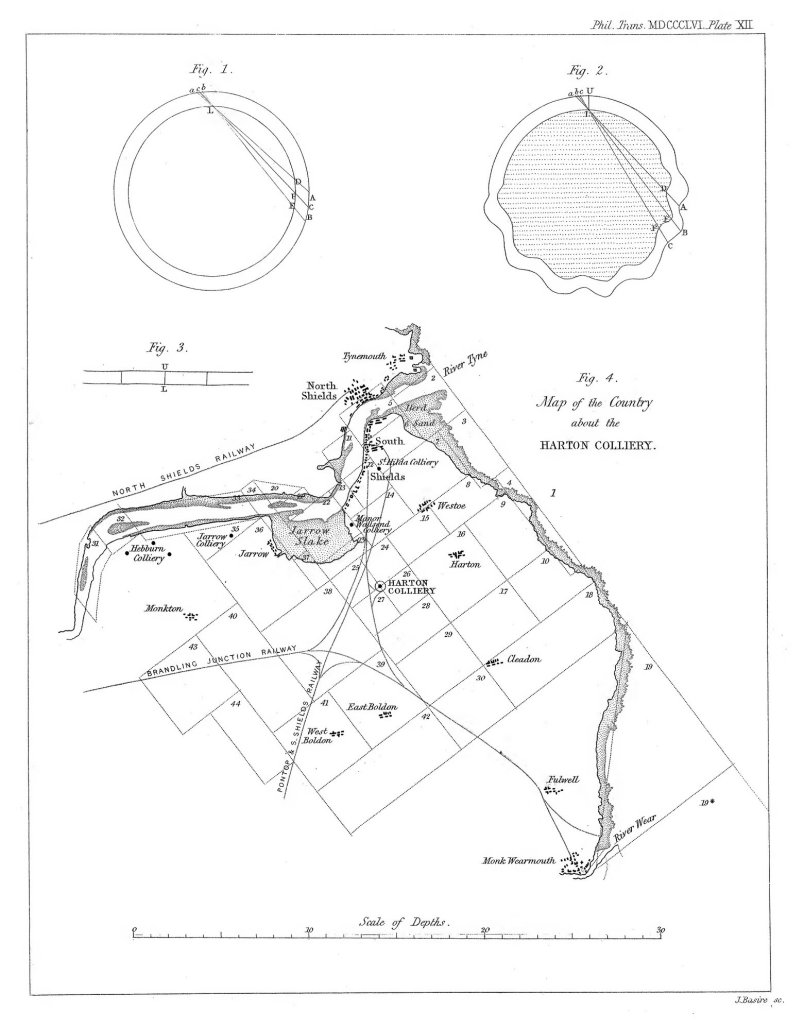
George Biddell Airy, Public domain, via Wikimedia Commons
The planet that got away
Now the famous disaster. In the 1840s, astronomers noticed that Uranus was not moving the way the maths said it should [Editorial note – this is meant to be a half-serious article, so no innuendos at this point please]. Something unseen was tugging at it [what did I just say?]. A young Cambridge mathematician named John Couch Adams ground through the calculations and predicted where this hidden planet ought to be sitting.
Adams tried to bring his prediction to Airy in person. He called at Greenwich once while Airy was in France, then twice in a single October afternoon, and was told first that the Astronomer Royal was out and then that the family was at dinner. So he left his figures behind and went home. And here the Airy, the man who filed his own cheque-book counterfoils, did something baffling. He effectively filed it under “later.”
He fired back a fussy technical question. Adams, shy and a bit chaotic, never replied. Airy did not chase him. When a search finally began, the following July, it went to James Challis at Cambridge, who recorded the planet twice that August without noticing what he was looking at.
Across the Channel, the Frenchman Urbain Le Verrier ran the same sums. He handed his prediction to a Berlin observatory, and on 23 September 1846 they pointed a telescope where he told them and found Neptune within a degree of the spot. France got the planet. Britain got a national face-palm and a decades-long argument about who really deserved the credit. Airy’s own summary of the aftermath: “I was abused most savagely both by English and French.”
There is, however, a final twist. The Greenwich “Neptune file,” the paper trail of who knew what and when, vanished for decades and only resurfaced in 1998, in Chile, among the papers of an astronomer who had borrowed it and never given it back. In the end, even Airy’s beloved paperwork escaped him.

NASA, Public domain, via Wikimedia Commons
How he helped kill off Babbage’s engine
This is the one that really stings.
Charles Babbage spent decades designing mechanical computers, the Difference Engine and then the wildly ambitious Analytical Engine, a programmable machine dreamt up more than a hundred years before its time. He needed government money to build them.
So the government asked its top scientific adviser whether these contraptions were worth the cash. That adviser was Airy. In September 1842 the Chancellor of the Exchequer asked his opinion of Babbage’s machine, and Airy’s own note says he replied “giving my opinion that it was worthless.” The funding was cut two months later.
We will never know what might have happened if Britain had built a working computer in the 1840s. Airy, a man who adored a tidy ledger, looked at Babbage’s machines and saw a money pit. In fairness, Babbage had a habit of finishing nothing: the government had already sunk £17,000 into the Difference Engine, work on it had stopped nine years earlier, and Babbage had wandered off to design a bigger one. But “worthless” is a brutal word to get wrong, as the Science Museum showed in 1991 when it built his later Difference Engine No. 2 from his own drawings. It worked.
The line that rules the world
In 1851 Airy installed a new instrument at Greenwich called the Transit Circle, a telescope locked so it could only swing north and south, used to time stars crossing the meridian with ferocious precision. The exact spot it pointed became Greenwich’s official line of zero longitude.
For centuries every country had measured longitude from its own capital, which turned maps and timetables into a polyglot mess. In October 1884, 41 delegates from 25 countries gathered in Washington for the International Meridian Conference and voted to run the prime meridian of the whole world straight through Airy’s transit circle. France abstained, and when it finally gave in, in 1911, it defined its legal time as Paris time slowed by nine minutes and twenty-one seconds, which is Greenwich time without having to say the word. So very petty and also so very French.
That decision was never undone. Stand at Greenwich today and you can plant a foot either side of a brass strip set into the ground. That strip is Airy’s. Your phone will insist you are standing about 102 metres west of zero, because the satellites measure from the centre of the Earth, Airy lined his telescope up using a bowl of mercury, and the two don’t quite agree.
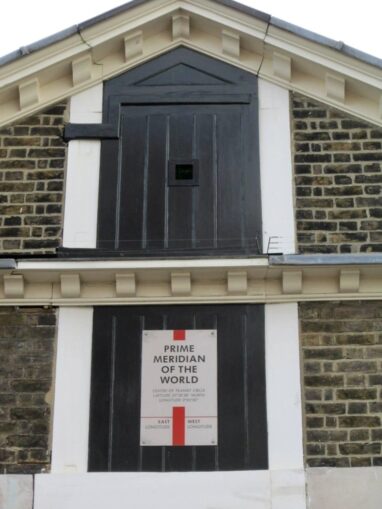
Ank Kumar, CC BY-SA 4.0, via Wikimedia Commons
The most important Englishman you would cross the road to avoid
Airy finally accepted a knighthood in 1872, at the fourth time of asking, and died in January 1892 at the age of 90. He outlived most of his rivals and, you suspect, filed every last receipt along the way.
He was difficult, controlling, and flatly wrong about some enormous things. He arguably cost Britain a planet and talked the government out of Babbage’s engine. But he also corrected his own eyes with nothing but maths, dragged a failing observatory into being the most exact on Earth, weighed the planet down a Tyneside coal mine, and drew the one line the modern world still navigates by.
If you are ever in Greenwich, I would strongly recommend a visit to the Royal Observatory to stand with a foot either side of his line. Just don’t check your phone whilst you’re there, as it will tell you you’re standing in the wrong place.
© Paranoid Android 2026




.jpg)