The Tank Museum itself is worth a visit, regardless of whether there’s an event taking place or not. It’s a very large museum and could easily take a full
day to explore if you want to see everything. We headed to the restaurant for a drink, only to find it was reserved for unlimited ticket holders. There is a smaller café downstairs, so it wasn’t too much of an issue. On non-event days, the restaurant is open to everyone.
Refreshed, it was onwards into the exhibits.
The first exhibits you encounter naturally focus on the early days of tanks during WWI. There’s a recruitment office for the Tommy, with scenes showing the journey from signing up, receiving a uniform and eventually heading out to the trenches.
It’s quite a sobering experience when you see the trench recreations, followed by a Mark I tank breaching a trench while two terrified German soldiers lob potato mashers at it. It wasn’t going to stop the tank, so their best option was probably to leg it. Even JwP could have outrun a Mark I, given its maximum speed of just 3.7 mph.
After the trench scenes, the next area opens up into a collection of WWI era tanks, where I relearned that there were male and female tank types but no trans tanks, which was nice.
The male types carried the heavier guns and acted as battering rams through the trenches. The female types were there to support the males (as it should be /s), armed only with machine guns to suppress the Hun infantry.
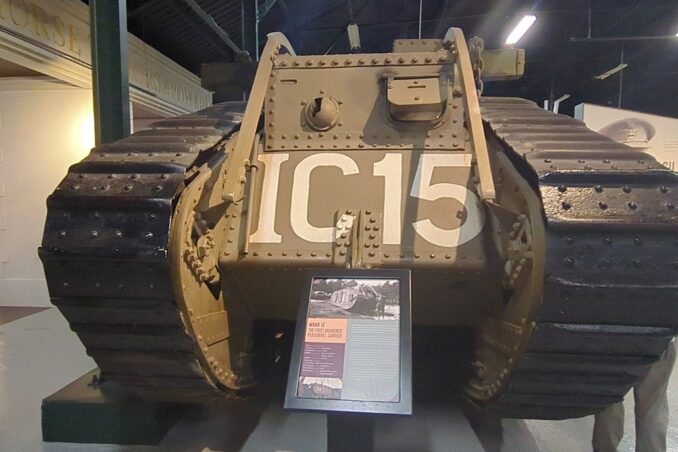
None of the tanks in the museum are hidden behind velvet ropes; you can get close to everything. There is also the first armoured personnel carrier, the Mark IX, which provides an interesting contrast to the Warrior vehicle mentioned earlier.
I can’t remember whether it was this one or another type that you can climb inside, but you can get into one of them. With a large engine, no comforts and very limited space, it must have been hot, cramped and a thing of nightmares during battle.
© foxes1884 2026
After seeing WWI warfare, there’s an area telling the story of horses and the transition from the cavalry of old at the start of The Great War to their later support and logistics roles as the reality of trench warfare became clear, even to the château generals’ miles behind the lines.
A cavalry charge was as terrifying as ever, but no match for the German Maxim or British Vickers machine guns. Regiments were gradually mechanised into armoured units as the war progressed.
Millions of horses died during WWI, along with the men. The museum does an excellent job of educating visitors on the human and animal cost of the war. With the arrival of the tank, it was at least some relief for the horse.
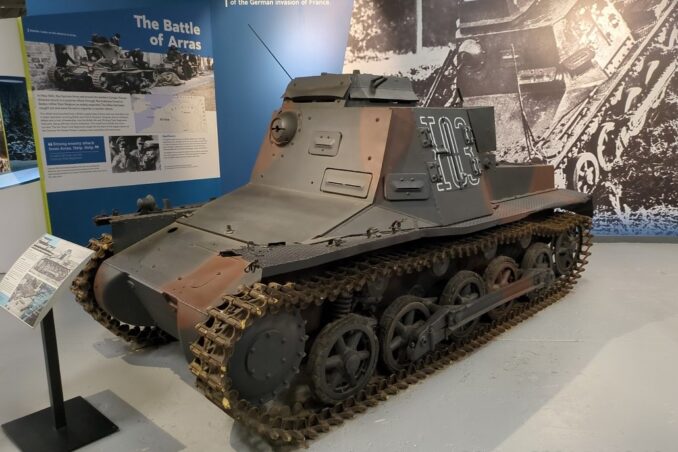
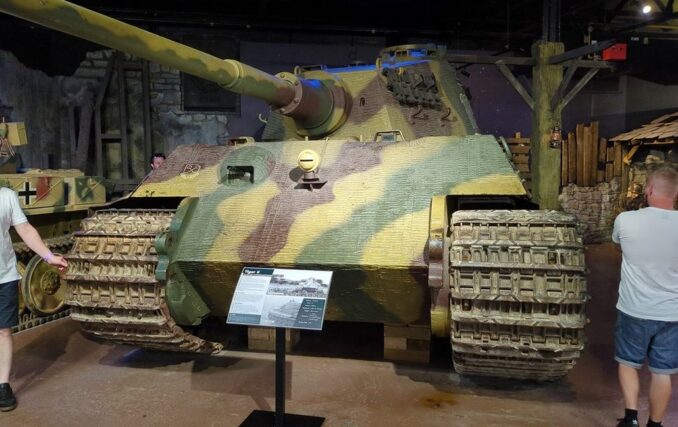
Next, you enter the WWII zone, and its tanks galore from all the belligerents. There are tanks from early in the war, like this Panzer I command tank (a minnow of the battlefield), through to the Tiger II (Königstiger).
© foxes1884 2026
© foxes1884 2026
Any WWII tank you can name is likely to be there: Churchill, T-34, Sherman’s and many more.
After WWII, you move into the Cold War and experimental tank areas, featuring NATO versus Warsaw Pact vehicles. There is a British TOG2 prototype from the early 1940s, which never made it into service because it was designed with trench warfare in mind, tactics that had become obsolete by the time WWII unfolded.
The TOG2 gained fame with video gamers as it appears in World of Tanks and War Thunder, becoming something of a much-loved joke unit due to its limitations.
This is also the area with the café and somewhere to have a sit down. There is an educational display area too, which, on my last visit, focused on vehicles and the life of the British Army in Afghanistan. This time, it was a display about the war in Ukraine from the perspective of the Ukrainians. Given the British establishment’s fever dream of a major war with Russia, it’s hardly surprising it’s there, if perhaps a little forced, but that’s another topic entirely. Moving on…
There is a section featuring a Centurion battle tank cut in half, providing an insight into tank design.
The final main section on the ground floor is the Tank Story area, which, as the name suggests, tells the story of the development of armoured vehicles from WWI to the present day.
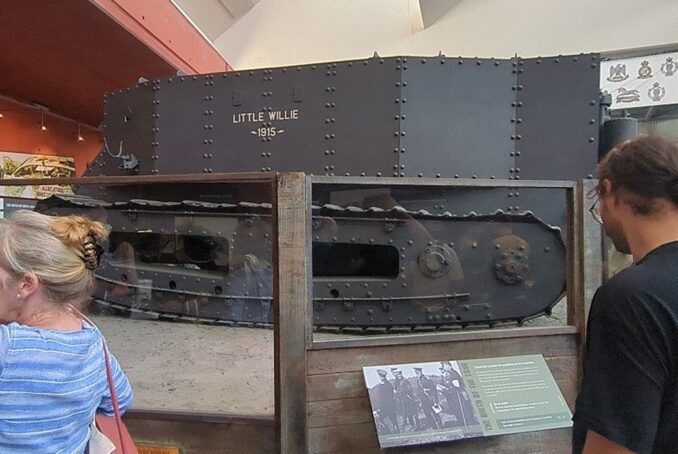
If you’re still following the guided path on the floor and haven’t had COVID flashbacks, the route will take you to Little Willie – the first working tank, built in 1915, and the progenitor of the Mark I tanks deployed on the Western Front.
© foxes1884 2026
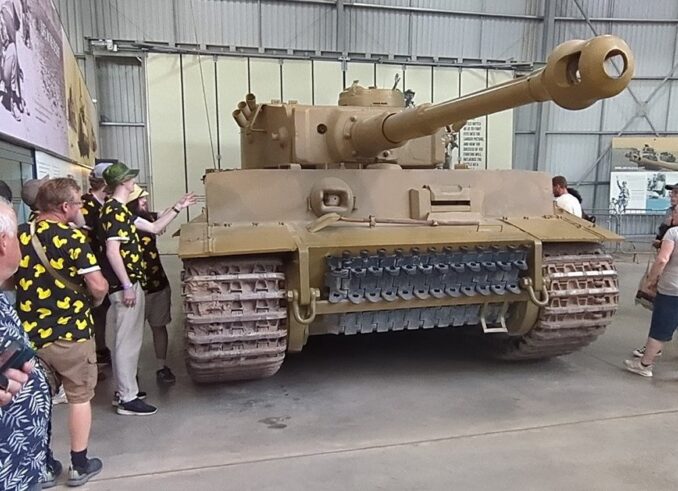
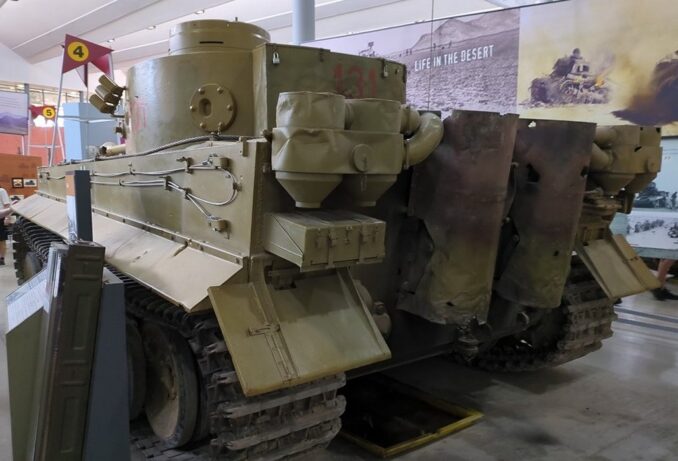
The star of the area is obviously the Tiger I (Panzerkampfwagen VI Ausführung E). It’s hard to get a shot of Tiger 131 without people in the frame, as the picture shows.
The chaps on the left in the colourful tops were either Germans or Austrians; I couldn’t see any beach towels, but I’d guess Germans. It looked like one of them was recounting how Großpapa was a driver or loader on a Tiger.
© foxes1884 2026
© foxes1884 2026
The 131 is a rare beast, as it’s the only Tiger I left that is currently running. The museum is raising money for the restoration of a Tiger II – its bigger brother. There’s also a T-34 on display, along with the German response to the T-34, which was the Panther. Here’s a picture of it for GQ.
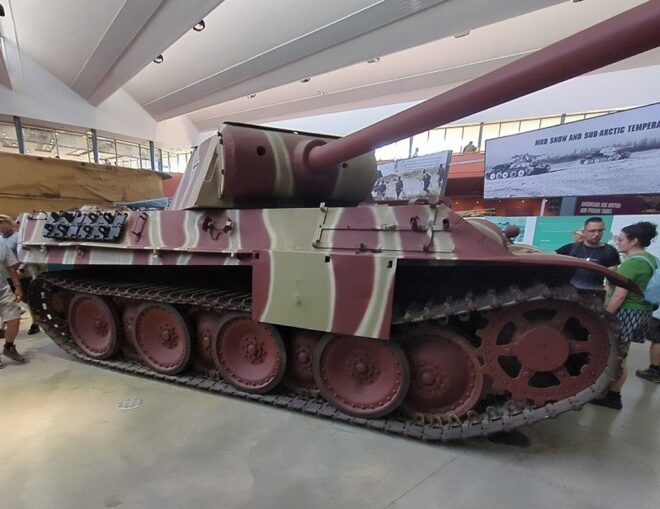
© foxes1884 2026
The American tanks are heavily represented, as you would expect, with Sherman Firefly and Chaffee. However, there are also Japanese and Italian tanks on display (naturally, the Italian ones were captured while driving in reverse).
And that’s the museum done, back out to the TANKFEST arena.
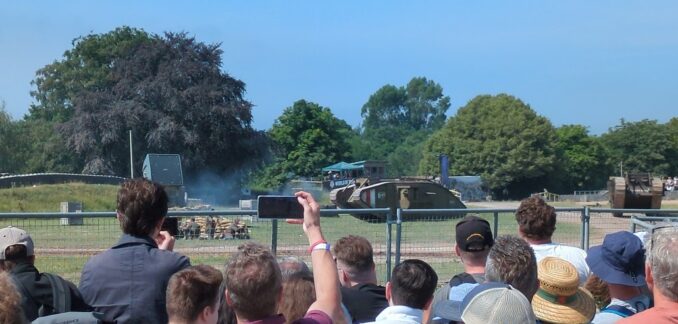
Back at the arena to catch a WWI battle re-enactment, complete with infantry and tanks. Machine guns blaring and explosions all around.
Seeing a couple of the tanks rolling forward at a snail’s pace gave some impression of what it must have looked like to see a line of them pushing through no man’s land. A vision of smoke, dust and hell. With the battle won and the arena cleared, it was time to escape the heat and retreat to the sheds behind us.
© foxes1884 2026
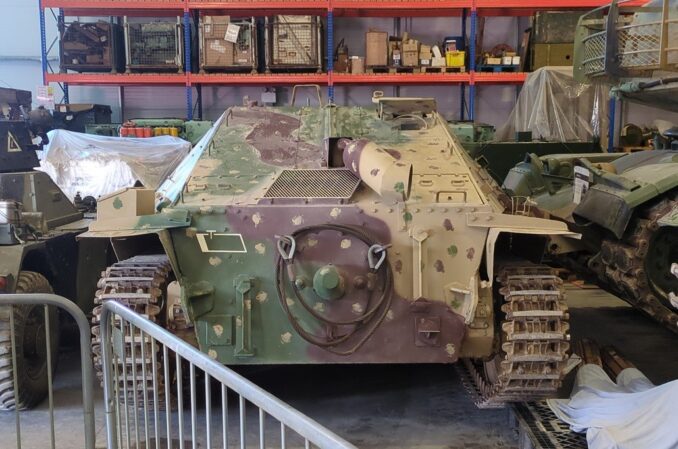
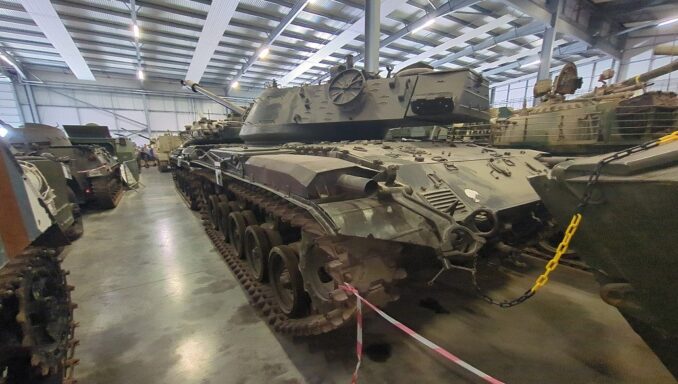
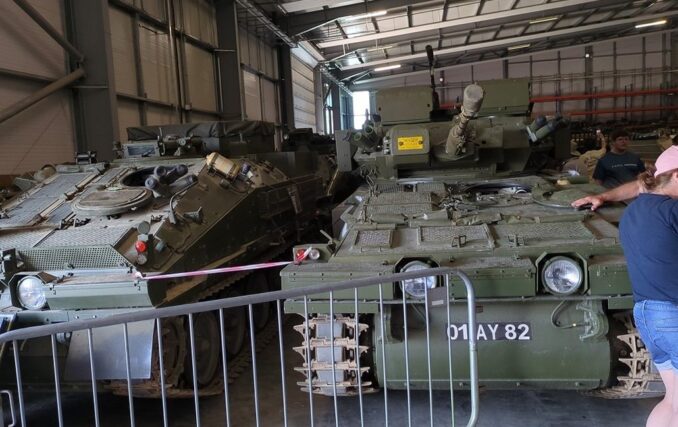
A key part of the work at The Tank Museum is the restoration of vehicles in the Vehicle Conservation Centre, which, in simple terms, is a large shed stuffed to the gills with vehicles – many donated and waiting their turn to be restored.
It basically looks like a super-hoarder’s shed where the wife failed to put her foot down. Regardless, it’s an impressive collection of modern and old machines, and well worth a gander.
© foxes1884 2026
© foxes1884 2026
© foxes1884 2026
Leaving the shed behind, there were the usual vendors selling everything military-related you could think of, from models to army surplus fatigues. Although, if you’re looking to dress up like Prince Harry, you might need to ask around the back.
Back out to the arena for a WWII re-enactment. The scenario for the battle is set late in the war, with the Germans in retreat in the West and having switched tactics to ambushing the advancing Allies from well-chosen positions.
The objective is to slow the Allied advance and inflict as much damage as possible without being wiped out, making use of whatever dwindling resources are still available. After each skirmish, the Germans withdraw to the next ambush point.
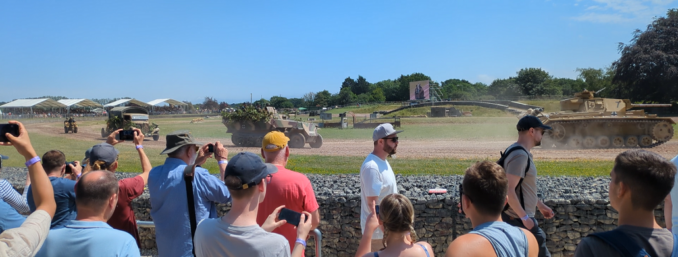
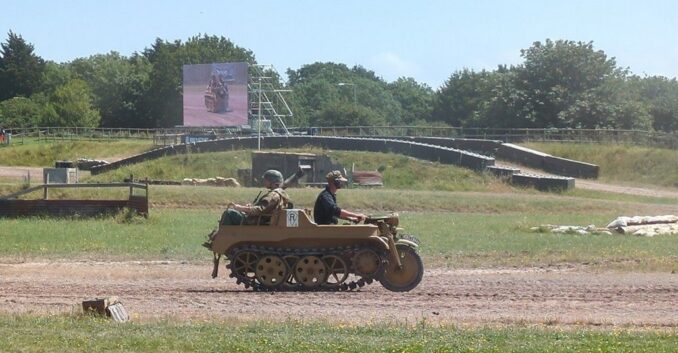
First, the Germans arrive in the arena with a light tank, half-track, infantry and an Sd.Kfz. 2 (Kettenkrad), carrying a couple of infantrymen armed with Panzerschrecks (anti-tank rocket launchers).
© foxes1884 2026
© foxes1884 2026
The ambush in place, the Germans wait.
Entering stage left, the Allies begin to roll in, moving straight into the trap. As the commentator explained, although the Germans were outmatched in terms of kit and resources, morale remained high and their tactics were disciplined and organised.
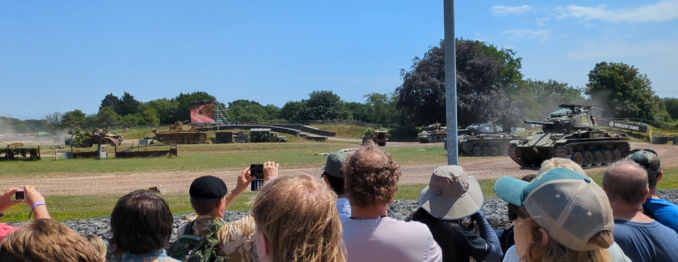
The trap closed. The sound of gunfire and explosions erupted across the arena. With the troops following period tactics, the Germans’ initial advantage was eventually overcome as more Allied reinforcements arrived, including an M24 Chaffee, which set about knocking out the German armour.
© foxes1884 2026
The Germans then withdrew to their next strongpoint. As the smoke cleared, the Allies followed them for the next encounter.
The re-enactments were the highlight of TANKFEST. They gave a faint echo of what it might have sounded like in a real battle. If a plane had flown in and strafed the arena, that would have been the full effect!
The sun was still blazing and everyone was cooked, so Dad called it. We made our way back to the car and headed home. Six hours well spent.
I’d definitely recommend TANKFEST. With entry to the museum included, it’s a great day out, even in a heatwave, or Summer, as we used to call it.
© foxes1884 2026