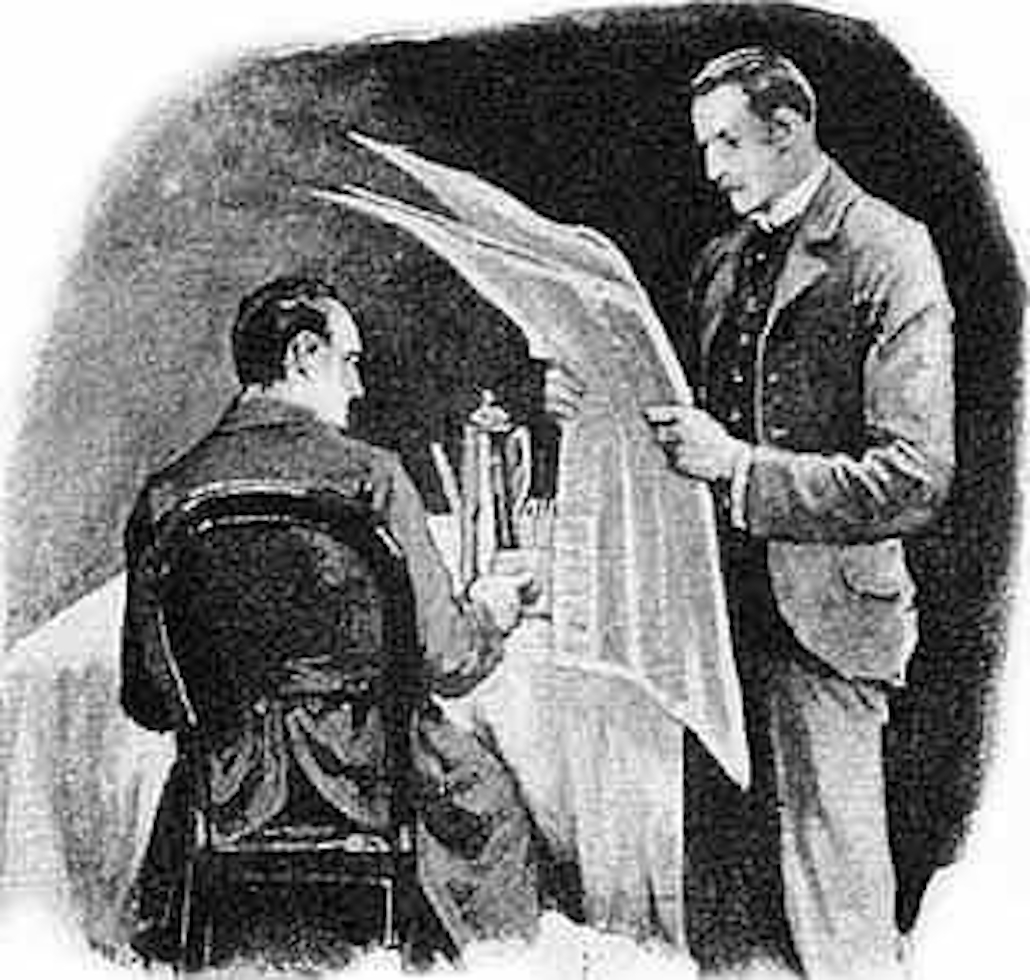
It was my friend’s custom every day after breakfast to peruse the newspapers and cut out any articles he found interesting, to preserve them in a scrapbook for future use. However, these excisions made the papers hard to read, and therefore I was in the habit of seizing The Times and looking over it quickly before he started work with the scissors.
While Holmes was still occupied with Mrs Hudson’s excellent venison sausages, well anointed with mushroom ketchup, I still had control of the journal, and an item caught my eye. ‘Look, Holmes,’ I exclaimed. ‘The Duchess of Slackwater’s ruby necklace has been stolen, and in mysterious circumstances. Do you think that she will soon be paying us a visit?’
Holmes seized the paper and eagerly read the short article. ‘By Jove, Watson, taken from an upper room while the door was locked. A mystery indeed, and I hope we shall be called upon to investigate it.’
He reached for his scissors, and I realised that I should not have the chance of further reading. But at that moment we heard the clangour of the front door bell, and a minute later Mrs Hudson ushered up a lady, dressed in the height of fashion and in a state of considerable agitation. But it was not the Duchess, whose face we knew well from the popular prints. She anticipated Mrs Hudson’s introduction by announcing herself, in a slight but charming German accent, as Irmgard Schambling, Countess of Schlaraffenburg.
‘Mr Holmes,’ she continued, ‘I beg to be permitted to consult you on a most delicate matter, and one that affords me some embarrassment. I have lost some jewellery, and it is not mine — but it was my responsibility to take care of it. Please, can you help me?’
‘Pray sit down, dear lady,’ said Holmes. ‘The coffee is still hot, and allow me to pour you a cup. Now, if you will, we would like to hear the circumstances of your loss. And please omit nothing, as the smallest detail may aid us to discover the perpetrator.’
‘Know, then,’ the Countess told us, ‘that my husband the Graf — that is, in English the Count — of Schalaraffenburg, has been distinguished by many military medals and orders, some of which were awarded to him by the Kaiser Franz Joseph himself.’ We remembered with distaste some accounts of the emperor’s conduct during the recent war between Prussia and France, but remained silent. ‘These orders are represented by various ornaments for the bearer’s dress: stars, badges for sashes, medals of every kind, some made of gold and adorned with jewels. These must be kept clean and in good repair, and today I called on a professional jeweller to come and attend to them. I had anticipated his visit by laying them out on a table in my private parlour, and had locked the door as I always do when these items are out of the safe. The jeweller duly arrived and I unlocked the door — and to my horror I discovered that almost all of them were missing!’
‘Could anyone but yourself have had access to this room while you were absent?’ Holmes enquired.
‘I cannot see how,’ she replied. The room is on the second floor of my house in Kensington Square and has only one door. The sole key is in my charge. The servants have been in my employ for years, and I trust them completely.’
‘You say that almost all are missing,’ said Holmes. ‘What was not taken?’
‘Only one thing, and perhaps the most dear of all to my husband: the Order of St John Nepopmuk, awarded only occasionally for an act of exceptional valour. It was given to my husband when as a young captain at the Battle of Koeniggraetz in 1866 he rescued the Crown Prince Friedrich Wilhelm of Prussia from capture by the Austrians in a hand-to-hand struggle against heavy odds.’
‘My husband does not know that these things have gone, she continued. ‘To you they may seem mere trinkets, but they are precious to him and he will be heartbroken by their loss — and he will be angry with me, as they were in my care. Please, I implore you to do your utmost to recover them.’
‘Dear lady,’ replied Holmes. ‘We will do all we can to investigate this matter, and if possible to recover the orders. I can promise nothing; but may I visit your house and examine the room from which they were taken?’
‘By all means,’ she said. ‘It is still early, and if you are able you may come at once.’
And so we did, accompanying the Countess in her own barouche. As the coachman guided us along the carriage drives in Hyde Park, Holmes asked her, ‘By the way, was anything else taken at the same time?’
‘Indeed,’ she replied, ‘and it was most singular. At the time I had been repairing a small piece of embroidery which had been damaged by moths, and I had left some items from my workbasket on the table. One was the skein of coloured silks I had been using to find strands to match the damaged parts, and the other was a pincushion. Neither was of the least value, though the pincushion was a pretty thing covered in a brightly printed fabric with a design of spring flowers.’
Holmes lapsed into thought as we approached Kensington Square. The house was one of the newer and larger ones on the north side, a tall flat-fronted building of brick still raw-looking, waiting for the passage of time to mellow it. We proceeded up to the second floor. The room was spacious, and through the open front window we could see the small shrubs and flower beds of the neatly kept front garden and, beyond them and over the road and railings, the trees of the central square.
We looked down from the window. There was absolutely no way a thief could have climbed up the flat wall lacking a drainpipe or even a creeper. ‘Was the window open at the time of the robbery?’ Holmes asked.
‘Yes, in summer these south-facing rooms can become oppressively hot if there is no circulation of air.’
Holmes examined the room minutely, but I could tell from his manner that he had not found anything of interest, which would have stiffened him into alertness like a pointer dog on a shoot. He also checked the lock on the door, as I knew looking for scratches that might have been caused by lockpicks, but again there was nothing to interest him.
The single medal that had not been taken was still lying neglected on the table: a bronze cross on a plain dark blue ribbon, polished to a mellow lustre but in no way showy, a simple and honourable award for valour. ‘You would do well to lock that up, my lady,’ said Holmes. ‘But I hope that soon it will be rejoined by its companions.’
We returned to Baker Street for a fortifying luncheon of veal collops and sherry trifle prepared by the indomitable Mrs Hudson. As we waited for the repast to settle, Holmes was idly improvising on his violin, a sound I have learnt to endure as I have heard far worse in the East. Yet I was relieved by the clangour of the front door bell. Holmes laid aside his instrument as our housekeeper ushered up an elegantly attired lady of middle years who announced herself as the Marchioness of Tring. Though we had never before seen her in person, we were aware of her renown as a society hostess at her house in Berkeley Square. Now, however, she was trembling and clearly on the verge of tears.
More accustomed to the failings of the weaker sex than the ascetic Holmes, I coaxed her into an easy chair and plied her with our best brandy from the tantalus. She soon recovered the power of speech to some extent. ‘Mr Holmes,’ she murmured faintly, ‘I implore you to help me. My finest jewels, those of the family of my dear husband the Marquess, have vanished — utterly, in broad daylight, and in a securely locked room! I cannot conceive how the robbery was carried out. But should my husband discover their loss, I dread to see how he would respond. He is a man of strong passions, and it is not well to arouse them.’ She finally succumbed to tears, somewhat mitigated by a second glass of brandy.
We were assailed by the sensation the Frencn term ‘déjà vu’, that we had seen all this played out before our eyes already. And indeed, when she had recovered and was questioned by Holmes, the facts of the matter proved curiously similar. The missing items were a necklace of large emeralds set in gold, a pair of matching earrings, and a brooch representing a dragonfly with a sapphire body and diamond wings.
As before, Holmes asked her whether anything of value had been left, or anything of no value taken. And once more the answers were strangely similar. A pearl necklace of considerable value had been ignored on the table, but a small paperweight of Venetian glass, in the many-coloured style known as millefiori, was missing.
When we visited the house later that afternoon we found an eerily similar puzzle: a locked room on an upper floor with the window open against the summer heat, above a completely bare house front which not even a monkey could have climbed.
As we walked back to Baker Street I could not help myself from saying, ‘Holmes, this simply cannot be mere coincidence: two closely similar robberies within a day of each other in nearly identical circumstances. There must be a method here.’
Holmes looked at me somewhat pityingly, but our friendship restrained him from mockery. ‘Three,’ he replied. ‘You forget the Duchess of Slackwater. I will warrant that it is a similar tale, though so far she has not granted us the honour of a consultation. Perhaps she will change her mind when the police have found themselves baffled, as I am sure they will.’
Holmes would never admit to bafflement, But all that evening after a substantial dinner of gammon and spotted dick well lubricated with custard, he remained in silent cogitation, his violin and syringe thankfully laid aside. I knew better than to speak and left him to his thoughts, hoping that the morning would bring insights.
— To be continued.
© Tachybaptus 2026