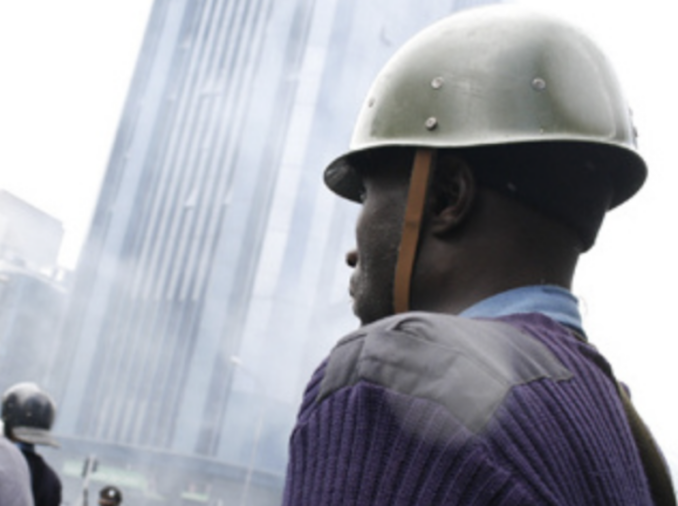
nairobi riot police,
openDemocracy – Licence CC BY-SA 2.0
Police killed at least 63 people, injured more than 601, and arbitrarily arrested over 1,765 during Gen-Z led protests in 2024.
By law, the president must deliver an annual state of the nation address, accounting for the government’s commitment to national values, principles of good governance, and international obligations. But for the past three years, those addresses have largely whitewashed failure, glorified corruption, and erased the blood and pain of victims of state violence.
This report pushes back. It is the people’s counter-account, a parallel record that strips away spin and tells the truth about the Kenya Kwanza regime. And three years in, the verdict is out, as Kenyans stare at a regime that has consistently violated the Constitution, trampled on the rule of law, and presided over unprecedented economic and social decline.
President William Ruto’s (WSR) promise of a people-centred “hustler” government has instead hardened into authoritarianism marked by state violence, systemic corruption, and captured institutions. What began with a symbolic break from his predecessor, appointing 46 judges and boosting the Judiciary’s budget, quickly turned into a sustained assault on the very institutions that anchor democracy.
Independent bodies created under the Constitution to safeguard rights and check executive power have been manipulated, silenced, starved, or co-opted. Parliament has been reduced to an appendage of the State House. The Judiciary has been battered by open contempt and deliberate defiance. The Office of the Director of Public Prosecutions has been converted into a blunt weapon for persecuting dissenters while shielding the president’s allies. Other oversight institutions have either been neutered or hijacked.
The result is a captured state.
Rule of law undermined
The three years of Kenya Kwanza regime has been marked by deliberate disobedience of court orders and unconstitutional creations of offices and bodies. After assuming office in September 2022, WSR appeared progressive by appointing judges long blocked by former president Uhuru Kenyatta and raising the Judiciary’s budget to Sh22 billion from Sh17 billion. But the honeymoon ended almost immediately.
The regime branded judicial officers as “cartels” for daring to stop its unconstitutional policies. It trashed a High Court conservatory order barring the gazettement of seven IEBC commissioners and bullied 34 state agencies into migrating to the e-Citizen platform despite an order halting the move for lack of public participation.
When courts restrained police from using excessive force on protesters, the regime defied the orders, with WSR telling police to “shoot them in the leg.” Security forces unleashed unprecedented terror, killing and maiming protesters. In July 2023 alone, 51 people were gunned down within five days during demonstrations against tax hikes, marking one of the darkest moments since the 2010 Constitution.
The regime doubled down and WSR openly declared that “no courts of law will stand in my way.” He ordered the continuation of road construction in Ndonyo-Njeru-Ithe despite a court injunction, for instance. His creation of the Panel of Experts on Protest Victim Compensation and a multi-agency anti-corruption team have been stopped by courts, and the formation of the National Taskforce on Police Reforms has seen some of its mandates struck down as unconstitutional.
Equally alarming is the regime’s capture of Parliament. By buying off opposition MPs, WSR secured a supermajority in both Houses and rammed through punitive legislation. The Affordable Housing Levy and the 2023 and 2024 Finance Bills, all deeply unpopular, passed despite public uproar. The Assembly and Demonstration Bill (2024) by Geoffery Ruku, a WSR ally who was later brought to the cabinet, sought to curtail freedom of expression, assembly, and protest.
The proposed Public Order (Amendment) Bill, 2025, by another ally, Nairobi Women representative Esther Passaris, aimed to ban gatherings near parliament, courts, and State House. Nandi Senator Samson Cherargei, elected on a UDA party, went further, seeking to amend Article 136 to extend the presidential term, including of other elective offices, from five to seven years, in a move that will entrench authoritarian rule.
Lawfare, compromised
Perhaps no institution illustrates the perversion of constitutional safeguards more deeply than the ODPP. Established under Article 157 of the Constitution to ensure impartial justice, the ODPP has instead been weaponised into an arm of the executive.
Under this regime, the ODPP has dropped corruption charges against WSR allies while zealously prosecuting critics of the state. Friends of WSR such as the Senior Advisor on Fiscal Affairs and Budget Policy, Henry Rotich, Cooperatives and MSMEs CS, Wycliffe Oparanya, and former CS Aisha Jumwa have all benefited from selective withdrawals of graft cases.
Meanwhile, ordinary Kenyans exercising their right to protest have faced trumped-up charges. At least 75 demonstrators have been charged with terrorism, while over 450 face serious criminal counts, among them minors as young as 15, according to the 50+ Million Kenyans Campaign.
This double standard has gutted public faith in the ODPP, which, instead of defending the Constitution, the office has become an enforcer of executive power, criminalising dissent while sanitising the corrupt.
Oversight institutions attacked or coopted
The Kenya Kwanza regime has systemically weakened independent commissions and offices. The Kenya National Commission on Human Rights has been muted through deliberate underfunding and political interference.
The Independent Policing Oversight Authority, tasked with ensuring police accountability, has recorded cases of killings and torture but has failed to secure justice for victims of state-led violence that happened under WSR’s watch. At least 246 people have been killed by police since the regime took office, but accountability remains elusive.
Among the independent offices, the Controller of Budget has been systematically undermined. Though mandated to oversee public expenditure, the CoB’s reports flagging unconstitutional withdrawals and mismanagement of funds have been ignored or met with executive hostility. The Office of the Auditor-General continues to produce damning audit reports that expose theft of public resources across ministries and parastatals. But parliament has consistently shelved these findings, as the executive weaponised them.
These watchdogs have been defanged.
Kenya is repressed
While the Kenya Kwanza regime operationalised the long-delayed Public Benefits Organisations Act in 2024, the move was overshadowed by aggressive attacks on civic freedoms. CIVICUS Monitor now rates Kenya “repressed”, the second worst rating a country can receive, indicating severe restrictions to the freedoms of expression, peaceful assembly, and association
Arbitrary arrests, abductions, and killings of activists, lawyers, journalists, and content creators have become common. Between 2023 and 2025, over 246 people were killed by police. However, we caution that the actual numbers are far higher, as the regime has deliberately concealed and tampered with evidence to mask the true scale of its abuses.
The years 2023 and 2024 marked one of the darkest chapters. There were over 118 police killings in 2023, and the majority occurred during protests over the high cost of living. Shockingly, 51 of these killings occurred within just five days in July 2023, when Kenyans took to the streets against tax hikes and economic hardship. These deaths were the most extreme outcomes of 296 torture and torture-related violations.
The violence persisted into 2024, as Gen Z-led protests demanding accountability and better governance were met with brutal state repression. At least 63 people were killed, more than 601 injured, 1,765 arbitrarily arrested, and 82 forcibly disappeared. Police also issued 20 unlawful summonses in connection to the demonstrations.
By September 2025, the crisis showed no signs of abating. Sixty-five more deaths, over 500 injuries, 355 unlawful arrests, three enforced disappearances, and 19 unlawful summonses had already been documented.
The ODPP emerged as a willing enforcer of the regime’s authoritarian playbook. Instead of prosecuting perpetrators of state violence, the ODPP turned its fire on the victims, filing anti-terrorism charges against 75 protesters and slapping serious criminal counts on 450 others. Among those targeted were at least 10 minors, some as young as 15, alongside older citizens, including a 61-year-old.
Civil society organisations have also been targeted. In 2024, the regime accused Ford Foundation and 16 NGOs – including the Kenya Human Rights Commission, Transparency International Kenya, and The Institute for Social Accountability – of attempting to destabilise the country for supporting the right to protest. Regulators and security agencies were unleashed on them until the courts intervened.
The Communications Authority of Kenya aided censorship. In June 2025, it raided broadcast stations and disrupted signals of NTV, KTN, and Citizen TV to suppress live coverage of protests, in open violation of Article 34 of the Constitution.
Evictions surged
The regime has presided over mass evictions without due process or alternative housing plans. Between March and April 2024, at least 6,000 households in Mathare and Mukuru were demolished amid heavy rains and flooding. Over 100,000 people in Trans Nzoia were also evicted in February that year. By mid-2025, another 127,000 people in Nairobi faced imminent displacement from riparian zones after a cabinet directive of April 30, 2024, ordered “voluntary evacuation” or “forcible relocation.”
The flagship promise of 250,000 housing units annually has collapsed. Only 103,000 units have been completed in three years, against a target of 750,000.
Healthcare has also suffered. The transition from National Health Insurance Fund to the Social Health Insurance Fund was marred by a Sh104.8 billion digital system procurement scandal, where the regime does not even own the technology. Meanwhile, doctors and nurses have staged repeated strikes over unpaid salaries and poor working conditions.
Education funding has stagnated. Government capitation for secondary school students has remained unchanged since 2018, despite inflation. The Kenya Secondary Schools Heads Association estimates a Sh117 billion shortfall in four years.
After assuming office, WSR is satisfying a relatively small circle of cronies at the cost of his ‘hustler’ movement – the poor, youthful base mobilised to elect him on the belief the new president would put money in their pockets and break the ethno-political ‘dynasties’ mould of Kenyan politics. The abandonment of his promise of ‘bottom up’ economic development has resulted in one of Kenya’s most significant challenges to presidential authority.
The government is largely made up of novices in high office selected on loyalty and regional considerations rather than merit. He appointed his political party’s politburo to sinecure positions within the government, ensuring loyalty to him ahead of the next general election, but also leaving no room for objective criticism to emanate from within party organs
WSR has continued to allow corruption in his government as he took over power with a cloud of graft cases hanging over his head although in most cases he was acquitted having bought off the judiciary.
© AW Kamau 2026