
DIP’s nuclear element
The vast expense of the nuclear element of the Defence Investment Plan (DIP) – by far its largest commitment – draws us to focus on the following:
- Dreadnought nuclear deterrent ballistic submarines (SSBN)
- Trident missiles and their warheads
- Nuclear-powered, but not nuclear-armed, fleet submarines (SSN)
Last time we looked at the eyewatering cost (up to £41 billion) of the Dreadnought SSBN project. This time we examine the warheads to be carried by the Dreadnoughts as the UK’s ‘independent’ nuclear deterrent. Although the UK uses the American Trident II D5 missile as the delivery system, the warhead itself is a British design, maintained and developed by the UK’s nuclear weapons establishment.
The warhead
The current UK warhead, known as Holbrook, replaced earlier Chevaline and Polaris-era warheads and entered service in the 1990s alongside the Trident-armed Vanguard-class submarines. It is believed to be similar in design to the United States’ W76 warhead, reflecting close technical cooperation between the two countries, although the UK warhead is, they say, independently owned, controlled, and maintained.
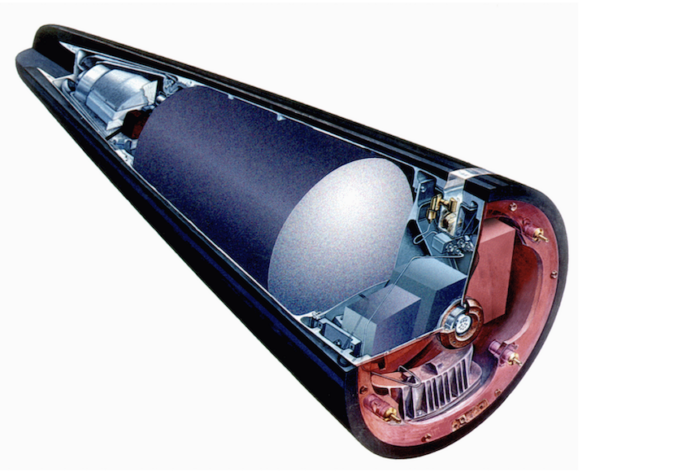
Cutaway illustration of a US W-76 nuclear warhead in its Mk-4 reentry vehicle,
Los Alamos National Laboratory – Public domain
The warhead is a thermonuclear weapon whose specifications are classified, but open sources estimate that its explosive yield is variable and can be adjusted depending on the mission requirement. This gives the UK a degree of flexibility while maintaining a smaller overall nuclear stockpile than larger nuclear powers.
For the Dreadnought class, the UK is developing a replacement warhead programme known as the Replacement Warhead Programme. This is intended to ensure that the UK’s deterrent remains effective throughout the Dreadnought submarines’ service life, which is expected to extend from the 2030s to the 2060s. The programme involves modernising warhead technology, production facilities, and the supporting infrastructure needed to maintain an independent nuclear deterrent.
As such, this is the first time the UK has designed, developed, built and tested a warhead in decades, with the last British test detonation of a bomb being at a facility in Nevada in 1991. Since then, the Comprehensive Nuclear Test Ban Treaty has prohibited the testing of nuclear weapons. Therefore, as we shall see, a different and costly procedure must be followed as the UK’s Atomic Weapons Establishment (AWE) switches from ensuring the current stockpile of warheads is safe and working to developing and deploying a new weapon.
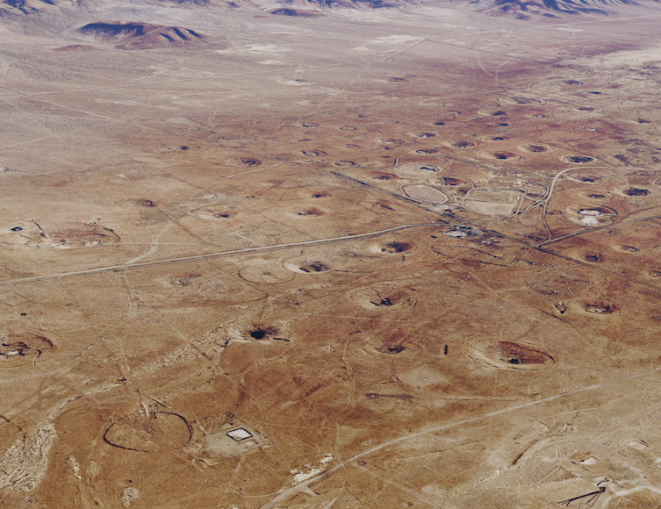
© Google Maps 2026, Google licence
For that next-generation UK Replacement Warhead Programme the UK government has not released a final total cost. However, recent parliamentary information indicates a £15 billion investment covering the sovereign warhead programme, sustaining the existing stockpile, developing the replacement warhead (known as Astraea), and modernising supporting infrastructure. Earlier estimates for replacement warhead work alone were in the several-billion-pound range, before the full scope of infrastructure and capability renewal was included.
The Atomic Weapons Establishment
The United Kingdom’s Trident warheads are built and maintained primarily by the AWE at its sites in Berkshire, with the main activities divided between Aldermaston and Burghfield.
AWE Aldermaston is the centre for the research, design, development, and production of many of the specialised components used in UK nuclear warheads. It is where scientists and engineers develop and maintain the technical expertise required to design, assess, and support the UK’s nuclear warhead capability, with a workforce of about 7,000.
AWE Burghfield is responsible for the assembly, maintenance, and refurbishment of operational warheads. This is where the various components are brought together into complete warhead assemblies and where in-service weapons are supported throughout their operational life.
Once assembled and approved, warheads are transferred under strict security arrangements to the Royal Navy’s armament depot at RNAD Coulport, located near HM Naval Base Clyde in Scotland. Coulport is the storage and handling facility for the UK’s Trident warheads and is where they are maintained, prepared, and fitted to Trident missiles before being deployed on Royal Navy ballistic missile submarines.
Developing Astrea at Aldermaston
Given our ratification of the CTBT, confidence in the design of Astrea will come from advanced computer modelling, supercomputing, materials science, hydrodynamic experiments, and other non-nuclear testing methods. This approach allows engineers to validate the performance and reliability of the warhead without carrying out a nuclear test explosion.
One of the big boxes noticeable at Aldermaston is the Orion Laser facility. Operational since 2013, this highly secure building houses a massive vacuum chamber where scientists simulate the extreme pressures and temperatures of nuclear explosions without conducting actual, full-scale nuclear detonations.
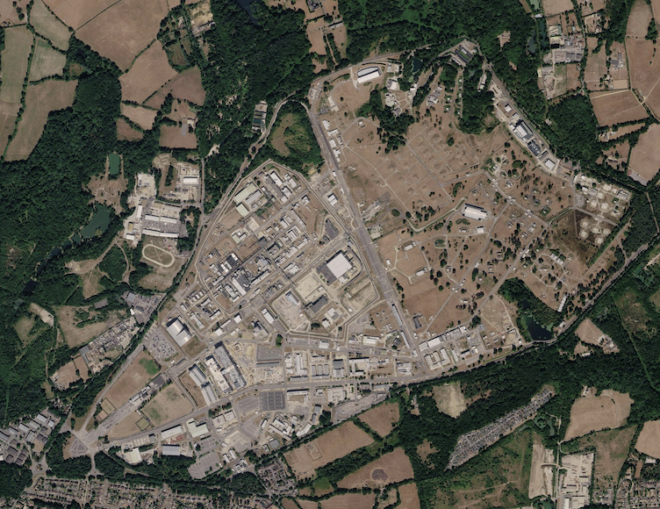
© Google Maps 2026, Google licence
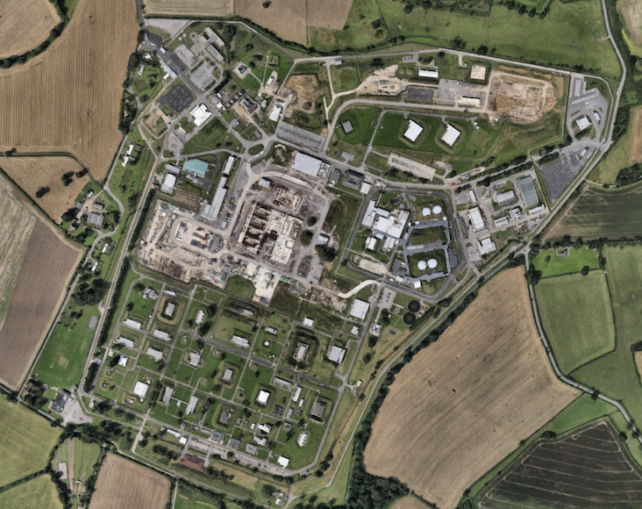
© Google Maps 2026, Google licence
According to Sky News, the mega laser is built in a hall, with two banks of long cylinders, lying horizontally and stacked one on top of the other, running down the length of the giant shed. Laser beams are fired into a special, separate chamber, onto tiny samples of material to see how they react under the extremes of pressure and heat that would be caused in a nuclear explosion. The resulting temperatures can reach up to 10 million degrees – the same as the outer edge of the sun.
Data from the laser experiments is analysed by a supercomputer at the Aldermaston site that uses 17 megawatts of power to crunch four trillion calculations per second.
The warhead will be designed to fit within the Mk7 aeroshell, the same general missile re-entry vehicle family being developed alongside the US W93 programme. However, the UK warhead itself remains, they tell us, a sovereign British design, with the US cooperation allowing compatibility with the Trident missile system while preserving independent national control of the warhead.
More eyewatering costs
According to SKY, the government is spending £15bn over the next four years alone on the programme, with part of the investment going into revamping Aldermaston’s 700-acre site (which was originally a Second World War airbase).
The Nuclear Information Service, informs us AWE is partway through a rolling 20-year construction and demolition programme, headlined by a £4.3 billion Future Materials Campus (FMC) and the Project Pegasus Enriched Uranium facility.
Project Aurora is a new plutonium manufacturing facility, added to the government’s 2023 list of major projects. It is currently estimated to cost between £2bn and £2.5bn. The facility was originally planned as part of the Nuclear Warhead Capability Sustainment Programme (NWCSP) at AWE and will likely replace the current A90 facility at Aldermaston, which was built in the 1990s.
This facility will be used to manufacture the plutonium ‘pits’ for the UK’s planned new warhead. These are designed to be compressed by explosives in the primary stage of the warhead, starting a fission reaction, which would then trigger a fusion reaction in the warhead’s secondary stage.
Again, according to NIS, the official start date of the project was January 2019 but, ‘No information was released by the MOD at the time, and very little has been said prior to its inclusion in the Major Projects Portfolio. It was excluded from the response to a June 2021 parliamentary question about planned infrastructure projects at AWE, and in September 2022 the MOD refused to give details about the anticipated cost of the project, saying that it was “beginning its Initial Assessment phase”’.
Another HS2?
All of which begs the question: What’s the point – at vast expense – of developing warheads our American special relationship allies already have? Added to which, as per Stormshadow, if the US won’t let us use conventionally armed cruise missiles containing American components, surely we will need their permission to use the Trident delivery system for our ‘independent’ deterrent?
Is the nuclear element of DIP, therefore, little more than a seaborne HS2 draining financial lifeforce from other areas od fefence?
© Always Worth Saying 2026