
Anyone who’s ever taken a moment to watch animals in the wild – birds in particular, can’t fail to have noticed they are constantly on the lookout for danger and predators, and are always primed and ready to take preventative and evasive action. The survival instinct is strong.
It’s a natural human instinct too. Young children don’t really have it, but they have parents to look out for them. As children get older, they are taught ‘never take sweets from strangers’, or ‘never get into a stranger’s car’. Slowly an awareness develops that not everything is fluffy and cuddly out there.
When today’s older generation was young, there wasn’t an awful lot to worry about when away from the home. There was a minute risk of being in the wrong place at the wrong time when a terrorist IRA bomb was detonated, but random attacks on strangers were unheard of, abductions were rare, and hoodlums and gangsters generally kept the beatings and killings within their own circles.
But in recent years, our streets have become increasingly chaotic and unsafe. Anybody who hasn’t noticed is either psychologically blinded by multicultural propaganda, or lives under a stone.
Muggers grabbing jewellery, watches, phones, and valuables; fights involving knives, machetes and guns; innocent people randomly and regularly attacked, and often killed; not to mention the avalanche of sexual harassment, sexual assaults and rapes.
High-Trust Society v Low-Trust Society
The term High-Trust Society is relatively new, and put simply, means a society whose members largely subscribe to the same values and social mores – a homogenous society, if you like.
In such a society, you can reliably go about your daily business unhindered. You can smile or say good morning to passing strangers without fear of being on the receiving end of any kind of unpleasantness, let alone a physical attack.
A Low-Trust Society is comprised of disparate groups, with different values, belief systems, views, and even laws – a recipe for never-ending disharmony and conflict.
These two terms were popularised by political economist Francis Fukuyama in a 1995 book, Trust: The Social Virtues and the Creation of Prosperity. He identified cultures with high levels of spontaneous sociability and voluntary association as high-trust, and societies that rely heavily on family ties or legal coercion to operate as low-trust.
Fukuyama was a political economist, so it’s easy to deduce from his theories that a High-Trust society is much more likely to be prosperous than its Low-Trust counterpart, because honest, cooperative behaviour, based on shared norms, is vital for economic prosperity.
Highly Developed Society v Primitive Society
Highly developed societies offer all manner of state-provided protections, welfare benefits, and support systems, but such societies aren’t completely safe, and inhabiting one isn’t totally worry-free.
The maintenance of a safe and secure society requires constant work and vigilance. No society stands still, and cities, towns and villages evolve like living, organic organisms.
It’s no secret that successive British governments have worked hard to create a multi-racial, multi-cultural, No-Trust Society in what was formerly a homogenous country.
Western governments now accept and import people in their millions from some of the most uncivilised and dangerous countries in the world – termed by the United Nations as Least Developed Countries (LDCs), or Developing Countries.
Governments welcome these foreigners with all manner of gifts and privileges, then distribute these new arrivals throughout their countries. The culture shock on both sides is considerable, as might be expected.
In the UK, asylum seekers aren’t allowed to work while their claim is processed, and with time to kill, it’s becoming increasingly common to see lone foreign males, or groups of foreign males, hanging around aimlessly and suspiciously – a sight now encountered in rural and remote parts of the country, as well as in cities and towns.
The male in this short dashcam clip, filmed loitering incongruously near a village primary school in Cambridgeshire, headphones on, staring at his smartphone, is most likely an undercover Ofsted inspector, checking the safety of the school environs, and activities on the school playing field. (00:53)
Technology’s Threat To Personal Safety
As technology has progressed, ever more portable devices have come along that carry a significant ‘distraction factor’ when used in public.
We regularly see people obsessively focussed on their smartphone screen, oblivious to the world around them, barely even looking where they are going.
The first such distraction device was, arguably, The Walkman – a portable tape player primarily used in public for playing music cassettes. It first appeared in 1979, although other portable tape players had existed since the late 60s.
While many people purchased one, I chose not to, as I felt the device compromised safety by effectively disabling one of your most crucial survival mechanisms when using it in public – your hearing.
Regular use over time seems to condition people to ignore their surroundings, and focus instead on a different world – far away from the one they are physically in.
The Woke Phenomenon
Political Correctness and Wokeism cultivates and promotes a false sense of security in the face of the realities of human nature. The simplistic idea that foreigners are nice, and Whites are bad, promoted ad nauseam for years, has surely led many people into trouble.
Western young people are indoctrinated with the belief that people of different races, with different cultures and different social values are just like they are – everybody is ‘the same’. Not only are these ‘others’ harmless, they are in many ways preferable and superior to their own kind.
The natural human instinct for self-preservation and survival is being erased in many by the constant campaign to hide problems, and convince people that those most likely to cause them harm are really the ones to cleave to.
And then people wonder how and why young women end up in the hands of foreign rape gangs.
A Dangerous Conspiracy of Silence
It is clear from accumulated experience that the political class, authorities, and MSM all pursue a policy of minimising knowledge of the scale of the personal security threat citizens face today.
Furthermore, knowledge of exactly where, and from whom the threat mostly comes from is also hidden as much as possible. Statistics that might enlighten the public are kept under the table, or simply aren’t collected.
Fortunately other countries are not so coy about publishing crime statistics which include the nationality, or race of perpetrators, and these stats are easy enough to find on the net. They don’t make pretty reading.
Forewarned is forearmed, but in the UK, gaslighting is the order of the day, proving that those who task is to protect the people actually conspire to do the complete opposite.
Public Transport Today
Travellers are a captive audience, and have to endure all manner of unpleasant and dangerous episodes on buses, trains, and planes these days.
You are increasingly at risk of losing your sanity, and even your life, when using public transport. There are plenty of videos around of uncomfortable, twitchy passengers, trying to ignore an incident, or some gross behaviour, and of passengers being attacked, and even being pushed in front of trains.
I recently had a rather uncomfortable experience while waiting 45 minutes at an ‘out in the sticks’ railway station for a branch line connection.
The station has an old, 19th century waiting room, which has recently been modernised with the addition of an automated sheet glass door, and CCTV. It’s nearly always unoccupied, and I settled down to wait for my connection in perfect peace and solitude.
But within 3 minutes, a large Black gentleman wearing a hoodie came through the door – on his own, no wife and kids – and joined me. Of all the seats in the room he could have chosen, he picked the one directly facing me. Everybody knows that’s a form of ‘personal space’ invasion, or a threat, if you prefer.
He then proceeded to slowly and loudly crunch a large packet of crisps in this silent room, before firing up his mobile phone with all manner of squawks and squeals, and engaging in a very loud conversation (speaker set at near maximum volume) with a lady he knew who apparently was still in bed at 3 in the afternoon – and all in barely intelligible, very loud, guttural, Africanised English.
Sticking religiously to the golden rule, I never once looked the guy in the eye during this one on one confrontation, as it was clear his face bore a hateful scowl, not a smile. I could feel his eyes boring into me, and I knew he knew that if the situation escalated to a police level incident, the police are trained to take his side, not mine.
I acted as if he wasn’t in my face, or my space, and stared at my phone – something I never normally do, and aimed my mind elsewhere. I wondered whether or not the waiting room door lock would release if there was a power cut.
After about 20 minutes, I couldn’t bear it any more, and simply had to leave the room. I chose my moment carefully, and coolly wandered out onto the platform, and re-located to the new, modern, full-length, glass-walled, door-free, waiting area instead.
Even there, I considered what my escape route would be.
A few days later, a Black British man, Anthony Williams, ran amok with a knife on a train in Cambridgeshire, leaving eleven people injured. Miraculously, and thankfully, all survived.
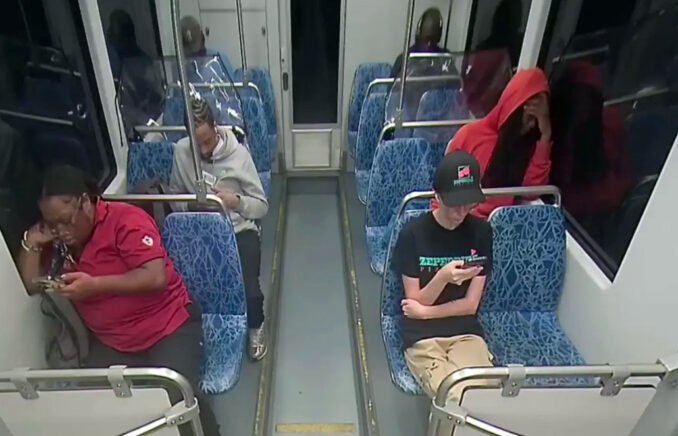
But my unsettling experience in the deserted railway station waiting room is very small beer indeed, when compared with that of 23-year-old Ukrainian refugee Iryna Zarutska, who was mercilessly and fatally stabbed from behind a few weeks earlier on a train in Charlotte, North Carolina.
The poor girl broke three crucial survival rules:
- always be aware of your surroundings when in public
- don’t bury your head in a mobile phone, or wear headphones
- never turn your back on a black (a warning I was given by a streetwise London girl many, many years ago, which jolted me out of my naivety)
As he left the train, the Black killer was heard to say “I got that White girl”.
Public Transport Safety Tips
- Never stand near the platform edge at railway stations, and always have your back to a wall
- Know your way out of a carriage or bus, and sit as close to it as is practical
- Buses usually have an emergency door, so seats close to these are also an option
- If you have to sit next to someone, choose your seat partner wisely
- If you are alone, use the seat closest to the aisle, so you can’t easily be blocked in
Think You Are Safe At Home?
Some people simply don’t respect personal space, or even understand the concept, and actually derive pleasure from invading it, making others feel uncomfortable and threatened.
TikTok ‘influencers’ like “Mizzy” (Bacari O’Garro), and others, have achieved notoriety by filming themselves deliberately scaring people by invading their homes and cars, and their personal space on the street, and on public transport.
Home invasion happens, whether for robbery, rape, or TikTok clicks, and it can sometimes be fatal for the victims.
Fears of finding an unwelcome visitor in your property are growing, and the days of leaving external doors unlocked in villages and remote locations are surely almost over.
Celebrity chef Jamie Oliver lives very near the migrant camp at the former RAF airbase in Wethersfield, Essex. He has often spoken of his love for migrants, and has taken Ukrainian refugees into his home. He worked with the charity Migrateful to ‘empower’ refugees through cookery classes.
Our guests at the Wethersfield camp are bussed in groups to nearby towns on a regular basis, and are known to cause ‘problems’. Oliver has been reported to have dramatically increased the security at his estate due to his concerns about his family’s safety while he’s away from home.
It’s Different For Girls
As a male, I assume that teenage girls learn how to deal with unwanted attention from their male contemporaries quite early on.
Obsessive attention from insecure, jealous, emotionally immature or unbalanced males is a rather different matter, as is the sort of attention European females get from recently-arrived foreign males, coming from countries with a totally different culture, and attitudes to women that are diametrically opposed to those held by Westerners.
Many of the virile, fit young males of unknown provenance who come here illegally haven’t only been lured here by the promise of a free ride for life at their hosts’ expense, but also by the widely advertised promise of ‘easy’ white women – as many as they want.
This poses a big problem for British women, especially as many of these males don’t seem inclined to take ‘no’ for an answer. They seem to believe that if they don’t get what they want, they can just ‘take’. Why they seem to have a preference for White women, rather than their own, remains a mystery.
Are young White women properly prepared to keep themselves safe under this cloud of threat? They seem to be taught that their own kind are worthless, while foreign males, especially from Africa and Asia, are the kindest and most considerate of all races, and make ideal partners.
Whenever you see a White girl on television, or in adverts, she has invariably chosen a Black man to share her life with, and to father her children.
Sadly, the huge increase in sexual assaults and rapes seen in recent years, and the industrial scale of abuse and trafficking of young non-Asian girls suggests that young women may not be as savvy as they think, and a whole new level of awareness is required.
In a high-trust, truly liberal society, girls should be able to feel safe to enjoy their freedom, and to dress how they like, and let their hair down on a night out.
But in today’s increasingly fragmented society, it seems wise for women to take precautions if they want to enjoy themselves on a night out, such as:
- don’t look vulnerable
- don’t dress like a hooker
- always keep your eye on your drink
- don’t get drunk
- when leaving, watch out for males loitering outside looking for victims
Terrorism Never Really Went Away, Did It?
From Irish Republicanism to Islam, British people have been on the wrong end of terrorist attacks for decades. We’ve been warned constantly to remain forever alert to the danger, and to report any suspicious activity we might see, however trivial it may seem.
However, in today’s politically correct climate, ordinary people might be reluctant to report their suspicions for fear of being accused of some ‘hate crime’, and ending up fined, or imprisoned, if their suspicions turn out to be unfounded.
As far as unintended consequences go, this is ‘the precautionary principle’ turned on its head, at a time when the current national terrorist threat level is severe, just one level below critical, at the time of writing.
Face The Facts
It’s time for everybody to face the facts. There are growing numbers of people out there who mean you harm, and they don’t fight fair. They will hit anybody, they will attack you from behind, delight in delivering a sucker punch, and happily push you onto a railway line, no doubt filming all these activities in the process.
Long-accepted standards of behaviour are in decline, and respect for other people continues to diminish. The entitlement culture doesn’t help. Giving people anything and everything they want is bad psychology, and encourages people to think they have the right to take anything they want, if necessary.
Protect Yourself and Take Precautions
Using the personal situational awareness technique is vital for maintaining personal safety. It’s a continuous process of observing and understanding your surroundings, recognising and anticipating potential threats early, and thus avoiding danger.
It relies on establishing a baseline of what is normal in an environment, using all your senses, and trusting your instincts. This helps you spot anomalies, or people behaving unexpectedly, and enables you to act quickly to stay safe.
Rely On Your Intuition (Unconscious Bias)
Intuition, also known as gut instinct, can save your life. This evolutionary trait allows you to spot threats quickly. It helps you separate friend from foe, and although intuition sometimes gets it wrong, it’s almost always your friend.
If a person, environment, or situation feels wrong, don’t ignore it. Move away immediately.
Sadly, unconscious bias is looked down on today as ‘undesirable’, and modern society is set up to programme it out of young people, making it easier for predators to get close to little girls and unwary women, in particular. This expunging of an inbuilt defence system is the equivalent of blinding potential victims to potential risks.
Pattern Recognition and Stereotypes
While it’s unfair to tar every member of a recognisable group with the same brush, it is fair to say things like a group of old people pose less potential threat than a group of strong, rowdy, testosterone-fuelled young males.
Pattern recognition is an integral part of the human thought processes that enable people to understand the world and judge potential risks in everyday life.
It has its basis in statistics, and enables the mind to categorise things on the basis of recognisable characteristics – one group has a particular propensity for one type of thing, while another group has a propensity for another type of thing.
As with intuition, pattern recognition sometimes gets it wrong, but it, too, is almost always your friend.
Eliminate Distractions
Don’t walk around staring at a £1k phone, oblivious to your surroundings, believing you are safe and living in some sort of diverse Utopia. Don’t use earphones in high-risk, busy, or unfamiliar areas where you need to hear as well as see emerging threats.
Don’t Attract Attention
Maybe consider dressing down a bit when you are out and about? Don’t advertise your wealth by wearing fabulous designer clothes, or expensive jewellery. Wealthy and aristocratic countryside individuals have dressed normally and unostentatiously for years when out and about.
Use the 20-20-20 Rule
This technique is used in occupational safety to assess the immediate environment, but is just as useful where maintaining personal safety is concerned.
Take 20 seconds every 20 minutes to scan 20 feet around you, actively looking for potential hazards or suspicious individuals.
Know When to Leave
Recognise the warning signs of a volatile situation, and have an exit strategy prepared to reach a safe, well-lit, public location.
Personal Safety Checklist (In No Particular Order)
- Keep an open mind in all situations
- Trust your intuition
- Develop your predictive skills. Try and predict how a situation might develop
- Don’t distract yourself with a smartphone
- Don’t block your auditory system with headphones
- Walk with purpose, confidence, and awareness, and own your space – street criminals target aimless, distracted, timid, eyes-down walkers
- Don’t flaunt your Smartphone or a flashy expensive camera, or jewellery
- Avoid making eye contact with potential threats
- Watch Your Back
- Be Here Now!
© 2026 NeverUpToTheJob Text and images (except where otherwise stated).