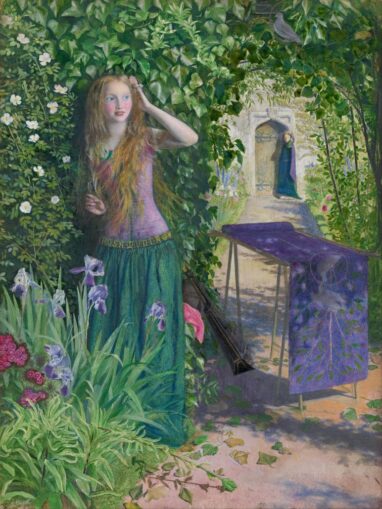
Arthur Hughes, Public domain, via Wikimedia Commons
I recall having a book called an Anthology of Childrens’ Poems and this was one of my favourites. A big lesson here for the climate change twats – us puny humans have no effect on the world-wide environment. I sometimes think that those sceptics who decry ‘poetry’ as a waste of time and effort should look into the subject objectively and discover the universal truths often propounded.
Yes, there is some awful pseudo intellectual crap feted but true writings often remind us of our place in The Universe. That is not to say resign yourself to whatever the fates throw at you – live, love and have a positive effect on your little bit of the World. It is not only the grannies who show the way – us great grandfathers have an oar to dip in the stream!
The Brook
I come from haunts of coot and hern,
I make a sudden sally
And sparkle out among the fern,
To bicker down a valley.By thirty hills I hurry down,
Or slip between the ridges,
By twenty thorpes, a little town,
And half a hundred bridges.Till last by Philip’s farm I flow
To join the brimming river,
For men may come and men may go,
But I go on for ever.I chatter over stony ways,
In little sharps and trebles,
I bubble into eddying bays,
I babble on the pebbles.With many a curve my banks I fret
By many a field and fallow,
And many a fairy foreland set
With willow-weed and mallow.I chatter, chatter, as I flow
To join the brimming river,
For men may come and men may go,
But I go on for ever.I wind about, and in and out,
With here a blossom sailing,
And here and there a lusty trout,
And here and there a grayling,And here and there a foamy flake
Upon me, as I travel
With many a silvery waterbreak
Above the golden gravel,And draw them all along, and flow
To join the brimming river
For men may come and men may go,
But I go on forever.r ever.I steal by lawns and grassy plots,
I slide by hazel covers;
I move the sweet forget-me-nots
That grow for happy lovers.I slip, I slide, I gloom, I glance,
Among my skimming swallows;
I make the netted sunbeam dance
Against my sandy shallows.I murmur under moon and stars
In brambly wildernesses;
I linger by my shingly bars;
I loiter round my cresses;And out again I curve and flow
To join the brimming river,
For men may come and men may go,
But I go on for ever.Alfred Lord Tennyson
In retrospect I suppose I was a little unusual in regard to literature and poetry. Some of my earliest memories from school are of delighting in finding the world of poetry.
I loved Milton, Donne. Marvell, Chaucer and many others from the middle ages onwards and have happily taken to works from there up to the present day. I am adamant in that, in the main, poetry must have metre, rhyme and cadence. There are exceptions where other forms are used – free verse can be engaging and as I showed last time writings such as those of Kahlil Gibran have a place in my heart.
Poetry tells a story and has a start, a middle and an end. Simples.
Anything else is, in my opinion pandering to lack of talent!!!!” For those thinking, ‘hmmm’ soyboy poetry lovers are poofs match my record of being one of only six who passed Parachute Regiment basic training from a group of fifty starters and who became one of the fastest promotions to WO1 (outside of wartime). I am a little chappie who can be a right cunt if the occasion merits it.
Milton was a particular favourite of mine, feel his pain in this great poem.:
On His Blindness
When I consider how my light is spent,
Ere half my days, in this dark world and wide,
And that one Talent which is death to hide
Lodged with me useless, though my Soul more bent
To serve therewith my Maker, and present
My true account, lest he returning chide;
“Doth God exact day-labour, light denied?”
I fondly ask. But patience, to prevent
That murmur, soon replies, “God doth not need
Either man’s work or his own gifts; who best
Bear his mild yoke, they serve him best. His state
Is Kingly. Thousands at his bidding speed
And post o’er Land and Ocean without rest:
They also serve who only stand and wait.”Copyright Credit: John Milton, “Sonnet 19
Gillygangle 2025