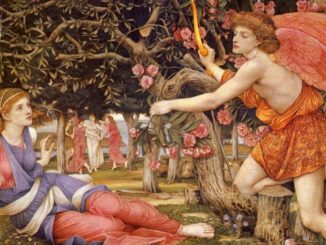
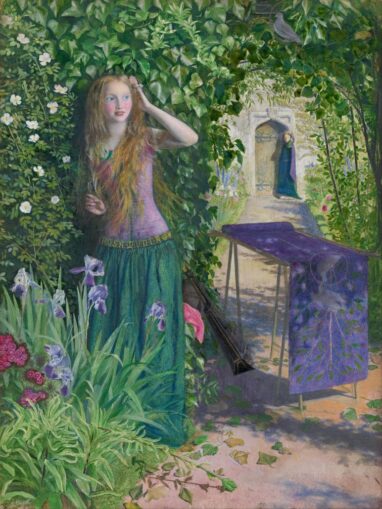
Arthur Hughes, Public domain, via Wikimedia Commons
My two favourite poets are William Butler Yeats and Dylan Marlais Thomas. I have been to each of their graves to pay my respects and toured the house where D.T. was born, also the shed overlooking the sea at Laugharne where he wrote many of his poems. I have also been to Dublin where W.B. was born but I did not realise at the time that was his birthplace.
I have not read the whole canon of either; they were both so productive but I keep coming back to their works and I shall explore further. This is one of my favourites from DT :
I see the boys of summer in their ruin
Lay the gold tithings barren,
Setting no store by harvest, freeze the soils;
There in their heat the winter floods
Of frozen loves they fetch their girls,
And drown the cargoed apples in their tides.These boys of light are curdlers in their folly,
Sour the boiling honey;
The jacks of frost they finger in the hives;
There in the sun the frigid threads
Of doubt and dark they feed their nerves;
The signal moon is zero in their voids.I see the summer children in their mothers
Split up the brawned womb’s weathers,
Divide the night and day with fairy thumbs;
There in the deep with quartered shades
Of sun and moon they paint their dams
As sunlight paints the shelling of their heads.I see that from these boys shall men of nothing
Stature by seedy shifting,
Or lame the air with leaping from its heats;
There from their hearts the dogdayed pulse
Of love and light bursts in their throats.
O see the pulse of summer in the ice.But seasons must be challenged or they totter
Into a chiming quarter
Where, punctual as death, we ring the stars;
There, in his night, the black-tongued bells
The sleepy man of winter pulls,
Nor blows back moon-and-midnight as she blows.We are the dark deniers let us summon
Death from a summer woman,
A muscling life from lovers in their cramp
From the fair dead who flush the sea
The bright-eyed worm on Davy’s lamp
And from the planted womb the man of straw.We summer boys in this four-winded spinning,
Green of the seaweeds’ iron,
Hold up the noisy sea and drop her birds,
Pick the world’s ball of wave and froth
To choke the deserts with her tides,
And comb the county gardens for a wreath.In spring we cross our foreheads with the holly,
Heigh ho the blood and berry,
And nail the merry squires to the trees;
Here love’s damp muscle dries and dies
Here break a kiss in no love’s quarry,
O see the poles of promise in the boys.I see you boys of summer in your ruin.
Man in his maggot’s barren.
And boys are full and foreign in the pouch.
I am the man your father was.
We are the sons of flint and pitch.
O see the poles are kissing as they cross.
Dylan Thomas
Sonnet 116
Let me not to the marriage of true minds
Admit impediments. Love is not love
Which alters when it alteration finds,
Or bends with the remover to remove:
O, no! it is an ever-fixed mark,
That looks on tempests and is never shaken;
It is the star to every wandering bark,
Whose worth’s unknown, although his height be taken.
Love’s not Time’s fool, though rosy lips and cheeks
Within his bending sickle’s compass come;
Love alters not with his brief hours and weeks,
But bears it out even to the edge of doom.
If this be error and upon me proved,
I never writ, nor no man ever loved.
William Shakespeare
Into my heart an air that kills
Into my heart an air that kills
From yon far country blows:
What are those blue remembered hills,
What spires, what farms are those?That is the land of lost content,
I see it shining plain,
The happy highways where I went
And cannot come again.
A.E. Houseman
On Wenlock Edge the wood’s in trouble;
His forest fleece the Wrekin heaves;
The gale, it plies the saplings double,
And thick on Severn snow the leaves.‘Twould blow like this through holt and hanger
When Uricon the city stood:
‘Tis the old wind in the old anger,
But then it threshed another wood.Then, ’twas before my time, the Roman
At yonder heaving hill would stare:
The blood that warms an English yeoman,
The thoughts that hurt him, they were there.There, like the wind through woods in riot,
Through him the gale of life blew high;
The tree of man was never quiet:
Then ’twas the Roman, now ’tis I.The gale, it plies the saplings double,
It blows so hard, ’twill soon be gone:
To-day the Roman and his trouble
Are ashes under Uricon.
A.E. Houseman
Gillygangle 2025