Many thanks to our host and mentor Swiss Bob for prompting me to write an article about solutions to the loss of lighting during power outages. Obviously oil lamps and lanterns won’t run a laptop, fridge or recharge your mobile, but at least they’ll provide a bit of lighting so you can see what you’re doing.
I’m the sort of prepper that starts getting ready for the end times and builds up stock only to realise that I’m way ahead of the game. Gradually we eat our way through the reserves of chickpeas before they go out of date and I fail to replenish them. This is in no way due to constructive criticism from the boss. Sometimes I have to hide my preparations….
A couple of years ago I made the cardinal error of having another great idea.
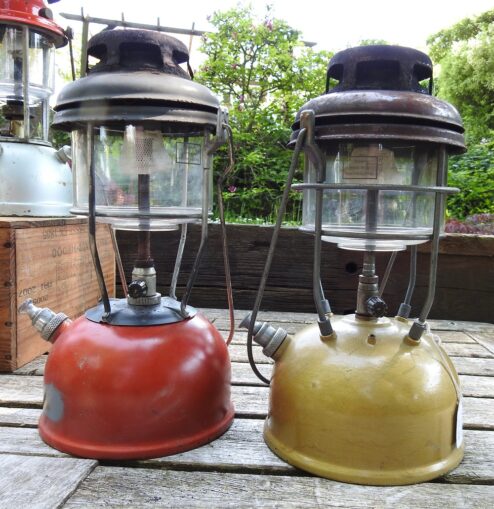
The idea was to buy a pressure lamp for use in emergency situations in addition to torches and candles. To get started I purchased from a well-known auction site a pair of Tilley lanterns as that was the only name I knew. How time flies, I see it was 2022 to be precise. I have found that life is always more interesting when trying to run before learning to walk so why buy something that works when you can buy two broken things?
As some of you know a pressure lamp is a device that produces light from the ignition and burning of vapourised fuel oil.
The majority of lamps do this by the pressurisation of a storage tank which then forces fuel up through a pre-heated nozzle where it is vapourised and ignites producing light. Various fundamental principles of physics are at work to create this joyous event which I have no intention of getting bogged down in at this point.
As neither of the lamps I had bought were working, I set about investigating whether spares were available for these. Spares are available although not cheap. However with new lanterns starting at £180 or so upwards, paying half that to get a working lamp is VFM (includes the joy of fixing a broken something and making it work).
I rapidly discovered the wonderful world of pressure lanterns and was pleased to find that there were many other makes of lantern available and I fell into the trap of collecting them!
Here’s a picture of my working lamps, I also have a couple of others waiting for me to find enough quiet time to concentrate on getting them to work.
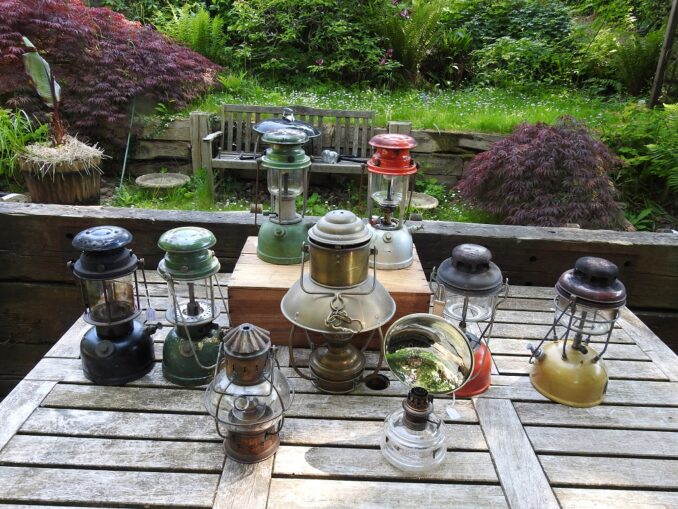
The two lanterns at the back of the picture are Bialaddin lamps, the green one a 310 and the red a 315 both from the mid to late 1950s.
The dark green one in the middle left is a Bialaddin 300x from the 1940s and the black one is a Vapalux 320 from the 1960s.
Astute Puffins will note that there are three other lamps in the picture that are not pressure lanterns. The problem with collecting lamps is that sometimes you see something that looks interesting but isn’t what you were concentrating on originally. The big one in the centre came from a local auction with the smaller one on the right, it’s a Dutch made hanging lantern with a 20”’ (Ligne) burner. The smaller one with the glass font and the mercury glass mirror is a German Kaestner & Tobelmann Patent kitchen light “Panzer-Handfest” 10”’ (Ligne) burner a kitchen lantern. The model probably came onto the market in the course of 1909, at the latest at the beginning of 1910, but probably disappeared with a tightening of the range in the time of WW1. With the change to electric lighting the firm went out of business in the 1920s. Spares for these lanterns are now only available from a manufacturer in France and I’m waiting for delivery of a replacement burner and chimney to complete this one.
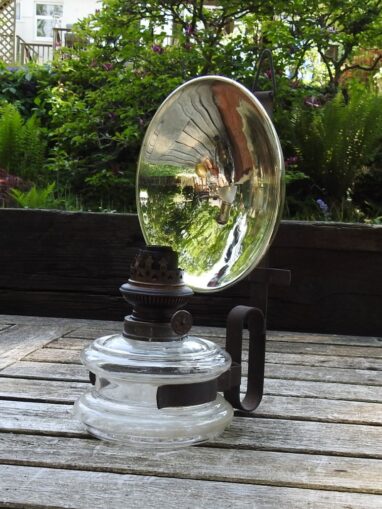
The term Ligne (represented by ”’) is a measurement by which circular burners are defined. In England they are called lines but in France they referred to by their real name. The burner converts a flat wick to a circular one during its passage up through the winding mechanism, quite clever really for such a simple thing as an oil lamp.
The small oil lamp on the left is a Sherwood nautical ‘onion’ lamp with a ¼” round wick which I picked up in an antique shop in Scotland last year. I see we also have another oil lamp in the sitting room and a couple of “pixie” oil lamps on the kitchen window sill that were used as night lights up until the 1950s.
Instructions for lighting a Tilley Storm lantern are found via this link:
https://base-camp.co.uk/instruction.html
More comprehensive information on pressure lamps and spares can be found by following the links below.
https://tilleylamp.co.uk
https://www.tilleylampsandstoves.com
https://classicpressurelamps.com
https://www.base-camp.co.uk
https://terry-marsh.com
Unfortunately and quite by accident I recently got my hands on a Swedish Optimus 00 camping stove that works on the same principles as pressure lamps and I own a Canadian made Coleman petrol fired stove which I bought in the 1990s. There is no hope once the bug hits.
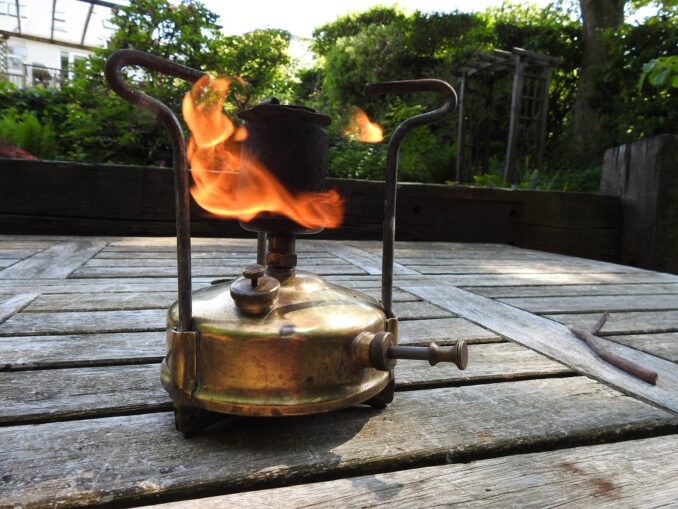
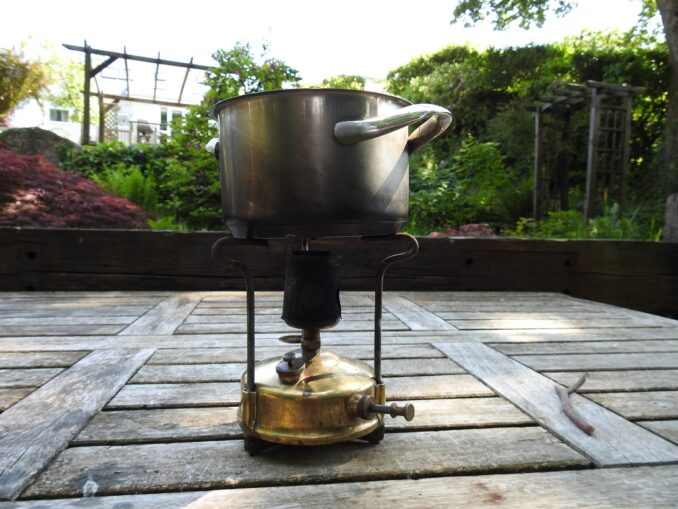
Please see the following link for more information: https://classiccampstoves.com
Action shot of lamps alight.
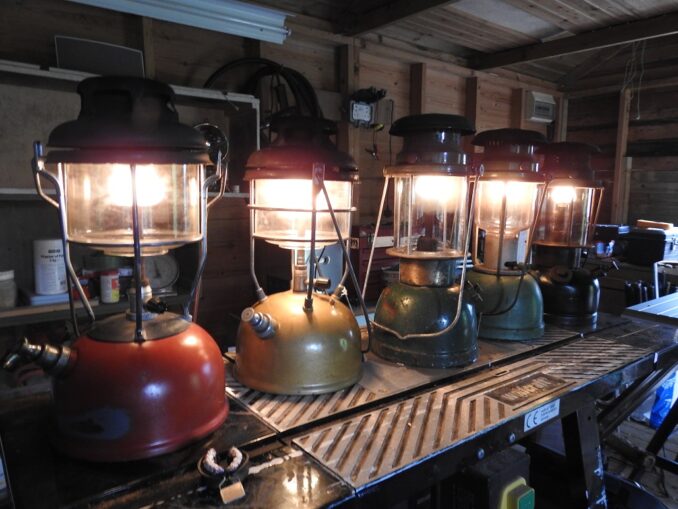
As with many prima donnas, my favourite (the Bialaddin 315) refused to fire up properly on the day. A quick check revealed that the pump leather retaining nut had come off, so no chance of pressurising or firing up the lamp!
Enjoy your collecting!
© text & images Blowmedown 2025