
 Welcome back, my friends, to the flamboyance that never ends! Greetings, pop pickers, and please be welcome to tonight’s cinematic edition of Fabulously Flamboyant Friday and yet another of our fortnightly mastications upon the meat and gristle of contemporary (and not so contemporary) culture.
Tonight, dear reader, as we respectfully mark both Bladder Leakage Awareness Week and the ancient Celtic new year (tomorrow night at sundown on the 31st of October), we shall ponder some of the most successful soundtrack albums in UK chart history – not ‘arf!
Why soundtrack albums? Well, for more than half a century, the British record-buying public has demonstrated a pronounced and peculiar affection for film soundtrack albums. From the wholesome entertainment of Rodgers and Hammerstein to the disco extravagance of the Bee Gees, the romantic nostalgia of Dirty Dancing and the extraordinary (if somewhat irritating) vocal gymnastics of Whitney Houston, movie soundtracks have repeatedly achieved the kind of sales figures about which most recording artists could only dream.
But why have British audiences been so enthusiastic about buying the music from their favourite films? And what do the six landmark albums we shall consider tonight tell us about the changing habits of the nation’s record-buying public? So, if you’re all sitting comfortably? Then we’ll begin.
I think we’ll start our journey way back in post-war Blighty. Columbia Records in the good ol’ US of A had done the world an enormous service by inventing what is still my favourite music storage format, the 12-inch LP. Hollywood was booming, and watching a film at a local cinema was a fairly regular experience for most post-war Poms. TV was in its infancy. There were certainly no streaming services or DVDs and, for most of cinema’s history, there had been no commercially available video recordings (and we won’t at this point consider my Uncle Mickey’s extensive, if somewhat dodgy, 8 mm gentlemen’s special-interest collection).*
So, although you might remember the story, admire the performances or find yourself humming a particularly memorable tune on the way back to your 1950s hovel, unless the film happened to return to your local cinema, your opportunities to experience it again were distinctly limited. And that’s where the soundtrack album enters our tale.
The soundtrack album offered something rather special: a way of taking a little piece of the cinema home. For the price of an LP, audiences could revisit their favourite musical moments whenever they wished. A collection of songs originally associated with a two-hour film could become a permanent fixture in the family living room.
And British audiences embraced this idea with extraordinary enthusiasm. Indeed, anyone examining the early history of Britain’s album charts might reasonably conclude the country was populated almost entirely by people with an insatiable appetite for Hollywood musicals. Long before the Beatles, Stones, Zeppelin and Pink Floyd established their dominance of popular music in the album market, soundtrack recordings enjoyed astonishing commercial success.
The first great example was South Pacific, an album that washed up on our shores during the late 1950s and proceeded to dominate British record-buying habits. It was followed by The Sound of Music in the 1960s, which became another musical phenomenon whose chart achievements remain remarkable more than six decades later.
By the late 1970s, however, the soundtrack had undergone a dramatic transformation. Gone were the lush theatrical orchestrations and reassuring Broadway melodies. In their place came thumping disco rhythms, leather jackets, polyester suits, teenage romance and John Travolta demonstrating an apparently inexhaustible supply of cheesy dance moves.
Saturday Night Fever and Grease transformed soundtrack albums into powerful extensions of contemporary pop culture. A decade later, Dirty Dancing would prove that dusty old recordings could generate spectacular new sales, and in 1992 The Bodyguard would demonstrate how a major recording artist and a Hollywood blockbuster could combine to produce a planet-rodgering international commercial phenomenon that would have record label bosses staggering under the enormous weight of their ill-gotten gains.
But let’s not get ahead of ourselves. Let’s begin in 1959, with South Pacific, the soundtrack that conquered Britain.
The Britain of the late 1950s was a very different place from the country we live in now. We were simple folk in a country emerging from post-war austerity, where rising prosperity and improving domestic technology were gradually transforming everyday life. Television ownership was increasing, and the record player was becoming an increasingly desirable household possession.**
The recent introduction of the long-playing record had made it possible to enjoy extended musical performances without repeatedly changing fragile 78 rpm shellac discs. And, just like radio, this new-fangled format offered an extended listening experience that could be enjoyed by the whole family. For record companies, this opened up an exciting new commercial opportunity. And South Pacific was precisely the sort of recording that appealed to this emerging market.
Based on the hugely successful Rodgers and Hammerstein stage musical, the 1958 film featured Rossano Brazzi and Princess Mitzi Gaynor (long before she adopted her fabulous plywood teeth) throat-warbling their way through a selection of beautifully crafted songs that were already recognised as standards: Some Enchanted Evening, I’m Gonna Wash That Man Right Outa My Hair and There Is Nothin’ Like a Dame.
These were all stone-cold classics: songs that offered an intoxicating combination of romance, escapism and familiar melodies. For British audiences accustomed to the relatively restrained entertainment of the post-war years, the film’s spectacular Pacific setting provided a welcome distraction from the grim realities of everyday life in post-war Britain. As a result, both the film and the soundtrack album proved to be almost unbelievably successful.
According to the Official Charts Company’s historical records, South Pacific accumulated 115 weeks at No. 1 on the British albums chart and spent 312 weeks on the chart altogether. It is an achievement that no subsequent album (not just soundtrack albums, any album) has ever matched in terms of weeks at the top. Historical sales figures put its British total at approximately 1.8 million copies by the turn of the century.
To appreciate the significance of that figure, remember that the British album market of the late 1950s was considerably smaller than the one that would emerge during the 1970s and 1980s. Record players were still relatively expensive, LPs represented a meaningful household purchase, and the album had yet to become the everyday consumer product that later generations would take for granted.
Nevertheless, British families purchased South Pacific in extraordinary numbers. Back then, records were frequently bought as shared household entertainment rather than as expressions of individual musical identity. A family might own relatively few albums, but those recordings would be selected for their cross-generational appeal. There was also an element of aspiration. Owning a collection of LPs suggested cultural sophistication and participation in the modern consumer age. Nevertheless, the main reason South Pacific was such a huge success was that it contained some seriously great music. And, judging by its monstrous sales, almost everybody wanted a copy.
If South Pacific established the commercial potential of the soundtrack album in the UK market, The Sound of Music took the concept to its logical conclusion.
Released in 1965, the film starred Julie Andrews as Maria, the spirited governess whose arrival transforms the lives of the von Trapp family. Its songs, once again written by the lavishly talented duo of Rodgers and Hammerstein, were perfectly suited to the record-buying habits of the period.
Do-Re-Mi, My Favourite Things, Edelweiss, Climb Ev’ry Mountain and, of course, the epic title song were all instantly memorable compositions that, once again, had significant cross-generational appeal. The film itself was an enormous box-office success and its soundtrack was an equally impressive chart-rodgering phenomenon.
The Official Charts Company records 70 weeks at No. 1 and 372 weeks on the British albums chart. Historical sales data published in 2006 put its British sales total at approximately 2.44 million copies. But perhaps the most remarkable aspect of this enormous success is that this was happening at a time when the British music industry was undergoing one of the most dramatic transformations in its history.
By 1965, Beatlemania was firmly established. The Rolling Stones were rapidly becoming international stars, Bob Dylan was revolutionising popular songwriting, and electric guitars were increasingly replacing orchestras as the defining sound of contemporary youth culture. Yet the British public continued buying The Sound of Music in enormous quantities.
It is tempting to imagine a nation divided between two musical camps. In one corner, a bunch of deeply unhygienic teenagers enthusiastically purchasing the latest devil’s music by the Beatles, the Rolling Stones and other disreputable beatniks and art-school dropouts of dubious parentage. In the other corner, their parents, apparently determined to keep the sweetness and light of Julie Andrews (impeccably turned out, no doubt, in a smashing twin-set) at the top of the album charts for as long as was humanly possible.
The reality, of course, was considerably more complicated, with many households enjoying a wide variety of music. But the contrast highlights an important characteristic of the British record market at that time: the enormous purchasing power of adults who regarded LPs as long-term additions to the family entertainment collection. And the musical soundtrack was still ideal for this purpose.
By the end of the 1960s, however, the record industry was changing. The album was increasingly becoming an artistic statement in its own right, rather than merely a collection of familiar songs. This new environment might not seem well suited to the lumbering old dinosaur that was the Hollywood soundtrack album, but that would not prove to be the case. And our next great soundtrack album demonstrated this quite clearly. It would face the challenge of changing times by pulling on its tight pants and dancing to a very different beat.
By the middle of the 1970s, Britain had become a country of dedicated album buyers. The growth of rock music, progressive rock and the concept album had transformed the LP into the preferred format for serious music enthusiasts. Teenagers who once spent their pocket money on individual singles were now purchasing albums by artists such as Pink Floyd, Led Zeppelin, David Bowie and Fleetwood Mac.
Meanwhile, the emergence of portable cassette players and in-car music systems was beginning to change where and when recorded music could be enjoyed. And it was against this background that Saturday Night Fever arrived.
Released in Britain in 1978, the soundtrack accompanied the 1977 film starring John Travolta as Tony Manero, a young Brooklyn man whose life revolves around his weekend dancing escapades. Although the film explored themes considerably darker than its superficial disco image suggested, its soundtrack was a cheesy celebration of the burgeoning contemporary dance music scene in the US. And dominating that soundtrack were the high-pitched, bat-bothering compositions and performances of the Bee Gees.
The Bee Gees had already enjoyed considerable international success, but their involvement with Saturday Night Fever elevated them to an entirely different level. Stayin’ Alive, Night Fever, How Deep Is Your Love and More Than a Woman all became defining recordings of the disco era.
Other artists, including Yvonne Elliman, Tavares and KC & the Sunshine Band, contributed to an album that captured the excitement of contemporary nightclub culture. But the contributions of the Bee Gees utterly dominated both film and soundtrack.
For British buyers, Saturday Night Fever represented a significant departure from the traditional film soundtrack. Rather than simply reproducing the musical experience of the cinema, it functioned as an essential contemporary pop album. Indeed, many people who purchased it were probably more interested in the Bee Gees than Travolta’s polyester strides and his advanced hoofing abilities.
The album spent 18 weeks at No. 1 in Britain and achieved historical sales of approximately 2.2 million copies. Perhaps more importantly, its substantial success demonstrated the increasingly close relationship between cinema, radio, television and the record industry.
A song heard in a film could become a radio hit. A radio hit could encourage someone to see the film. And the popularity of the film could persuade audiences to purchase the complete soundtrack. The various elements reinforced one another. Record companies had stumbled upon a remarkably effective commercial formula – one they were very keen to repeat. And so, inevitably, cue Grease.
If Saturday Night Fever demonstrated the commercial power of contemporary dance music, Grease proved that nostalgia could be equally profitable.
Released in 1978, the film saw John Travolta return to the musical format, this time alongside a ridiculously cute Olivia Newton-John, displaying weapons-grade sweetness (quite capable of killing off diabetics) and levels of Alice-band wholesomeness that could seriously traumatise both Mormons and unwary members of the Amish community.
Based on a successful stage production, Grease presented a romanticised vision of American teenage life during the late 1950s. Its soundtrack mixed theatrical songs with newly written pop material, resulting in one of the most commercially successful combinations in film music history – it also seemed to feature some of the oldest schoolkids in American film history.
Nevertheless, the hits were extraordinary: You’re the One That I Want and Summer Nights both reached No. 1 in Britain, while Newton-John’s Hopelessly Devoted to You became another enormously successful single. Frankie Valli’s recording of the title song, written by Barry Gibb, provided a touch of contemporary flavour.
The result was an album that successfully operated on several different levels: younger audiences enjoyed the excitement of the film and its charismatic stars, older listeners recognised the affectionate references to the music and fashions of their own youth, and dedicated pop fans could enjoy the album without necessarily having any particular enthusiasm for the fabulously flamboyant nature of musical theatre.
The record-buying public lapped it up and bought it by the truckload. Grease spent 13 weeks at No. 1 on the British albums chart, with UK sales and certification eventually reaching approximately 2.7 million units.
What makes Grease especially interesting is the way it anticipated the enormous success of Dirty Dancing almost a decade later: both films used idealised versions of earlier periods in American popular culture, both featured memorable romantic relationships, and both generated soundtrack albums that appealed to audiences considerably broader than the films’ principal teenage demographic.
But there was an important difference: Grease largely recreated the musical styles of the 1950s through contemporary performances. Dirty Dancing, on the other hand, would make extensive use of genuine recordings from the early 1960s. For the British record industry, that distinction would prove commercially significant.
Of all the albums examined here, Dirty Dancing is arguably the most remarkable. Released in 1987, the film starred Patrick Swayze and Jennifer Grey in a romantic drama set at a holiday resort during the summer of 1963. It was a relatively modest production, and few could have anticipated the scale of its commercial success. The film became a cultural phenomenon and its soundtrack became one of the biggest-selling albums in British music history.
The album’s achievement was all the more surprising because much of its music was far from new. Recordings by the Ronettes, the Contours, Otis Redding and others introduced younger listeners to the sounds of the early 1960s. Alongside them appeared contemporary recordings including (I’ve Had) The Time of My Life by Bill Medley and Jennifer Warnes, Eric Carmen’s Hungry Eyes and Patrick Swayze’s She’s Like the Wind.
The combination proved to be extraordinarily effective. For older listeners, the soundtrack evoked memories of their youth. For younger audiences, it provided an introduction to music from a period they had never experienced. And for everyone who enjoyed the film, the songs became inseparable from its most memorable scenes.
Crucially, the soundtrack also arrived during a period of significant technological change. By the late 1980s, the British record industry was experiencing the rapid growth of compact disc sales. Vinyl remained popular, and music cassettes still offered a practical alternative for people who wanted to listen in their cars or on portable players. Consequently, Dirty Dancing benefited from an unusually broad selection of formats, and the subsequent sales figures speak for themselves.
Dirty Dancing eventually achieved ten-times platinum certification in Britain, equivalent to three million UK album units – a remarkable achievement for a soundtrack built partly around recordings that were already approximately 25 years old when the film appeared.
The album was an excellent example of how popular films could revive the commercial fortunes of older recordings. The soundtrack, it would seem, could become a bridge between generations. Songs that might otherwise have remained largely confined to oldies radio programmes and specialist compilations were suddenly introduced to millions of new listeners. And the shiny, new-fangled CD format was the perfect vehicle to exploit that enormous sales potential.
The UK’s record companies were not slow to spot the potential. Their old tapes were quickly dusted down, remastered (often very badly) for CD, and before you could say, ‘Sorry, buddy, there’s no time to discuss your royalty rates for digital re-releases’, the UK market was flooded with ye memorable olde albums that had long since been deleted from the vinyl catalogues of the UK’s major record labels. And, oh boy, did they sell.
By the early 1990s, the relationship between Hollywood and the international music industry had become increasingly sophisticated: record companies recognised that a successful film could provide enormous promotional opportunities for re-releases and new album sales; film studios understood that a hugely popular song could generate valuable publicity for a forthcoming release.
And few productions demonstrated the power of this relationship more effectively than The Bodyguard – the 1992 film starring Kevin Costner and Whitney Houston in a romantic thriller involving a successful singer and the security specialist employed to protect her.
In my humble opinion, it’s a dog of a film. If you gave me the choice of having an appendage nailed to a coffee table or re-watching the film, I confess I would probably re-watch the film. But I’d have to think about it. However, the punters loved it and its commercial success was substantial. The soundtrack was an even bigger success. In fact, it was an absolute monster.
Houston recorded six songs for the album, including I Will Always Love You, a track originally written and recorded by Dolly Parton. Houston transformed Dolly’s soppy country ballad into a spectacular vocal tour de force that became an enormous worldwide hit and (I grudgingly have to admit) one of the defining pop performances of the 1990s.
Its mahoosive international success provided the perfect demonstration of how a soundtrack single could promote both a film and an album. The album featured contributions from several other artists, but its commercial identity was overwhelmingly associated with Houston.
Rather than being perceived simply as a compilation of film music, The Bodyguard functioned almost as an additional Whitney Houston album. That distinction was crucial. Fans who might not ordinarily purchase a soundtrack were attracted by the opportunity to own several new Houston recordings. Meanwhile, people who enjoyed the film could purchase the album as a souvenir of their cinematic experience.
The result was an extraordinary international success. Guinness World Records has identified The Bodyguard as the world’s biggest-selling soundtrack album of all time, reporting sales of more than 44 million copies worldwide.
The Bodyguard demonstrated the importance of carefully coordinated international promotion. The film, its leading star, its principal single and the soundtrack album all benefited from one another’s success. It was the soundtrack album as a fully integrated, cross-media entertainment product. And very few, if any, examples have ever proved to be more effective at this marketing task. However, although I can admire its monumental success, I still can’t stand it. In fact, I much prefer the soundtrack to The Jungle Book.
Anyway, that’s probably quite enough of my soundtrack slobbering for one evening. So I shall say TTFN to one and all.
May all your passages salubrious, your sports bags well placed and your puddles well jumped.
Goodnight, and may your Frog go with you – not ’arf!
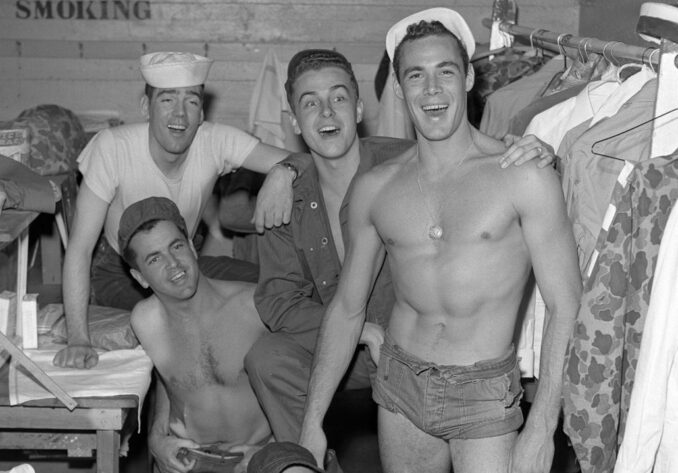
Featured image: Cast members of South Pacific in their dressing room (cropped). Licensed under the Creative Commons Attribution 4.0 International licence.
Hat tip to All Music, Official Charts, Wikipedia, Best Selling Albums, Guinness World Records and Dave’s Music Database for all the facts and info. And a big thank you to Chat and Grok, by whom all the hard work is done.
Notes
* When Uncle Mickey sadly but inevitably dropped off the perch, a number of his nephews and I lobbied hard for the preservation and careful curation of this valuable family archive. Sadly, his widow had other ideas and consigned the films to the cleansing fires of a garden bonfire, along with his extensive collection of Health & Efficiency magazines. Family rumour suggests their front-garden pampas grass also disappeared around the same time…
** I still have a 1950s Garrard 301 turntable. It still works perfectly and it is still one of the finest turntables I have ever owned. A fully refurbished 301 (refurbished by SME – Garrard’s current owner) will set you back about £30k these days. I had quite a conversation about that with my home insurers, I can tell you.
© Ivory Cutlery 2026