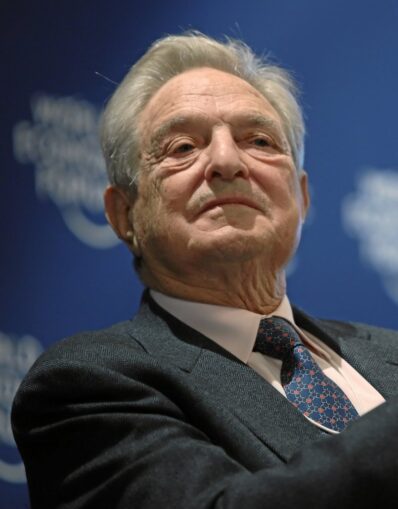
The tearoom on Chancery Lane was a haven of quiet opulence, its walls lined with damask and its tables adorned with crisp linen, where the soft clatter of teaspoons against bone china composed a subtle overture. On an autumn afternoon in 1956, George Soros sat opposite Robert Mayer, the air between them thick with the scent of bergamot and unspoken possibility. Soros, his lean frame taut with resolve, pushed a lock of dark hair from his forehead and spoke in a hushed, deliberate tone. “I’m finished here,” he said, his words carrying the weight of a decision long wrestled. “The firm — it’s not where I belong anymore.”
Mayer, whose calm demeanor masked a keen opportunist’s mind, set his teacup down with the precision of a man accustomed to calculated risks. His eyes, sharp and appraising, met Soros’s. “Funny you should say that, George,” he replied. “My father’s got a small brokerage in New York, and he’s on the hunt for someone with your kind of fire. I’ve thought about mentioning it before, but it felt…… indelicate, trying to steal you away.” He paused, letting the words settle like dust after a storm. “Now, though, it seems the stars have aligned.” Soros leaned back, his fingers tracing the rim of his cup as his mind churned. New York—the city where dreams were minted and fortunes spun on the edge of a coin. “Tell me about it,” he said, his voice steady, a spark of hunger flickering in his gaze. “Tell me everything.” At a crucial juncture in George Soros’s life, Robert Mayer had emerged as a harbinger of opportunity. Now, with Soros’s plans laid bare, the circumstances had shifted dramatically. Soros, though unable to sever ties instantaneously, acted with alacrity. This serendipitous offer would propel him into the crucible of American finance, positioning him at the very epicenter of opportunity.
Yet, the path was not without obstacles. The authorities, skeptical of Soros’s indispensability, denied him a visa, citing his youth — at 26, he was deemed neither uniquely qualified nor irreplaceable by American talent. Nevertheless, through a stroke of fortune and nascent connections with F. M. Mayer’s enterprise, the impasse was overcome. In September 1956, George Soros set foot on American soil, a moment that marked the inception of his ascent. For the next three years, until 1959, Soros toiled under Mayer’s aegis, trading stocks with a focus that belied his limited scope of action. By his own admission, he was no investor then — merely a trader, navigating the markets with constrained autonomy. Yet, his efficiency was undeniable. Soros devised a strategy that would become a hallmark of his career: he gravitated toward under researched/explored sectors, a pursuit that demanded both intuition and audacity. This approach, while risky, granted him a near-monopolistic edge. In uncharted territories, scant knowledge sufficed to excel, allowing him to outmanoeuvre competitors. As these fields matured and specialists emerged, Soros, with prescience, withdrew, ceding the stage to others. He styled himself a “pre-expert,” a pioneer who thrived on the cusp of discovery. In candid reflections, Soros has acknowledged a certain indolence, a propensity to exert only the effort required. He has mused, with disarming self-criticism, that in his most prosperous years, he laboured least, only to redouble his efforts when fortunes waned. Even during his earlier tenure at Singer & Friedlander, he was not renowned for meticulousness or rigour. Yet, when he ventured into a new domain, his approach transformed. A selective perfectionist, Soros immersed himself deeply in what mattered, while matters he deemed peripheral fell by the wayside. This disciplined pragmatism, as history attests, served him extraordinarily well.
At F. M. Mayer, Soros honed his expertise in European equities, a niche that captivated American banks and institutional investors. The post-war European landscape, vibrant with possibility, was fertile ground for speculation. The establishment of the European Coal and Steel Community signaled the march toward the Common Market, and whispers of a united Europe—a veritable United States of Europe—stirred the ambitions of financiers. Soros, attuned to these currents, positioned himself as a conduit between continents, capitalizing on the burgeoning interest in Europe’s economic renaissance. This era also bore witness to the clandestine gatherings of the Bilderberg Group, first convened in 1954 at its eponymous Dutch hotel. Shrouded in secrecy, these meetings yielded little to public scrutiny, with terse, guarded statements their only yield. Officially, the group disavowed any influence over political machinations, yet decades of evidence suggest otherwise.
From its inception, the Bilderberg conferences deliberated the unification of Europe and the advent of the Euro, setting the stage for seismic shifts in global finance. In this crucible of ideas, Soros found himself navigating a world where foresight and discretion were paramount, his early forays laying the groundwork for a career that would redefine the boundaries of financial influence. Soros had by then parted ways with E.M. Mayer and joined the ranks of Wertheim & Co. Reflecting on the landscape of European enterprises, he paints a picture of an era shrouded in informational scarcity. As a trader and analyst of European securities, Soros describes himself as a one-eyed man among the blind, navigating a terrain where the paucity of concrete data compelled him to craft speculative memoranda. Yet, this very limitation became his advantage, positioning him leagues ahead of his peers. He had unearthed a niche in the market and wielded it with finesse, earning the attention and counsel of the industry’s titans. With a quiet pride, Soros recalls this period as his first significant triumph. He stood at the epicentre of the financial world, with even the colossi of the industry—J.P. Morgan among them—hanging on his every word. They sought the rare insights into European markets that only he could provide, for no one else in the United States had ventured so deeply into this uncharted domain. His was a pioneering endeavor, bold and singular.
At Wertheim & Co., Soros immersed himself in the study of German banks and insurance firms, presenting his analyses to J.P. Morgan. Though time constraints precluded a more exhaustive study, his insights sufficed to convince the firm of an imminent surge in European stock values. Entrusted with the mandate to invest, Soros acted decisively, and the markets responded with a resounding boom. Yet, this triumph was short-lived. The introduction of a 15 percent surcharge on foreign investments, enacted through JFK’s Interest Equalization Tax, struck a devastating blow to Soros’s burgeoning enterprise. Almost overnight, the edifice of his European dealings crumbled. Though a handful of profitable transactions lingered, Soros was compelled to chart a new course, his vision undimmed but his path irrevocably altered………………
To be continued
© DJM 2026