
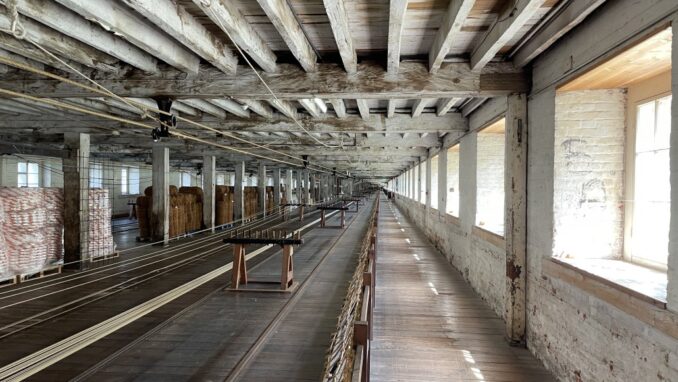
Diacius, CC BY-SA 4.0, via Wikimedia Commons
One of the Corsican Corporal’s big things was what was known as the Continental System. This was him forcing all the countries he controlled and as many others as possible not to do business with Great Britain. Now I always thought this just to put us in an economic stranglehold and to some degree it was but we still had a large Empire we could trade with providing the Royal Navy was able to rule the waves.
In those days, 1805, we had a Navy of about 950 ships and about 140,000 sailors and marines. Of these 950 ships about 135 were ships of the line. Those ships carried 60 or more cannon.
The Royal Navy blockaded French coasts on 16th May 1806 and Napoleon’s reply came on the 21st November when the Continental System was introduced. This prohibited the French Empire from any trade with the British Empire. The French blockade was known as the Berlin Decree and forbade the import of British goods into any country allied with or dependent upon France. Even mail was forbidden.
Of course there was much smuggling and extensive trade was still happening via Spain and Russia. In an attempt to correct this Napoleon ended up in the Peninsula War and the invasion of Russia in 1812. Both of these excursions ended badly for the frogs.
So far nothing new there but it rather looks like the Continental System was aimed at the Royal Navy and its supplies. Destroy the Royal Navy and the blockade will end. In the early 1800s the Royal Navy’s supply system was probably the largest industry in the world. This wasn’t just for building ships but the whole rigmarole of keeping them afloat.
On average a RN ship needed 27 miles of rope and this had to be replaced every two years, that is for every ship. As those of you living near the sea will know salt water is extremely corrosive. The comes to 20,000 miles of rope each year. Most of this came from Russia, the Russians made money and we got the rope we needed. Napoleon naturally frowned on this.
Each mast came from a dead straight tree, over 100 feet of it. No trees in the UK were tall enough so we imported them from Russia and America.
As well as 27 miles of rope a ship needed 4 acres of canvas, 2,000 oak trees for the hull, hundreds of barrels of tar and pitch to waterproof the hull. The sails could last between 5 and 10 years. The Royal Navy had a massive infrastructure with docks and warehouses catering for all these needs and refits.
After the battle of Austerlitz when Russia was defeated the Tsar agreed to stop supplying Britain. Overnight Russian and Baltic exports collapsed. However the crafty Brits had been planning for this day. For 100 years we had been planting white oaks in New England. Any tree there with a girth of 2 feet or more was earmarked for the Royal Navy and the colonists were forbidden to cut it down. They were not happy and this was another contributing factor for the American Revolution.
Thirty years before this Britain had started planting trees in the Caribbean, South Africa and India. Some of those plantations are still there. When the hemp for ropes was cut off we turned to India where the East India Company had been planting hemp for decades.
The result of the Continental System was that we were importing what we needed from our Empire. There was also a fair bit of smuggling goods via neutral ships from Russia, the Baltics and Denmark.
Even though Russia had agreed to stop all trade with Britain, there was plenty of smuggling, enough to cheese Napoleon off and enough to cause the 1812 invasion of Russia. As we all know the Grand Armée lost about 450,000 men in that disastrous campaign and France never really recovered.
This has not touched on the other supplies for the Navy such as biscuits, meat and Rum. Woe betide the man who tried to deprive the matelot of his Rum, it was probably more important than the bum and baccy.
Could this whole story be summarised as a load of old rope.
© well_chuffed 2026