
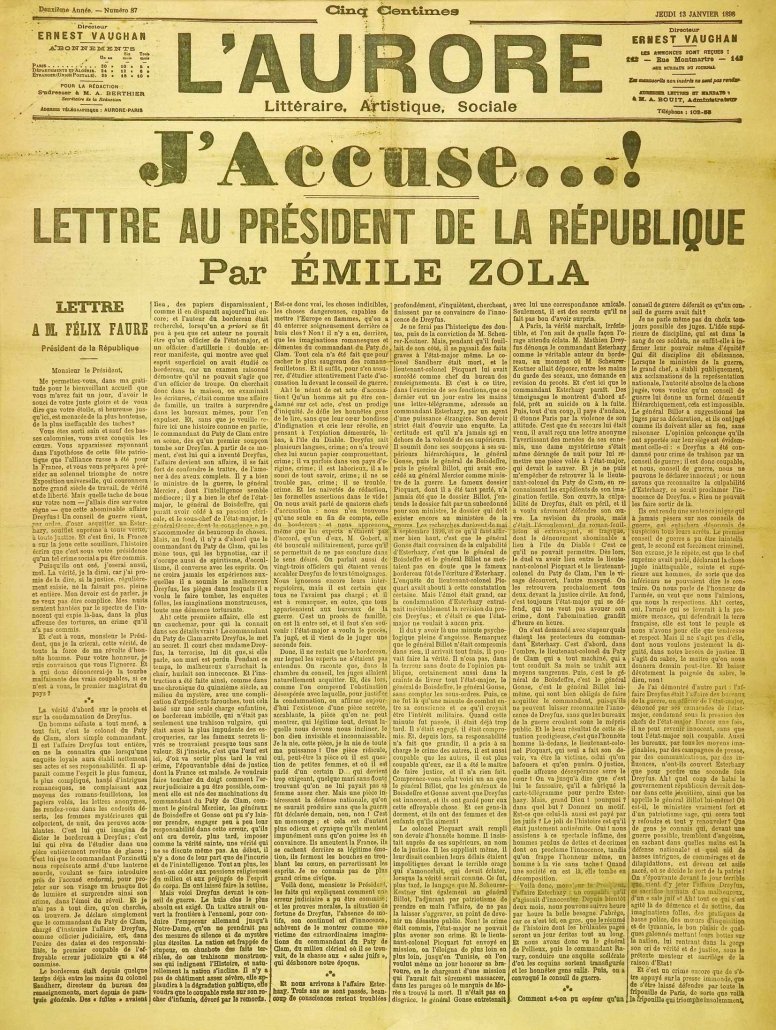
Émile Zola, Public domain, via Wikimedia Commons
“My fiery protest is simply the cry of my very soul. Let them dare, then, to bring me before a court of law and let the enquiry take place in broad daylight! I am waiting.”
— Émile Zola, *J’Accuse…!* (13 January 1898)

Paul Cézanne, Public domain, via Wikimedia Commons
Imagine being accused without notice or evidence.
Not tried in a court.
Not allowed to defend yourself.
Nothing presented before a jury of your peers.
No charge sheet. No indictment. No adversarial hearing. No judgment.
This is neither habeas corpus nor jurisprudence. It is not law at all. It is executive diktat—punishment imposed by administrative fiat rather than judicial process. In common-law terms, it is power exercised *ultra vires*. In continental terms, it is punishment without *procès*. In any society still claiming adherence to the rule of law, such a procedure should be impossible.
And yet, it has occurred—in December 2025.
There are moments when history does not repeat itself so much as clear its throat. When the language of power tightens, when dissent is rebranded as danger, and when analysis that strays from orthodoxy is treated as subversion, we should feel a familiar chill. We are living through such a moment now.
I write this not to defend a state, a war, or an ideology—but to defend the idea that serious, credentialed analysis must not be punished simply because it is inconvenient.
The Crime of Nuance
In an age of slogans, nuance has become suspicious. To ask why a conflict emerged is treated as an attempt to excuse it. To examine structural causes is conflated with moral endorsement. And to challenge a dominant narrative is increasingly framed not as debate, but as “harm.”
This is precisely why the work of **Jacques Baud** has become so controversial—and so necessary.
Baud does not fit neatly into the categories modern discourse prefers. He is not a partisan polemicist. He does not speak in absolutes. His analyses are often counterintuitive because they are grounded not in moral theatre but in military logic, historical precedent, and geopolitical incentives. In short, he approaches war the way professionals do, not the way social media demands.
“It is essential to recall here that the Minsk 1 (September 2014) and Minsk 2 (February 2015) Agreements provided for neither the separation nor the independence of the Republics, but their autonomy within the framework of Ukraine.”
— Jacques Baud
Credentials That Demand a Hearing
Baud’s background is not marginal. He is a former colonel in Swiss strategic intelligence, a country whose military culture is built around neutrality, deterrence, and sober assessment rather than expeditionary ideology. He served in senior United Nations roles, including as Chief of Doctrine for Peace Operations, and worked with NATO structures in Ukraine prior to 2014. His professional life has been spent inside the very institutions now dismissing him.
This matters. Democracies are supposed to value dissent more when it comes from insiders who understand the machinery of power. Instead, we are witnessing the opposite: expertise is tolerated only when it confirms policy.
Ukraine and the Refusal of Simplification
Baud’s analysis of the Ukraine war is unsettling precisely because it refuses the comforting binary of good versus evil. He does not deny Russian aggression. He does not romanticize Moscow. But he insists—correctly—that wars do not begin in a vacuum.
He points to NATO expansion, the failure of the Minsk agreements, internal Ukrainian fractures following Maidan, and Western encouragement of a military posture that made escalation likely. He asks uncomfortable questions about whether unlimited arms transfers serve Ukrainian civilians or primarily serve broader strategic goals aimed at weakening Russia. He challenges premature media certainties and calls for forensic standards over instant moral verdicts.
None of this is radical. It is what strategic analysis has always looked like—until now.
Punishment Without Law: The Legal Breach
What has occurred here is not merely political overreach; it is a systemic legal failure.
On 15 December 2025, the European Union imposed sanctions on Jacques Baud—asset freezes and travel bans—without trial, without charges, and without any opportunity for defence. The accusation? Spreading “pro-Russian propaganda” and “conspiracy theories” through his published analyses. Baud, living in Brussels, received no prior notice.
At the most basic level, the principles violated are ancient and foundational:
– *Audi alteram partem* — hear the other side. A core principle of natural justice ignored entirely.
– *Nulla poena sine lege* — no punishment without law.
– *Nullum crimen sine lege* — no crime without pre-existing law.
– Presumption of innocence — abandoned in favour of reputational guilt.
Under Article 6 of the European Convention on Human Rights, every person is entitled to a fair and public hearing by an independent and impartial tribunal, with disclosure of evidence and the right to challenge it. Here, there was none.
In common-law terms, this resembles a bill of attainder—punishment imposed by executive action without trial. Such acts are prohibited precisely because they collapse the separation of powers. The executive accuses, prosecutes, judges, and punishes in a single motion.
That is not law. That is authority unbound.
A Familiar Shadow: Dreyfus Revisited
History offers a warning.
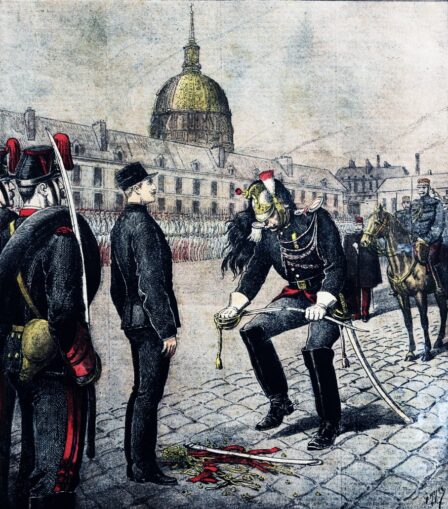
Henri Meyer, Public domain, via Wikimedia Commons
During the Dreyfus Affair, French institutions closed ranks to protect their authority rather than the truth. Evidence was concealed, procedures bypassed, dissenters smeared. Captain Alfred Dreyfus, a loyal officer, was convicted on forged evidence and secret dossiers, his trial a sham.
“I swear that I am innocent. I remain worthy of serving in the Army. Long live France! Long live the Army!”
— Alfred Dreyfus, during his public degradation (1895)
It took Émile Zola’s “J’Accuse…!” to expose the rot and force reform.
“I accuse Lt. Col. du Paty de Clam of being the diabolical creator of this miscarriage of justice… I accuse General Mercier of complicity, at least by mental weakness, in one of the greatest inequities of the century.”
— Émile Zola
Today’s situation is not identical—but it rhymes. Once again, a credentialed insider is treated as a threat not because he is wrong, but because he refuses to conform. Once again, institutions prioritise narrative stability over procedural justice.
That never ends well.
Why This Matters Now
War does not suspend law; it tests it. The moment when power feels most justified is precisely when restraint matters most.
Silencing dissent does not strengthen democracies. It erodes their ability to correct error, to learn, and to distinguish authority from legitimacy.
Today, then, I accuse—not a nation, but a practice:
punishment without trial,
accusation without evidence,
and power without accountability.
History is meticulous in remembering who defended such practices—and who did not.
© Roger Mellie 2026


