
Andrewrabbott, CC BY-SA 3.0, via Wikimedia Commons
‘Sandy Irvine sat outside his tent, shoulders hunched, his hat pulled down over his ears, his scarf shielding his badly sunburned face. His skin had been severely blistered by the sun, and the wind on the North Col had so cracked his lips that drinking and eating had become painful … ‘
What an opening – immediate and vivid; worthy of a thriller, in my opinion. And this is just the prologue: the book ‘proper’ begins with ‘I have no recollection of how old I was when my father first told me the story of Uncle Sandy. I must have been five or six and I dimly remember wondering what he would have been like, this mysterious uncle who disappeared on the upper slopes of the world’s highest mountain.’
Julie Summers is Andrew ‘Sandy’ Irvine’s great-niece, his nephew Peter’s daughter. As a child, she knew all of Irvine’s brothers and sisters fairly well. They seemed, she recalls, ‘inconceivably old and immeasurably tall’ (Irvine himself was 6’ 4”). The book began as a personal quest through the known press cuttings and memorabilia in the family. Looking for further material was largely assumed to be a fool’s errand, as relatives assured Julie she already had all that there was, and that Sandy’s father Willie, devastated by his son’s death, would have destroyed anything relating to Sandy as being too painful to keep. Then an uncle remembered an old ice axe which had been kept on a wall in the gun room of Willie’s house in Wales … and Sandy’s binoculars … and a boat he had made as a child. Eventually, some cousins did a final trawl through the family attics, and three old trunks were found: the last one held the treasure. Letters of condolence, Sandy’s own correspondence before and during his Everest trip, photographs, his address book, details about his award-winning rowing career and motorcycle expeditions, receipts, plans, diagrams, maps and articles from the local papers of the time emerged, forming a priceless archive.
The story of Mallory and Irvine has been told many times, and doubtless will continue to be. But here is a Sandy not seen before: the Oxford student who had an affair with his best friend’s step-mother, an ex-chorus girl who, at twenty five, was more than thirty years younger than her wealthy husband (the affair had to be hurriedly hushed-up, and ended in divorce). Although Marjory, the woman in question, seems to have been genuinely besotted with Sandy, he most likely viewed her as a ‘delightful diversion’. They were still in touch as he left England in February 1924.
On another occasion, we see the even-tempered Irvine, the ‘good companion’ lose his rag completely, bellowing red-faced at a Tibetan who tried to take back and exchange a ‘good little mare’ he had sold him after having many problems riding other horses. Yet another persona is the public schoolboy who, by stripping down a school gun, discovered the reason the English WWI guns were jamming was not the guns themselves, but the ammunition dies; their sides became imperceptibly degraded with use, thus producing bullets that were slightly too large for the barrel. He then invented a gun of his own which would fit on the nose cone of an aircraft and fire while missing the propellers. (On the advice of one of his teachers, Sandy’s teenage researches were written up and passed on to the War Office, which sent back a letter of praise).
We see Sandy being taught to fish by his grandfather, and climbing in a local quarry on the Wirral; bumping along in a 1920s Vauxhall tourer on the deserted hairpin bends of Hardknott Pass; riding a tricycle on just two wheels on an Oxford towpath, beside his college’s boat; on a merry-go-round in Sikkim; making a scientific research expedition to Spitsbergen; learning skiing almost at once (descending a downhill run as a beginner in the Alps in thirty seconds when the next man took five minutes), and, of course, on the Everest trip, always the analyst, trying out various breathing techniques per step in order to develop a more efficient system of endurance. Both he and Mallory were advocates of what would now be called a type of Buteyko or yogic breathing, a slow, deep rhythm of inhalation which cut down the number of in-breaths and maximised the diaphragm’s efficiency. His youth, strength, enthusiasm and joie de vivre, together with his appreciation of anything quaint or quirky, bubble out through his letters and sketches, even when up against terrible odds. Indeed, that is when he seemed to thrive.
Although a chemistry student, his real passion and forte was engineering. Never happier than when tinkering with a broken piece of apparatus in order to rebuild and improve it, his value to the newly-emerging sport of mountaineering-with-oxygen was obvious. Indeed, this was probably what led the older and more experienced George Mallory to pick twenty-two year old Irvine as his climbing partner on that fateful day: a decision criticised by many, as Irvine – although a proven athlete, explorer and adventurer – was not as seasoned a climber as some others on the expedition.
One of the condolence letters to his father read, ‘One cannot imagine Sandy content to float placidly in some quiet backwater, he was the sort that must struggle against the current and, if need be, go down foaming in full body over the precipice’. A modest yet intrepid man, he was shy but funny and, we discover, a great raconteur when he got going. He loved adventure, he loved cars and he loved women.
Their faces look out still from the contemporary photos, beside each other; Irvine’s with its broad, open grin, Mallory’s more guarded, more distant and yet, somehow, more direct. The famous mountaineer and writer Audrey Salkeld said to the author,’Get inside his head, Julie, I want to know what he was thinking’. That ambition has been fully realised. No-one else could have written this book.
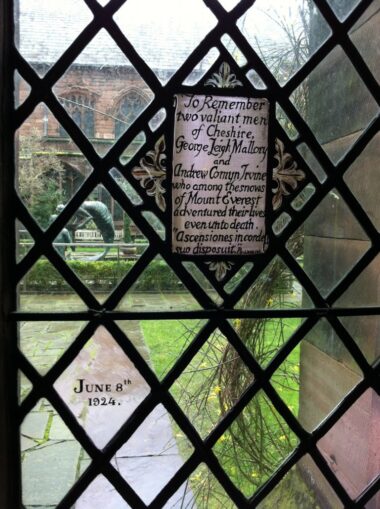
As the joint memorial window to Mallory and Irvine (both Cheshire men) in Chester Cathedral says: ‘Ascensiones in corde suo disposuit’ (‘He set his heart on stepping upward’).
Featured image: Rdevany, CC BY-SA 3.0, via Wikimedia Commons
© foxoles 2026


