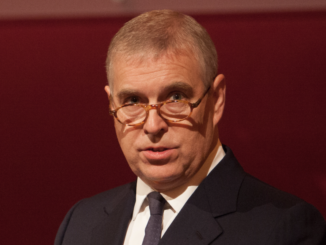
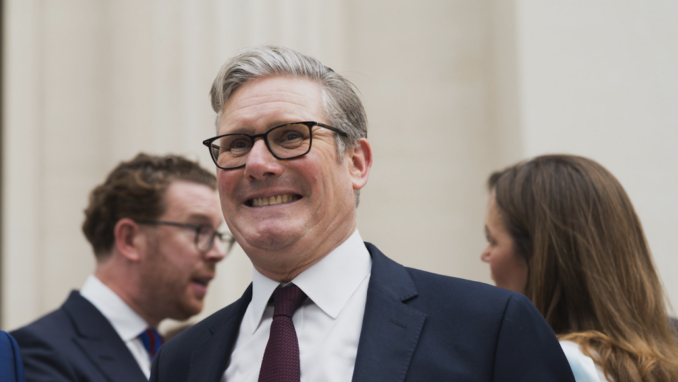
UK Culture Minister Chris Bryant (cropped) and PM Kier Starmer,
Department for Digital, Culture, Media and Sport – Public domain
Earlier this week, to lob a grenade at his successor Andy Burnham’s first day in the House of Commons after the recess, Keir Starmer announced his resignation from Parliament. Speaking via his local newspaper, the Camden New Journal, Keith said he wanted to concentrate on international affairs and combating violence against women and girls. His parliamentary departure triggers a by-election in the Holborn and St Pancras constituency, one that Labour is not bound to win.
Starmer resigned as prime minister in June 2026, aged 63, after losing support within the Labour Party following two difficult years in Number 10, meaning there are now an astonishing nine ex-prime ministers still living. Their average age is 64. Further afield, four surviving ex-US presidents average 77. Elsewhere, the mortality rate is higher. Two French former presidents still draw breath. Russia, China and Cuba boast one each; North Korea, none.
What of those ex-prime ministerial ‘wilderness years’? What can Keith expect? If his predecessors since the war are anything to go by, he will live to a ripe old age, spend time writing (especially on his memoir) and might just become fabulously wealthy and/or win a Nobel Prize.
Churchill’s wilderness years are usually thought of as lying between 1930 and 1939, after he left the Conservative government and before returning as First Lord of the Admiralty when Britain entered the Second World War. His post-prime ministerial years were productive, lasting from 1955 (aged 80) until his death in 1965, in his 91st year.
After losing the 1945 election, Churchill remained Conservative leader and became Leader of the Opposition, delivering his famous “Iron Curtain” speech in 1946. He continued writing, painting and travelling extensively. He returned as prime minister in 1951, then retired in 1955. Thereafter he concentrated increasingly on writing his memoirs and historical works. He received the Nobel Prize for Literature in 1953.
What of his successors up to the present day? Read on!
Clement Attlee (Prime Minister, 1945–1951)
After Labour lost the 1951 election, the former Fleet Town amateur footballer, by then aged 68, remained Labour leader until 1955, when he retired from the Commons. He accepted a hereditary peerage as Earl Attlee and moved to the House of Lords, where he remained politically active. He wrote his memoirs and continued supporting Labour and the causes associated with his premiership. Attlee lived quietly in later life and died in 1967, aged 84.
In office: 6 years
In the wilderness: 16 years
Anthony Eden (1955–1957)
Eden resigned after the disastrous Suez crisis when aged 59. He was created Earl of Avon in 1961 and largely withdrew from active politics. Eden spent much of his retirement at his home in Wiltshire, travelled and wrote his memoirs, including Full Circle, published in 1960. His health remained fragile following numerous operations, and he died in 1977, aged 79.
Years in office: 2
Years in the wilderness: 20
Harold Macmillan (1957–1963)
A veteran of the Grenadier Guards, wounded on the Somme, Harold Macmillan resigned from the premiership after becoming seriously ill, aged 69, and subsequently retired from the Commons the following year. Of trade rather than gentry, he remained chairman of his family publishing company, Macmillan Publishers, and continued to take occasional interest in politics.
In 1984, at the age of 90, he accepted a peerage and entered the House of Lords as Earl of Stockton. More of a one-nation man than a Thatcherite, his interventions from the upper chamber included labelling privatisation as ‘selling the family silver’ and describing striking miners as ‘the best men in the world, who beat the Kaiser’s and Hitler’s armies and never gave in’. He remained Chancellor of Oxford University until his death in 1986.
In office: 6
In wilderness: 23
Alec Douglas-Home (1963-1964)
More gentry than trade, after losing the 1964 election, when aged 61, Alexander Frederick Douglas-Home, Baron Home of the Hirsel, became Conservative opposition leader until 1965, when Edward Heath succeeded him. He returned to government in 1970 as Foreign Secretary under Heath, serving until 1974. He later accepted a life peerage and sat in the House of Lords. He remained active in Conservative politics and public affairs for many years, dying in 1995 at the age of 92.
In office: 1
In the wilderness: 31
Harold Wilson (1964–1970, 1974-76)
Wilson retired unexpectedly as prime minister in 1976, citing age (despite being only 60) and personal reasons. He accepted a life peerage and became Baron Wilson of Rievaulx. He chaired the influential committee reviewing Britain’s financial institutions and made occasional political interventions. By now slightly puddled, he also briefly attempted television presenting, appearing on programmes including Friday Night, Saturday Morning. Increasingly troubled by ill health, he lived quietly before dying in 1995, aged 79.
In office: 8
In wilderness: 19
Edward Heath (1970–1974)
Perhaps lacking a family hinterland – as a confirmed bachelor – Heath remained a long-term Conservative MP after losing the premiership in 1974 aged 57. He served in Parliament until 2001 and eventually became Father of the House. Smouldering from the backbenchers, he was a persistent critic of Margaret Thatcher and her economic policies.
Outside politics, he devoted considerable time to sailing, music, conducting orchestras, European affairs, and (profitably) advising the China Ocean Shipping Company. He never sought a peerage and remained a Commons politician for an unusually long 51 years.
In office:4
In the wilderness: 32
James Callaghan (1976–1979)
Callaghan stayed on as an MP after losing the 1979 election, when 67 years old, eventually retiring from the Commons in 1987. He was then created Baron Callaghan of Cardiff and moved to the House of Lords. He remained involved in Labour politics and public affairs, while also supporting charitable and educational causes. He became one of the longest-lived former prime ministers, dying in 2005, just one day before his 93rd birthday.
In office: 3
In the wilderness: 25
Margaret Thatcher (1979–1990)
After resigning in 1990, aged 65, Thatcher remained a major political figure. She became a life peer, wrote two bestselling volumes of memoirs and travelled internationally giving lectures and speeches. She continued intervening in British and international politics, notably criticising European integration and advocating intervention in Bosnia.
After several small strokes, she ended her public-speaking career in 2002. She died in 2013 aged 87 and received a ceremonial funeral with military honours (having recaptured Crown territory from the Argentine during the Falklands War) at St Paul’s Cathedral.
In office: 11
In the wilderness: 22
John Major (1990–1997)
Major resigned as Conservative leader immediately after the 1997 election defeat, when 54, but remained an MP until 2001. He subsequently became a senior elder statesman, writing his memoirs and publishing historical works, particularly on cricket and politics. He took part in charitable and public activities and frequently commented on political affairs, especially Europe.
In between public and charitable good-spiritedness, Mr Major found time to advise the honest and transparent bean counters at Credit Suisse and to chair the European division of (arms dealers) The Carlyle Group. He was knighted and later admitted to the Order of the Garter, but declined a peerage. The 83-year-old now lives largely outside frontline politics.
In office: 7
In the wilderness (thus far): 29
Tony Blair (1997–2007)
The then 54-year-old Blair immediately left the Commons after resigning from Number 10 and established the Tony Blair Institute. This concentrates on governance, international development and political leadership while raising vast amounts of funding – much from despots, much from undisclosed sources.
Mr Blair became a prominent international figure, serving as a Middle East envoy and advising governments around the world. Meanwhile, son Ewan Blair built Multiverse, a billion-pound tech apprenticeship business. Blair Snr also wrote several books and memoirs and became a frequent speaker on global politics. At age 73, and now knighted, his post-premiership career has therefore been unusually international and commercial.
In office: 10
In wilderness: 19 (so far)
Gordon Brown (2007–2010)
Brown remained an MP after Labour lost the 2010 election, when aged 59, and retired from Parliament at the 2015 general election. He subsequently concentrated heavily on international education, poverty reduction and financial reform. He served as the United Nations Special Envoy for Global Education and remains involved in charitable work through his foundation. He has also continued writing books and commenting on British and international politics, while maintaining a relatively low-key public profile.
In office: 3
In the wilderness (so far): 16
David Cameron (2010–2016)
Cameron resigned immediately after the 2016 Brexit referendum, aged 49, and initially withdrew from frontline politics. He wrote his memoirs and became involved in charitable and business activities, including secretly lobbying UK ministers for a collapsing finance firm in the Greensill scandal.
In a remarkable return to government, he was appointed Foreign Secretary by Rishi Sunak in November 2023, becoming the first former prime minister since Alec Douglas-Home to return to the Cabinet under another premier. He returned to the Lords following the 2024 Tory election defeat and is currently aged 59 and properly addressed as The Right Honourable David Cameron, Baron Cameron of Chipping Norton, PC.
Years in office: 6
Years in wilderness (so far): 10
Theresa May (2016–2019)
At age 62, Mrs May stood down from the premiership but remained the Conservative MP for Maidenhead and continued speaking and campaigning on issues including modern slavery and human trafficking. Before the 2024 election, she announced she would not seek re-election. She subsequently entered the House of Lords as Baroness May of Maidenhead. Currently, Mrs May is 69.
In office: 3
In wilderness (so far): 7
Boris Johnson (2019–2022)
Johnson initially remained Conservative MP for Uxbridge and South Ruislip after resigning as prime minister aged 58. He returned to journalism and writing, becoming a newspaper columnist and later writing books and a memoir. He continued making political interventions and giving speeches but resigned from Parliament in 2023 after the Partygate inquiry – and is now 62.
In office: 3
Current wilderness years: 4
Liz Truss (2022)
Truss remained an MP after her extraordinarily short premiership, from which she resigned aged 47, and continued to promote her economic and political views, particularly her argument for lower taxes, deregulation and a smaller state. She wrote Ten Years to Save the West, published in 2024, and became a prominent speaker on conservative politics internationally.
She was thrown out of the Commons by her constituents at the 2024 general election, the first time a former British Prime Minister has lost their parliamentary seat since Ramsay MacDonald in 1935. According to Companies House, 51-year-old Mrs Truss is a director of two companies: The Office of Liz Truss Limited and CPAC London Limited – CPAC being the Conservative Political Action Conference.
In office: 49 days
In the wilderness thus far: 4 years
Rishi Sunak (2022-2024)
Following the Conservatives’ defeat in the 2024 election (when aged 44), Sunak remained Conservative MP for Richmond and Northallerton and became Leader of the Opposition until November 2024, when succeeded by Kemi Badenoch. He has since largely kept a lower public profile while remaining involved in politics and international affairs.
As of September 2026, he remains an MP and is the only former prime minister still sitting in the Commons. As such, he has to disclose his financial interests. In recent months, our friends at the TheyWorkForYou website report Mr Sunak declared:
- £741,000 as an advisor to Microsoft Corporation
- £188,000 from Chosun Media of South Korea
- £1,096,000 as a senior advisor to Goldman Sachs
- £373,000 from Anthropic Public Benefit Corporation
Crikey! Beats chirping to the Camden New Journal, concentrating on international affairs and combating violence against women and girls!!
© Always Worth Saying 2026