We all looked into the vault, lit by the thin winter daylight seeping through the window behind us. Indeed there was no trace of anything but the pallet lying forlornly in the middle of the floor. The walls were lined with the doors of deposit boxes, but these were all closed and appeared inviolate.
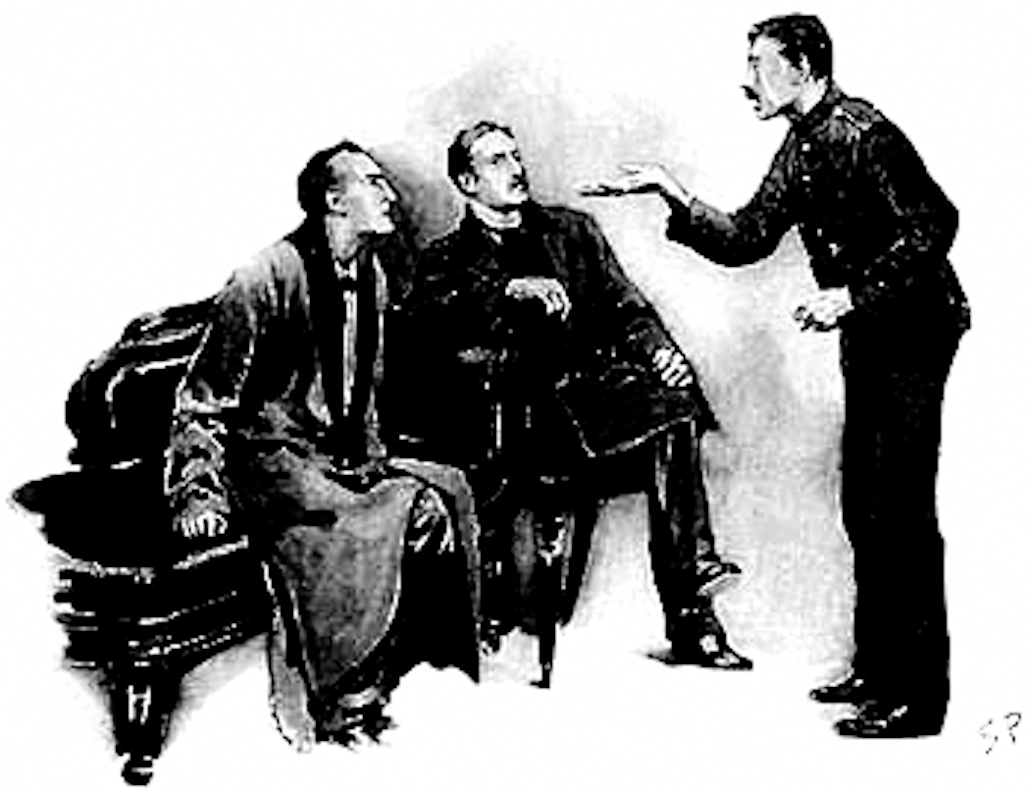
Holmes sprang foward. ‘Let no one enter until I have thoroughly examined the place. Mr Pilchard, what were these ingots?’
In a broken voice, Pilchard said, ‘They were sent to us for safe keeping by a Mr Joachim Burbelstein, a German magnate working in Russia. They were to be shipped to Panama to finance a new attempt to make a canal across the isthmus after the French failed in their enterprise a few years ago. There were five hundred small ingots of ten troy ounces apiece, weighing almost a ton and a half in total and worth £212,500. And every one of them gone! This is the end of our bank, whatever has happened to Mr Reeker.’
Entering the vault, Holmes lit the gasolier on the ceiling and by its light made a most thorough examination of the room, in several places creeping on his hands and knees. I observed that he twice picked up a small object and carefully wrapped it in his handkerchief. Then he rose to his feet and started tapping the floor and walls with his cane.
‘Aha, as I thought! There has been some intrusion in the floor here.’ He tapped again and we could hear that the sound was more hollow than elsewhere.
By this time we had visitors. One was the night watchman, hastily summoned by the bank staff from his home in Stepney. He was closely followed by our friend the inevitable Inspector Lestrade of the Metropolitan Police, accompanied by two constables of the City Police in their distinctive simian-crested helmets.
‘Well, Holmes,’ said Lestrade. ‘I see that you have flocked like a vulture to a fresh kill.’
Holmes smiled thinly. ‘I don’t think I need to spoil our friendship by reminding you that the vulture is followed by the jackals eager for their share of the remains. Anyway, this is what we know so far –‘ and he gave the Inspector a brief account of events, finally saying ‘I believe that the miscreant, whoever he might have been, has removed the gold through a hole in the floor, carefully concealed but not well enough to resist inspection.’
‘But,’ he continued, ‘let us hear what the night watchman has to say.’
The watchman, who had given his name as Stanley Gurner, stood by, apprehensively wringing his hands.
‘Come, Mr Gurner,’ Holmes urged, ‘We don’t believe that you have done anything wrong –‘ (as he said this he gave Lestrade, who had been fingering a pair of handcuffs, a sharp glance of warning). ‘But tell us, have you heard any noises in the night as you were keeping watch?’
‘Well, sir, it were ‘ard to tell, as the workmen on that there new business next door ‘as been workin’ late into the night, with ‘orses an’ carts bringin’ deliveries at all hours. Proper keen they must-a been to open on time.’
‘And can, you, Mr Gurner, or anyone here, give me a description of the appearance of the vanished Mr Reeker?’
It was agreed that he was a small, slight man with balding sandy hair and a neatly trimmed moustache. His sight was poor and he habitually wore a pair of gold pince-nez.
We went out into the street to examine the premises, which were closed and there was no sign of life. On the door frame there was a new and shiny brass plate: ‘The Golconda Gold Mining Company.’ The windows had been whitewashed on the inside and we could not see in, but muddy footprints on the pavement indicated recent activity.
‘You’ll get a warrant to enter the premises, won’t you, Lestrade?’ said Holmes, as he produced a curious hooked instrument from his pocket and started work on the door lock. It soon yielded with a click and Holmes entered. Law or no law, we could not resist following him.
Inside there was not the slightest sign of setting up a new business of any kind. Picks, shovels and heaps of broken bricks and soil lay around. ‘Lestrade, you will need to have all those fingerprinted,’ said Holmes. ‘But look here!’ He pointed to a hole in the wall large enough to admit a man, and it was on the side towards the bank. Ignoring the mud, he climbed into the hole. ‘Watson, will you come and give me a hand to push this up?’
We heaved at an unseen surface in the roof of the tunnel. It gave way with a shower of fragments, and light flooded in from above. We were in the bank vault, looking up through a hole in the floor.
* * *
Back at Baker Street that evening, after an excellent dinner of mutton chops and Mrs Hudson’s unexcelled plum duff, we were relaxing over glasses of Holmes’s Armagnac and a couple of fine Trichinopoly cheroots from a gross awarded to Holmes by a grateful Indian client. Holmes had been at work with a pair of tweezers and a microscope. ‘Come over here, Watson, and have a look at this. What do you see?’
I peered into the device. ‘A multitude of small shells, foraminifera, bivalves, all kinds. Surely this is chalk.’
‘Indeed, and something never found in the City of London. This is one of the fragments of mud I picked up in the vault, evidently fallen from the instep of a shoe. And,’ he added with a note of triumph which in anyone less gifted I would have considered smug, ‘I have been consulting that essential work Gargell’s Cretaceous Fossils of Southern England, and have identified one species found uniquely in a small coastal area a couple of hundred yards across. It lies at the south-eastern corner of Hayling Island. Tomorrow we shall visit and see what we can see.’
The following morning, after a sustaining breakfast of kedgeree and crumpets, we were on a train from Victoria Station to Havant. Disembarking, we engaged a station cab for the five-mile journey to the south shore of the island. The houses were relatively new and all had gardens at the rear, with a small back alley between them screened from public view by a wall some ten feet high. Returning from our initial inspection, Holmes visited a chemist’s shop where he bought a small shaving mirror pivoted in a frame, a hardware store for a broomstick, and a stationer’s for a roll of passe-partout adhesive tape. With these he fashioned a crude periscope, and we inspected the alleys.
After half an hour’s survey looking over the tops of the garden walls he exclaimed, ‘I think we have it. Take a look, Watson.’ After manipulating the tilting mirror I could see, hard up against the back wall of the garden, a freshly filled-in hole. We counted the gardens, and it was the sixth one from the east end of the street. Thrusting the pole into a convenient holly bush, we came round to the front and checked the street numbers, which were odd on this side, even on the other. The house was number 11, Sebastopol Drive.
‘Now,’ said Holmes, ‘we must again enlist the forces of the law.’ We found a post office and sent a telegram to Lestrade, who was no doubt at that time bumbling around the City looking for clues. Then we retired to a nearby public house for a substantial luncheon of steak and oyster pie washed down with the landlord’s tolerable home-brewed stout, and a return to the post office two hours later disclosed that the Inspector was on his way and would be at Havant station shortly after five with a warrant for the house. By now at least, he knew enough not to ask why.
We greeted him on the platform in the dusk and, to his complete mystification, conveyed him and two constables in a four-wheeler to Sebastopol Drive. No force was required: we simply rang the bell of number 11. The door was answered by a small sandy-haired bespectacled man with a neat moustache, whose apprehensive glance changed to one of complete panic as he spotted the uniformed constables, who restrained his attempt to bolt.
We found the gold buried in the back garden and that was the end of the affair for us as the law took its cumbersome course, which ended in a sentence of ten years for Reeker. His accomplice was never found, so at least the miserable Reeker did not betray him.
Lestrade was accustomed to Holmes’s coups, but could not forbear to ask how he had found him so swiftly.
‘I would recommend a study of Gargell’s Cretaceous Fossils of Southern England ,’ replied Holmes, and would say no more.
© Tachybaptus 2026