
The Puffin is a well-travelled bird, although a trip to the moon might be beyond even the most enthusiastic non-reader of articles and comments. Fear not, the moon might be coming to you.
The Museum of the Moon is a spectacular touring art installation created by British artist Luke Jerram. First presented in 2016, the work features a giant, illuminated spherical sculpture measuring 23 ft in diameter, displaying detailed imagery of the Moon’s surface.
The artwork uses high-resolution photographs of the lunar landscape, based on NASA photography, to recreate Earth’s constant companion at a scale that allows audiences to appreciate its remarkable craters, mountains and vast plains.
Suspended above the ground, the glowing sphere creates an otherworldly atmosphere, inviting visitors to experience the Moon as though it were within reach.
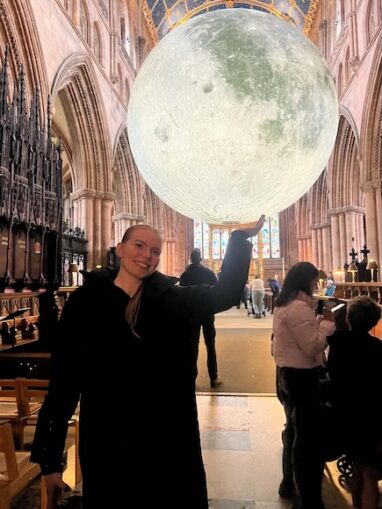
The installation is designed to travel between different locations and has been exhibited in a variety of settings, including museums, concert halls, public spaces and outdoor festivals – and as I type – this humble author’s local cathedral. And what a setting our ‘seat’ is.
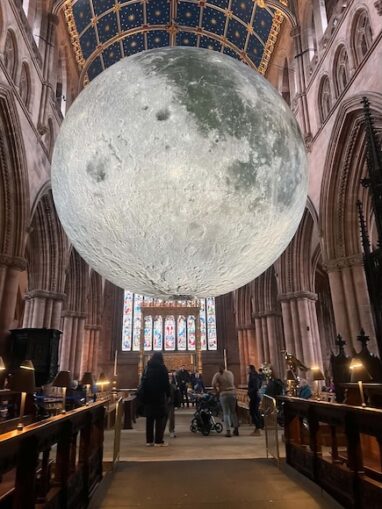
© Always Worth Saying 2026, Going Postal
Beyond the aesthetics, a place of Christian worship remains appropriate. In Christianity, the Moon has several important meanings; in the Book of Genesis, God creates the heavenly lights to mark seasons, days and years. Second, it is connected with Easter and the resurrection of Jesus, with Christ’s death occurring around the Jewish Passover, which follows a lunar calendar, the date of Easter being calculated using the spring equinox and the Paschal Full Moon.
However, early Christians developed a strong solar association through their origins within Roman culture. The emperor Aurelian promoted the cult of Sol Invictus, the “Unconquered Sun”, during the third century AD, and 25 December became associated with both solar celebration and Christmas. Likewise, the halo (halos = the ring of light around the sun) surrounds the heads of the divine. Churches lie east to west with the altar, and often a magnificent east window (more of which later), facing the rising sun.
Might the mosque be an even better setting? Islam follows a lunar calendar with the appearance of the crescent moon helping determine the beginning and end of Islamic months, making it central to the timing of Ramadan, Eid and the Hajj pilgrimage.
© Always Worth Saying 2026, Going Postal
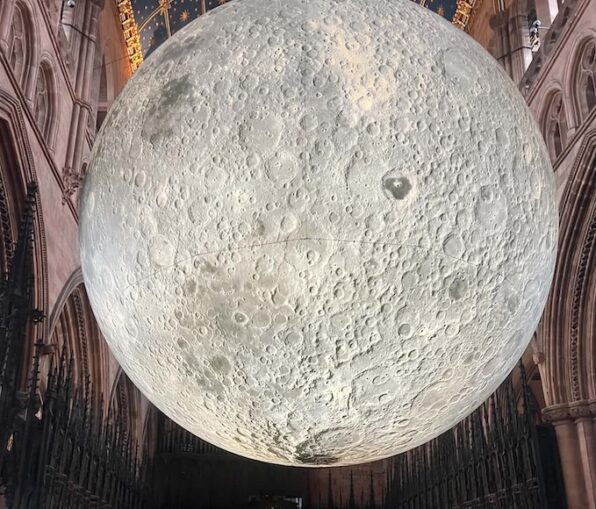
If you spot a line across the lunar surface about two-thirds of the way down the above photo, you might be reminded of “the splitting of the Moon,” a miracle performed by the Prophet Muhammad. After the people in Mecca asked Muhammad for a sign, the Moon appeared divided into two parts, with a mountain visible between them.
Switching to science, the installation’s lightweight, inflatable spherical structure allows it to be suspended above viewers. The surface is printed with detailed lunar imagery supplied by NASA, using data from the Lunar Reconnaissance Orbiter. The images have a resolution of 120 dots per inch, providing detailed representations of craters, ridges and other lunar features. At an approximate scale of 1:500,000, each centimetre of the sculpture represents five kilometres of the Moon’s actual surface.
The technical department informs us that a human eye can distinguish details separated by about one arcminute. On that basis, you would need to be 220 – 250 miles above the Moon’s surface to resolve a feature around 100 yards across with the naked eye.
That is about the altitude of a low lunar orbit, rather than the distance from which we might observe the Moon from Earth. In other words, the installation lets you examine the Moon’s landscape at a scale that, in terms of fine detail, evokes viewing from a spacecraft orbiting close to its surface.
© Always Worth Saying 2026, Going Postal
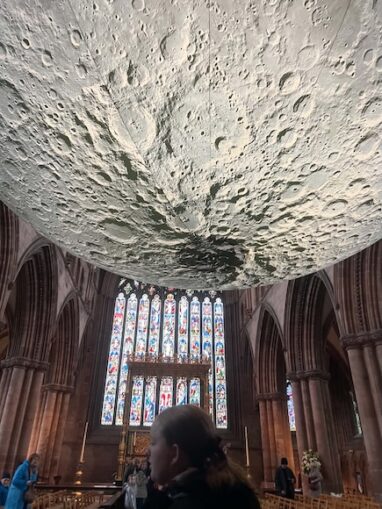
Back in Carlisle Cathedral, in the background is one such magnificent east window. This is one of England’s largest and most elaborate examples of Gothic window tracery, measuring about 58 feet in height and 26 feet wide. Its medieval upper glass, dating from around 1350, depicts the Last Judgement, while the lower panels, installed in 1861, portray scenes from the life of Jesus.
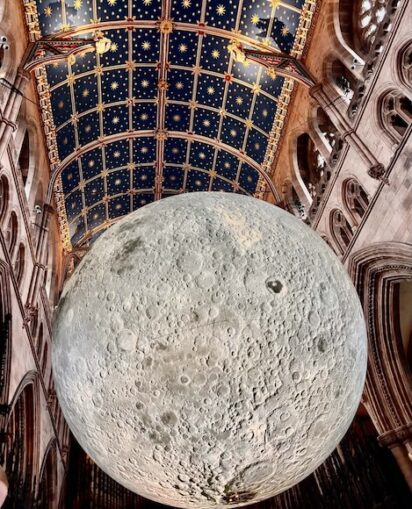
Likewise, the view above is of blue panels, gilded stars and golden suns, which create the impression of looking up into a celestial sky.
© Always Worth Saying 2026, Going Postal
The underlying oak ceiling dates from the medieval period, around the late fourteenth and early fifteenth centuries, but its distinctive decorative scheme was designed by Owen Jones during the cathedral’s Victorian restoration in the 1850s. It was repainted in 1970. Not that Owen Jones – although it does resemble a series of European Union flags.
This Owen Jones (1809–1874) was a pioneering British architect, designer, and design theorist who revolutionised Victorian taste. As Superintendent of the Great Exhibition, he decorated the Crystal Palace in bold primary colours. He mapped the Alhambra’s Islamic geometry and published The Grammar of Ornament, which, as every Puffin knows, inspired generations of designers to embrace flat, vibrant patterning.
One intriguing detail is that each blue panel contains 16 golden stars and a central golden sun, except for one panel, where a star is missing. The cathedral invites visitors to see if they can spot it.
As for the artist who created the Museum of the Moon, Luke Jerram is a multidisciplinary artist known for his large-scale installations that bring together art, science, engineering and public participation.
Although Puffins may be puzzled by his tolling extinction bell or a statue of his daughter made from 5,000 coloured stickers, his Moon is a triumph and can be seen on tour. There’s more than one, allowing for forthcoming displays at Campfield Studios, Manchester, 23 October – 8 November, ArtHouse Jersey, 15 – 29 November and Barnsley Bright Nights, 20 – 21 November.
Lots of selfie opportunities for the more photogenic members of the family!
© –AUTHOR–2026, Going Postal
© Always Worth Saying 2026


