
All has changed. Or has it?
We have been here before, literally. The Puffin is a well-travelled bird with a good memory and can recall rolling dunes, desert villages, remote sun-drenched harbours and trails of camels heading into the nothingness. Boys dive for pearls in the creeks. Flat-roofed mud houses line the Gulf, clinging to the waterfront. Across the strait, smugglers’ dhows slip back and forth, their holds crammed with colour TVs and washing machines bound for the Ayatollah’s Iran.
All has changed. Or has it? Four decades ago, the backdrop was the Iran–Iraq war, not America and Israel facing Iran; the language was tanker wars, not drones and ballistic missiles. First, some context.
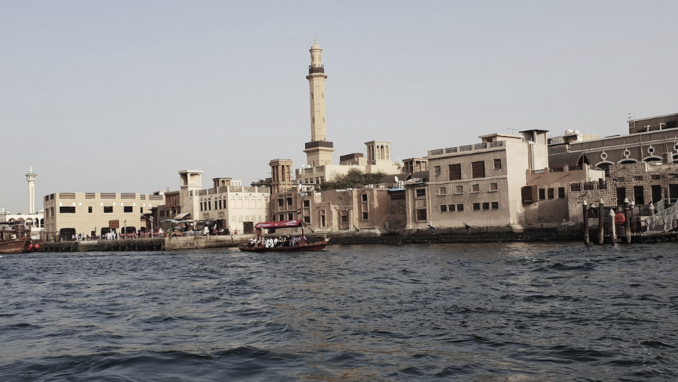
View from a moving Dhow looking towards Old Dubai,
Vedaant Jamaiyar – Licence CC BY-SA 4.0
The Islamic Revolution in Iran
The Islamic Revolution in Iran was a mass uprising in 1978–79 that toppled the U.S.‑backed monarchy of Mohammad Reza Pahlavi – the Shah of Iran – and led to the creation of the Islamic Republic of Iran under Ayatollah Ruhollah Khomeini. It emerged from widespread dissatisfaction with the Shah’s autocratic rule, social inequality, and Western (especially American) influence, uniting diverse groups around calls for change.
By February 1979 the Shah had fled, and Iran was declared an Islamic republic after a referendum. The revolution reshaped Iranian society, politics, and law along religious lines and had a profound regional and global effect up to this present day.
The Iran-Iraq War
The next year, and taking advantage of the volatility in the neighbouring country, the Iran–Iraq War began in September after long‑standing tensions over territory and regional power led to an Iraqi invasion. A central spark was the dispute over the Shatt al‑Arab waterway at the top of the Gulf, the opposite end to the Strait of Hormuz, which is a vital channel for oil exports that both countries claimed. Iraq had agreed to share access under the 1975 Algiers Agreement, but later renounced.
Iraq’s leader Saddam Hussein also feared the impact of Iran’s revolution and its calls to export revolutionary ideology — especially among Iraq’s majority Shi’a population — seeing it as a threat to his secular Ba’athist regime. Expecting Iran to be weak after the revolution’s disruptions, Iraq launched a full‑scale invasion, hoping to seize strategic territory and assert dominance in the Gulf. The war dragged on until a UN‑brokered ceasefire in 1988, with enormous human and economic costs on both sides.
Tanker wars
In between times, the ‘Tanker War’ was a phase of the wider Iran–Iraq conflict that unfolded roughly between 1981 and 1988, when both Iran and Iraq began targeting oil tankers and merchant shipping in the Persian Gulf in an effort to weaken each other economically rather than achieve decisive victories on land. Iraq initiated the campaign by attacking vessels carrying Iranian oil, aiming to cut off Iran’s primary source of revenue and force it to negotiate, especially as the ground war had settled into a costly stalemate. These early attacks relied heavily on air power, including missiles fired from aircraft against tankers and oil facilities, particularly around Iran’s key export hub at Kharg Island.
By 1984, the conflict had escalated sharply as Iraq widened its strikes across the Gulf, targeting not only Iranian shipping but also neutral vessels trading with Iran—prompting Tehran to retaliate in kind. Iran began attacking ships linked to Iraq’s regional allies, especially Kuwait and Saudi Arabia, since Iraq itself relied less on tanker exports due to pipeline routes. This turned the conflict into a broader campaign of intimidation and economic warfare, in which commercial shipping from many countries became targets regardless of their direct involvement.
US Involvement
Although there’s insufficient proof for the wary that the United States explicitly encouraged Saddam Hussein to invade Iran in 1980, some critics assert the U.S. gave a green light to Saddam despite Washington initially declaring neutrality.
What definitely happened is that after the war began, the U.S. tilted toward supporting Iraq with economic aid, technology and intelligence to counter post‑revolutionary Iran, which had antagonised the U.S. since 1979. Even to the point of turning a blind eye when the USS Stark, a U.S. Navy frigate, was hit by two Iraqi Exocet missiles on May 17, 1987 while patrolling in the Persian Gulf. The attack killed 37 sailors and injured 21.
Throughout the eighties
From the early 1980s, the violence had intensified, with both sides deploying mines, missiles, aircraft and small-boat attacks, damaging or destroying hundreds of ships and severely disrupting global oil flows.Iraq carried out more attacks overall, but Iran increasingly matched its efforts later in the war, making the Gulf a dangerous zone for international shipping.
The situation eventually drew in external powers, most notably the United States, which intervened to protect Kuwaiti tankers and ensure freedom of navigation, leading to direct clashes with Iranian forces in the late 1980s.
The Tanker War ended alongside the Iran–Iraq War in 1988, having demonstrated how economic targets like oil transport could become central battlegrounds, and highlighting the vulnerability of global energy supplies to regional conflicts.
However, the region and the technology were different then compared to now.
Iran’s developing capabilities
Iran’s ballistic missile development began during the Iran–Iraq War, when Tehran acquired its first missiles (such as Soviet‑style Scud‑Bs) around 1984–85 to counter Iraqi attacks and compensate for weak air power. Over the late 1980s and 1990s, Iran reverse‑engineered and indigenously produced ballistic systems like the Shahab‑1 and Shahab‑3, expanding its capabilities into the 21st century with increasingly longer‑range designs.
By the 2000s and beyond, Iran’s missile arsenal had grown into a core pillar of its military deterrent.
In the 1980s, drone warfare was in its infancy and primarily limited to reconnaissance and surveillance roles. Military powers like the U.S. and Israel deployed small, rudimentary unmanned aerial vehicles (UAVs) to gather intelligence, assess battlefield conditions, and occasionally guide artillery, but armed drone strikes were virtually nonexistent and the technology far less advanced than today.
The Global Positioning System (GPS) was developed by the U.S. Department of Defense, with the first experimental satellites launched in 1978. The full 24‑satellite constellation became operational in 1993, providing precise global navigation for military and, later, civilian use.
Meanwhile nearby
The locale has changed too. Around 1980, the population of Dubai was roughly 275,000–300,000 people, less than a tenth of what it is today, with the urban area still a relatively small city.
As of the most recent official estimates, the population of Dubai stands at around 4 million residents in 2025, making it the most populous city in the UAE. About 92 % of that population are expatriates. This figure reflects rapid growth over recent years, with Dubai’s population having more than doubled since the early 2010s as the city has attracted workers and families from around the world due to its economic and other advantages.
The first tall building was the Dubai World Trade Centre, completed as recently as 1979. It was the tallest building in the Middle East at the time.
In the 1970s, before the Iran–Iraq War, the Strait of Hormuz already handled a growing share of global oil traffic, but volumes were lower than today. Roughly 12–15 million barrels per day passed through the strait,
By the 2020s, the strait handled about 21–23 million barrels per day, carrying roughly one-fifth of global oil trade, reflecting both the growth of Gulf oil production and, until recently, more stable shipping conditions.
Our response
As for the previous Western response, the Royal Navy’s presence in the Persian Gulf during the Tanker War was the Armilla Patrol. Established in 1980, the patrol maintained a continuous deployment of Royal Navy warships to protect British-flagged merchant vessels, ensure freedom of navigation, and respond to threats such as mines and missile attacks.
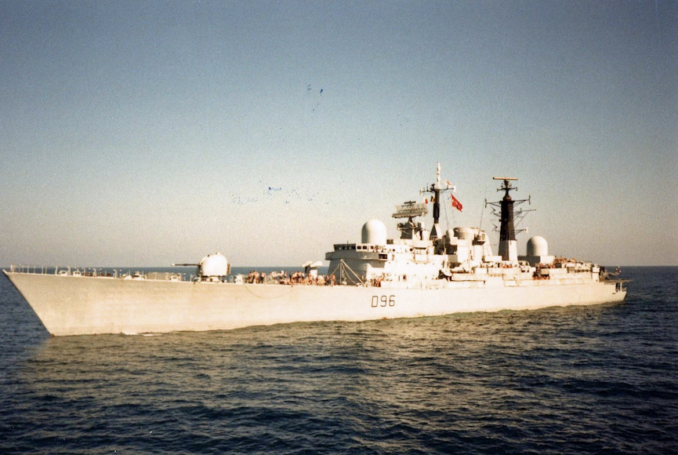
HMS Gloucester relieving HMS Nottgingham on Armilla Patrol circa 1987,
Frattonstation – Licence CC BY-SA 4.0
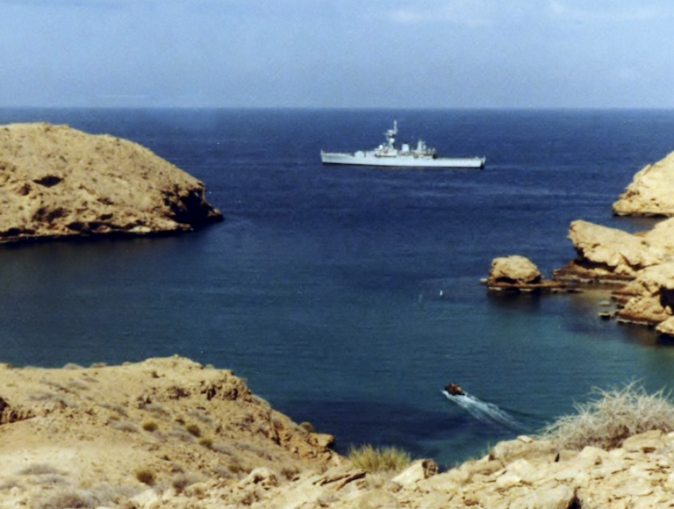
HMS Naiad (F39) stationed off the coast of Oman, during Armilla Patrol, 1980.,
Roycrawf – Licence CC BY-SA 4.0
Ships like HMS Coventry, HMS Birmingham, and HMS Naiad, along with Royal Fleet Auxiliary support vessels, rotated through the patrol. While smaller in scale than U.S. operations, the Armilla Patrol was crucial for deterrence and helped safeguard Gulf shipping throughout the 1980s.
The Royal Navy also coordinated with U.S. forces in convoy operations, intelligence sharing, and maritime surveillance, helping maintain freedom of navigation for commercial shipping in one of the world’s most strategically vital waterways.
In those days, Sea Dart and Sea Wolf missiles were pitched against Cold War generation Soviet anti-ship missiles that were clumsy, slow and difficult to use by today’s standards.
Since then…
Since then, as Puffins know, the world has changed. Iranian offensive capability has increased, not least through reverse engineering and canny use of GPS and drones, while British defensive naval capability has decreased to the point that we don’t have any vessels in the Gulf and only one, HMS Dragon, available to protect Cyprus in the Eastern Med.
© Always Worth Saying 2026


