
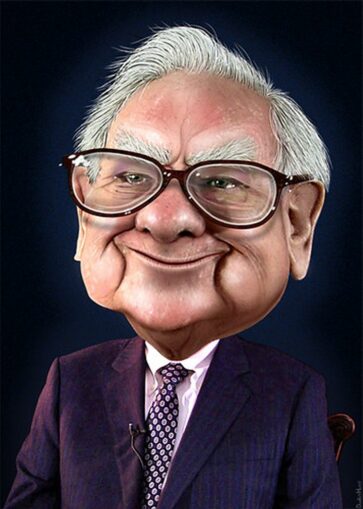
It’s poetic that Warren Buffett stepped down at Berkshire Hathaway earlier this year after one of the most extraordinary investing careers in modern history. Financial savvy Puffins (are there any other ?) will not need to be reminded of the WBs investing acumen and commitment to high-quality American companies, as the financial news has been replete with these testimonials………. But in addition to being a savvy investor, he was also a tremendous beneficiary of monetary policy that simply kept markets moving higher over time. But don’t get me wrong : Buffett’s knack for outperforming the overall market undoubtedly solidifies him as a legend. But , he’s also far more of a shark than most people believe him to be. Some of the stories that get passed around in the financial underworld paint a very different picture of Warren Buffett than the jolly old man happy to sit, slurp Coke, and laugh with TV talking heads. His patience was unmatched, and his ability to leverage his brand into extraordinarily favourable transactions with companies who desperately needed capital became the best self-fulfilling prophecy investment tool there ever was. This was brought into sharp focus in 2008, when due to catastrophic shenanigans on Wall Street, no Banks would consider lending to other Banks & the financial system came within hours of collapse. Buffett got his pound of flesh – and much more – when he let it be known he was lending to certain Street institutions in whom he had belief. Subsequently, with all the brand equity in the world — and because his cheery demeanor belied his ruthless style — companies continued to seek him out not only when they needed capital, but also a vote of confidence. Perhaps he was the perfect balance between cutthroat investor and public relations polish. And whether his “never bet against America” shtick was honestly how he felt or not, it was instrumental in driving decades of goodwill toward the American financial system. He was the cornerstone of the list of reasons people globally wanted to invest in American exceptionalism. Buffett put an investing face to many of the greatest American companies in history. Names like Bank of America, Gillette, Coca-Cola, McDonald’s, American Express, and Apple all became widely accepted as “blue chips,” with some measure of Warren Buffett’s help, as his image and likeness acted as liaison between major corporations and Main Street investors. But while many people will celebrate his legendary career and speculate about the future of Berkshire Hathaway, to me his departure really does make it feel like sweet sorrow.
As everybody knows, Berkshire is currently flush with almost $350 billion in cash. Legacy media has harped on how large its cash position has become and everyone has speculated about how and when it said cash may be deployed. Ergo, one way to look at Berkshire today is that the company is waiting to pounce on the next great opportunity. But another way to look at it is that, sadly, there’s nothing worth buying. Buffett’s legacy will not be a couple of major parting investments in America, or in up-and-coming U.S. companies as he has preached, but rather a declaration that there simply isn’t anything out there that deserves his capital right now.
Not un-coincidentally, a broader debate is out there about whether or not US productive capacity and manufacturing ethos has been been stripped out. There’s no more hotly contested financial topic right now than the US major trade imbalances and its fiscal policy of exporting printed U.S. dollars while importing an unsustainably high quality of life — fuelled by a growing debt pile and major fiscal deficits. The country that helped make Berkshire Hathaway early on was a country rooted in manufacturing and production. Early on, Buffett acquired Nebraska Furniture Mart, a family-run business, and See’s Candies, an American manufacturer and distributor of candies founded in California in 1921 — quintessential American manufacturing and sales. Before quantitative easing distorted markets to the point where they are expected to trade at 30x earnings at all times—for no reason other than “unlimited” fiat liquidity from lax central bank policy—companies actually needed to generate a profit and produce goods in order to be successful. And Buffett’s knack was identifying these fairly priced, cash-generative companies with great growth potential.
Nowadays, all companies need to be successful is to get a semi-unvetted listing anywhere on any U.S. stock market through a SPAC, burn through tons of cash while lying about their future prospects, and sell as much equity as possible to financial institutions that will eventually be bailed out for their poor decisions. In the year 2025, the Fed was the rising liquidity tide lifting all dogshit company boats. When Berkshire was making the meaningful investments that turned it into the monolith it is today, money was sounder, markets were less distorted, and investing required far more calibration toward value and actual analysis. Now, the stock market has simply become an out-of-control casino where valuations, prices, and financial metrics don’t matter—and liquidity is, to quote Fed Governor Neel Kashkari, “infinite.”
Austrian-focused amateur market analysts like myself have argued that there will be a yuuuuuuuuuge price to pay for how distorted our public markets have become. I’ve also argued that the gutting of US productive capacity and manufacturing base, as well as it’s commitment to borrowing, can’t and won’t last forever. But as everybody has sat around waiting for us “broken clocks” to eventually be proven right by some exogenous, catastrophic financial unknown, the market has slowly been mutating into an entity that may never be “cheap” again—because all semblance of value investing and active management have been replaced in favor of bullshit CEO storytelling (epitomised by DJT back in the day), & entrenched passive bid/options acting as the tail that wags the market dog. Whether intentional or not, Buffett’s retirement personifies just how distorted markets have become and how different the playing field is now than it was 50 years ago. Maybe it’s nothing more than a coincidence that Buffett is going out with a large cash pile with no new major investments in sight but to me its indicative that the “between the lines” commentary can only highlight the statement his retirement makes about the state of the country and the market today. It’s easy to crown Buffett as the best ever — I don’t think anybody will argue that. But there is an underlying Shakespearean-style tragic element to the timing of his stepping down suggesting that the days of investing exceptionalism and of true grit, promise, productivity, and manufacturing in America—have passed.
© DJM 2025


